
Wyoming subcommittee probes Weston County post‑election audit after clerk fails to appear under subpoena
Get AI-powered insights, summaries, and transcripts
Subscribe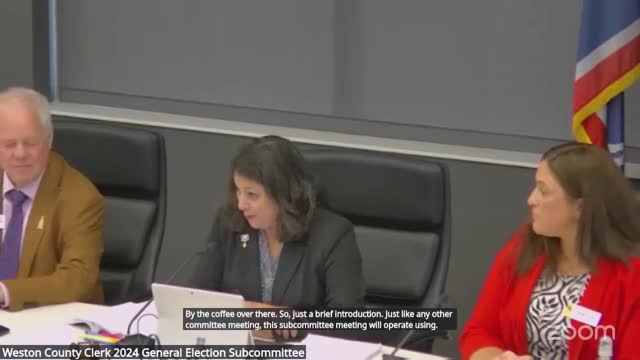
Summary
A Wyoming legislative subcommittee convened Oct. 15 to review a disputed post‑election audit and the handling of the 2024 Weston County election, including a hand count that corrected earlier unofficial results. The Weston County clerk, Becky Hadlock, was subpoenaed but did not appear; the secretary of state has referred the matter to prosecutors and recommended removal under state law.
A Wyoming legislative subcommittee convened Oct. 15 to review a disputed post‑election audit and the handling of the 2024 Weston County election, including a hand count that corrected earlier unofficial results. The session focused on why the county’s initial post‑election audit reported no errors for a sample of ballots while a later hand count found dozens of mismatches. The Weston County clerk, Becky Hadlock, was subpoenaed to appear but did not attend the subcommittee meeting. Subcommittee members said they will pursue the legal process for that failure to appear.
The meeting’s purpose, Chairwoman Rodriguez Williams said, was “to investigate issues surrounding the post election audit by the Weston County Clerk following the 2024 primary election,” and to prepare a report for the Management Audit Committee. Members heard detailed testimony from the Wyoming secretary of state, county election workers who conducted the hand count and local journalists who reported from Weston County. Much of the session centered on the post‑election audit process, recordkeeping and whether the statutory safeguards and chain‑of‑custody practices were followed.
Why it matters: state election officials said the episode exposed a gap in oversight that could let major tabulation errors go undetected unless there is an unusually large anomaly. Secretary of State Chuck Gray told the subcommittee his office’s independent investigation concluded the clerk submitted a “false post election audit” and referred the case to the county attorney and the state attorney general, and recommended removal under Wyoming statute 18‑3‑902. Gray said the governor declined to pursue removal under that statute.
What the secretary of state reported
Wyoming Secretary of State Chuck Gray described two related problems: (1) errors in ballot printing that produced multiple different ballot versions sent to precincts, and (2) a post‑election audit report that initially said no errors were found when, by Gray’s account, the hand examination later revealed multiple mismatches. Gray told the committee his office randomly selected 75 ballots for a post‑election audit and that the clerk’s first written report claimed “no errors or observations.” After a hand examination by a county canvassing board, Gray said his office documented 21 mismatches in the audited sample — ballots where the image showed a clearly marked oval for a candidate but the county’s cast‑vote record (CVR) had recorded an undervote.
“Most importantly, we must highlight the Clerk Hadlock’s conduct in filing a false post election audit,” Gray said in his written statement to the committee. He said the sheriff’s office and county clerks association later agreed to a hand examination that produced corrected counts.
Hand counts, local testimony and the clerk’s absence
Two Weston County volunteers who participated in the hand count — Deborah Piana and Anne Slagle — told the subcommittee they helped perform a manual recount after the county and the secretary of state identified an anomalous undervote pattern. Slagle said the county used several ballot versions and that the final, printed version of the ballot had moved a candidate’s oval down a line; ballots printed with earlier proofs left that oval in the original position, which caused the tabulation equipment to record undervotes for that contest.
Piana and Slagle described a methodical hand count that compared paper ballots to each other and to the machine CVR. Both said the hand count corrected the totals; Piana told lawmakers she believed the hand count was accurate and that a machine‑only audit had missed problems. Committee members repeatedly urged the clerk — who had been subpoenaed to appear — to provide direct testimony, but Clerk Hadlock did not attend the session. The chair read a letter from Hadlock stating she had scheduling conflicts and that she had arranged two other people from the county hand‑count committee to testify in her place.
Subpoena and legal referrals
The subcommittee’s staff said a subpoena for Clerk Hadlock was signed Sept. 17, served Sept. 23 at 14:25 by officer Garhart (badge 214), and that failure to comply can carry penalties under Wyoming statute 28‑1‑110. Secretary Gray said his office referred the findings of its investigation to the Weston County attorney and the Wyoming attorney general and recommended removal under Wyoming statute 18‑3‑902; the governor declined to proceed under that statute.
Local reporting and public comment
Local journalists and residents provided additional detail about communications in Weston County before and after the election. The newsletter journal’s editorial staff described repeated efforts to reach the clerk and a sequence of public statements they said were inconsistent with records and later corrections. Members of the public and election‑integrity volunteers told the subcommittee they favor stronger, clearer statutory checks, more training for clerks and broader public visibility into post‑election audits.
Where the record stands
The subcommittee did not take a formal vote; members said they would prepare a written report for the Management Audit Committee and continue reviewing records and testimony. Committee members emphasized they were trying to separate technical errors (for example, mistakes in ballot proofs and testing) from potential willful wrongdoing. Gray and others told the panel they concluded the submission of a post‑election audit report that contradicted later verified hand counts raised substantial legal and ethical questions that warrant follow‑up by the attorney general and county prosecutors.
What lawmakers asked for next
Committee members said the subcommittee will: compile testimony and documentary evidence for a written report, follow up on the clerk’s failure to appear under subpoena, and consider statutory clarifications about who conducts and certifies post‑election audits, who may participate in those audits, and whether any new requirements for canvassing boards or sample hand counts are needed. Several members asked the Legislative Service Office to draft options for statutory changes addressing (a) timing and method for post‑election audits, (b) audits’ public access consistent with ballot secrecy rules, and (c) who is eligible to sit on a canvassing board.
Ending: The subcommittee recessed after hours of testimony, saying it would continue work on a written report. Chairwoman Rodriguez Williams said the panel would reconvene virtually the following week to develop next steps and finalize the report to the Management Audit Committee.