
Committee weighs 9‑1‑1 funding options as counties warn operations are underfunded
Get AI-powered insights, summaries, and transcripts
Subscribe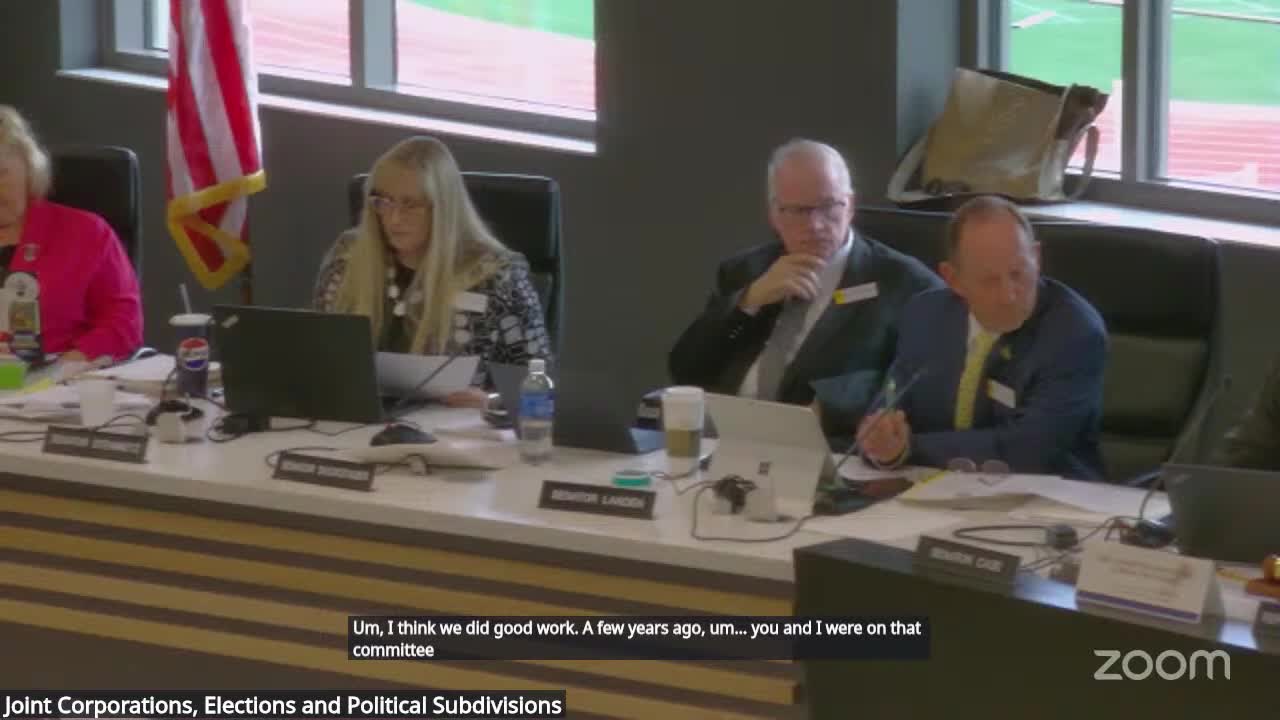
Summary
Local 9‑1‑1 center leaders told the Corporations, Elections & Political Subdivisions Committee the current 75¢ per‑line surcharge no longer supports operations or required upgrades to NextGen 9‑1‑1.
Local public‑safety officials told the committee that current 9‑1‑1 funding is inadequate to maintain operations and pay for NextGen upgrades.
Matt Johnson, chief of police in Torrington and the lead PSAP official for Goshen County, said his county operates a public‑safety answering point that covers four law‑enforcement agencies, nine volunteer fire departments and four EMS services across roughly 2,300 square miles. “We don't receive enough income to fund the first part of that, let alone the second,” Chief Johnson said, describing current revenue as insufficient to keep centers operating and build the next‑generation system.
Telecommunications providers and vendors agreed the current surcharge model is strained. Jody Levin, representing Charter and Verizon, said modern calling technology has fractured the old fee base that was tied to a single landline and noted that new caller devices and Internet‑based services complicate a per‑line surcharge. “You can't continue to just fund it on a phone bill or on anything that has a number attached to it,” Levin said.
Committee members debated short‑term and long‑term approaches. Senator Steinmetz proposed drafting a bill to increase the per‑line surcharge to a higher cap (discussed in committee as up to $2.00), with county commissioners retaining local control to adopt higher rates where needed. That idea drew strong opposition and after a later motion to reconsider the draft measure the committee declined to advance an immediate surcharge increase.
Instead the committee approved a separate motion to draft a different vehicle: a state appropriation placeholder (a 9‑1‑1 grant bill) that would create direct one‑time or ongoing funding for counties to stabilize PSAP operations while the working group continued to study a durable revenue model. Telecommunication companies, county officials and sheriffs' representatives volunteered to continue technical and fiscal work with the committee’s staff to refine cost estimates and options.
Why it matters: Public‑safety answering points provide critical emergency dispatch and must operate continuously. Committee discussion recognized that NextGen upgrades — which move call delivery from voice lines to IP‑based data and add location, text and multimedia capability — will require substantial capital and recurring costs. Stakeholders urged a hybrid model combining local surcharge authority and targeted state appropriations while working toward long‑term structural funding.
Ending: The committee asked the working group of providers, sheriffs, county commissioners and state staff to develop detailed cost estimates and consider hybrid funding options, and directed staff to produce a draft appropriation bill as a placeholder for the next meeting.