
Wyoming interim subcommittee hears proposals to follow state constitution on apportionment; weighted voting and hybrid plans debated
Get AI-powered insights, summaries, and transcripts
Subscribe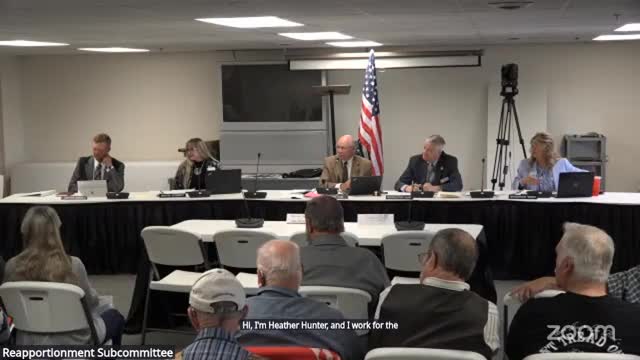
Summary
A joint interim subcommittee convened in Weston County to gather public input and examine proposals after the Legislature passed a measure directing study of constitutional apportionment. Law office staff reviewed legal history; residents and advocates proposed options including weighted voting, a "founder's plan" that preserves county-line seats,
CHEYENNE (Oct. 14, 2025) — A joint interim subcommittee of the Legislature’s Corporations, Elections & Political Subdivisions committee convened in Weston County on Oct. 14 to take public testimony and consider options for legislative apportionment required under a recently enacted statute directing study of “constitutional apportionment.” The meeting brought legal background from the Legislative Service Office, two competing local proposals, and multiple public speakers who urged the panel to preserve county-based representation.
The committee’s chair, Senator Cale Case, opened the hearing saying the group had been sent by the Legislature to "listen to your concerns about representation and redistricting." Matt O'Brick of the Legislative Service Office summarized the enabling statute — described in the meeting as Senate File 174 (enrolled act referenced by staff) — and walked the committee and audience through the state and federal legal baseline, including the Wyoming Constitution’s apportionment provisions and the equal-protection requirement of the U.S. Constitution’s Fourteenth Amendment.
Why it matters: The statute assigns the Legislature’s management council a committee to study apportionment and report findings to the Legislature no later than Dec. 1, 2025. Committee members and many speakers framed the issue as a tension between following Article 3, section 3 of the Wyoming Constitution (which the text of the state constitution describes as treating counties as legislative districts, with each county having at least one senator and one representative) and federal equal-population jurisprudence derived from decisions such as Reynolds v. Sims and later federal-court rulings that require substantially equal population among state legislative districts.
LSO counsel’s summary and legal history
Matt O'Brick, legislative staff, told the subcommittee that the LSO memo traces Wyoming’s historical practice of county-based districts and how that practice came under federal challenge beginning in the 1960s. "Since statehood until the 1960s, Article 3, section 3 was followed," O'Brick said, and he summarized the federal cases that prompted a shift toward population-equal districts. He described the general federal standard that a plan with a smallest-to-largest district population deviation under roughly 10% is typically deemed prima facie constitutional, and that plans with larger deviations risk strict scrutiny.
Public proposals: weighted voting and a county-based hybrid
Two detailed proposals were presented to the committee. William Curley and Tricia Bauman (Baumann) presented a weighted-voting plan they call "population adjusted legislative apportionment." Bauman told the committee the plan would preserve county-based districts (so each county’s electeds would reside in that county) while scaling each legislator’s floor vote to reflect population. She described the plan’s engineering: "A house unit has 10,000 in population [and] would receive a full vote. A senate unit would be 40,000 in population and would receive a full vote," and voting weights would be scaled proportionally. Under that example the presenters said the modeled House would have 63 representatives and 57.5 total weighted votes; the Senate model produced 27 senators and 14 total weighted votes. The authors said committee and committee participation would remain equal for members (full participation in debate, sponsorship, committees), with the weighting applied only to floor roll-call votes.
William Curley and his coauthor emphasized that the plan’s objective was to make each citizen’s vote on the floor be "approximately equal in weight to that of every other citizen" by allocating fractional legislative votes to representatives from low-population counties rather than by splitting counties between districts.
A second proposal, labeled in testimony as the "founder’s plan" and introduced by Sue Morales (who identified herself as representing support in Weston County), offered a different hybrid that keeps county lines as districts and uses a fixed apportionment formula intended to limit the discrepancy between county population share and floor voting share. Morales described the formula as designed to keep voting-power deviations low (she cited sideboards such as “below 1.4% in the House and 3.8% in the Senate” as modeled outcomes) while maintaining one senator and one representative for every county.
LSO and public concerns, constitutional and practical
Multiple witnesses urged caution and flagged constitutional and operational obstacles. Joey Carrenti and other commenters pressed the committee to consider the broader constitutional picture, noting Article 3 sections (3, 11, 25, 48 were all mentioned in testimony) and practical triggers such as the constitution’s reapportionment requirement following a federal census. Carrenti warned that a mid-decade census or other events could produce additional reapportionment obligations sooner than anticipated.
Marty Irman and other local officials raised a separate set of legal questions about whether weighted votes would affect numerous Wyoming constitutional clauses and statutory processes beyond floor roll calls, including quorum rules, election of presiding officers, special-session thresholds, and provisions relating to the introduction of budget-session bills. LSO director and counsel repeatedly noted that prior federal and lower-court decisions have invalidated some weighted-voting schemes for state legislatures in the 1960s and 1970s but that some county and local governments elsewhere in the country continue to use weighted voting and that modern jurisprudence has points of uncertainty.
Tribal representation and Voting Rights Act concerns were raised: committee members and presenters noted that any plan must take care not to dilute federally protected minority voting strength in places where Native American populations form substantial local majorities.
Public testimony and local perspective
Residents and local officials from Weston County and neighboring counties urged the committee to respect the state constitution’s county-based language and to find a solution that preserves a clear local voice. Representative John Nyman (speaker; present during the meeting) and other local legislators reiterated that many of their constituents want county-based representation because they value having legislators who reside in the county and represent courthouse and school-board-level concerns directly.
Several members of the public described the administrative burdens counties experience when a single county is split among multiple legislative districts (for example, separate ballots and election administration chores), and urged solutions that reduce that friction.
Next steps and timing
Under the statute discussed at the hearing, the assigned committee must report findings to the Legislature by Dec. 1, 2025. Committee members signaled they will collect more written materials and follow up with an additional interim meeting or webinar to craft a recommendation to the full Corporations committee, likely in mid-October for internal drafting and continued review. LSO staff and several presenters said they would submit additional legal memoranda, sample maps, and calculation worksheets for the subcommittee’s consideration.
No formal legislation or ordinance was adopted at the hearing and no committee votes were taken. Instead, the hearing assembled technical background, two concrete reform proposals (weighted voting and a county-preserving hybrid "founder's plan"), and public testimony that emphasized both legal risk and deep local support for county-based representation. Committee members and LSO staff acknowledged that any path forward could provoke litigation and that several constitutional and statutory provisions would need to be considered if the Legislature pursued weighted voting or a constitutional amendment to change apportionment rules.
Ending note: the committee took public testimony for three hours and recessed after the session, asking participants to submit written material and maps. Committee chairs said they will schedule follow-up work and aim to present the subcommittee’s findings to the full committee and management council in accordance with the Dec. 1, 2025 reporting deadline.