Get Full Government Meeting Transcripts, Videos, & Alerts Forever!
Get email alerts on the Housing Code Point Of Sale topic
No spam. Unsubscribe anytime.
Point‑of‑sale ordinance debate continues as city presents inspection data ahead of November ballot
Summary
City staff presented inspection results and photos for the point‑of‑sale ordinance; inspectors report 141 inspections to date and multiple exterior hazards discovered. Public commenters called for repeal; the ordinance’s repeal will be decided by a Nov. 4 ballot measure.
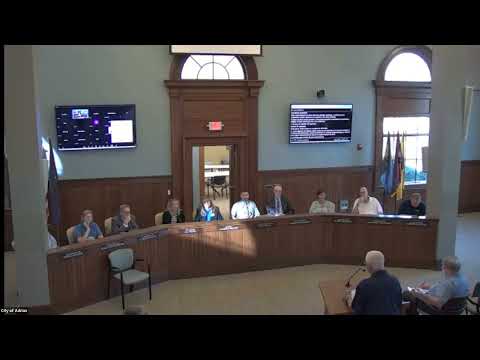
City staff updated the Adrian City Commission on implementation of the point‑of‑sale (POS) ordinance and answered questions about inspections, enforcement and next steps ahead of a Nov. 4 ballot on repeal.
Community Development Director Lisa Huett Cruz and point‑of‑sale inspector Sherry Berardi gave a slide presentation summarizing inspection activity since the ordinance’s adoption. According to the department, 141 homes have been inspected; 18 passed with no findings, 74 had repairs completed prior to closing, and 49 remained in progress at the time of the presentation.
“The purpose [of the ordinance] is to improve the livability of City of Adrian neighborhoods … by bringing them into conformity with minimum standards of the International Property Maintenance Code as adopted,” Huett Cruz said, reading the ordinance purpose language into the record and noting the ordinance was adopted June 3, 2024, effective Nov. 30, 2024.
Berardi, who told the commission she handles point‑of‑sale inspections, showed before‑and‑after photos of properties in which exterior blight and safety hazards were removed or repaired — examples included demolished unsafe barns, repaired foundations, removal of illegal pools, and cleanup of yards with hazardous debris.
Several speakers during the public‑comment period, including Carrie Smith (a local title company manager), urged repeal of the ordinance, saying implementation and enforcement have been inconsistent and that title companies and sellers are becoming de facto enforcers. Smith told the commission that sellers in for‑sale‑by‑owner transactions have appeared at closings unaware of the ordinance and that same‑day inspections have created operational headaches. “For those reasons and many others, I encourage all residents to vote yes to repeal the point of sale ordinance on November 4,” Smith said.
Other public commenters said donor groups and neighborhood priorities were separate issues; some supported enforcement that addresses hidden hazards found when inspectors enter yards under POS authority.
Commissioners asked staff to clarify enforcement tools and current policy. Berardi said the program currently has no inspection fee and that the department has been operating without an escrow requirement or a fee schedule while awaiting the outcome of the ballot measure. She said inspectors typically respond within one to two days of requests and that most inspection reports are delivered to the requester the same day or the next day.
On enforcement, staff said they can pursue civil infractions for visible blight that violates the municipal code (for example, tall grass, junk vehicles) and that point‑of‑sale inspections often reveal hazards not visible from the street because inspectors enter yards with homeowner permission or use a submitted home‑inspection report in lieu of an on‑site POS inspection.
Berardi said the department has sent notices when property owners did not respond, but acknowledged that, at present, the city has limited recourse when the condition cited in a point‑of‑sale report is not visible from the street and the owner declines to comply. Staff said policy work would be required to create an escrow or fee structure and that the commission must decide whether to retain the ordinance after the Nov. 4 vote.
Ballot language being presented to voters reads in part: to repeal City of Adrian ordinance number 24‑002, commonly referred to as the point‑of‑sale ordinance. Staff emphasized that a “yes” vote would repeal the ordinance; a “no” vote would retain it.
The commission did not take formal action on the ordinance at the meeting; public comment and the staff presentation were part of the informational record. Commissioners and staff agreed there is additional policy work to do if the ordinance remains in place, including defining fee schedules, escrows for repairs, and formal enforcement steps.