
Committee debates two‑year categorical grant for student‑success professional development; amendment fails and bill not advanced
Get AI-powered insights, summaries, and transcripts
Subscribe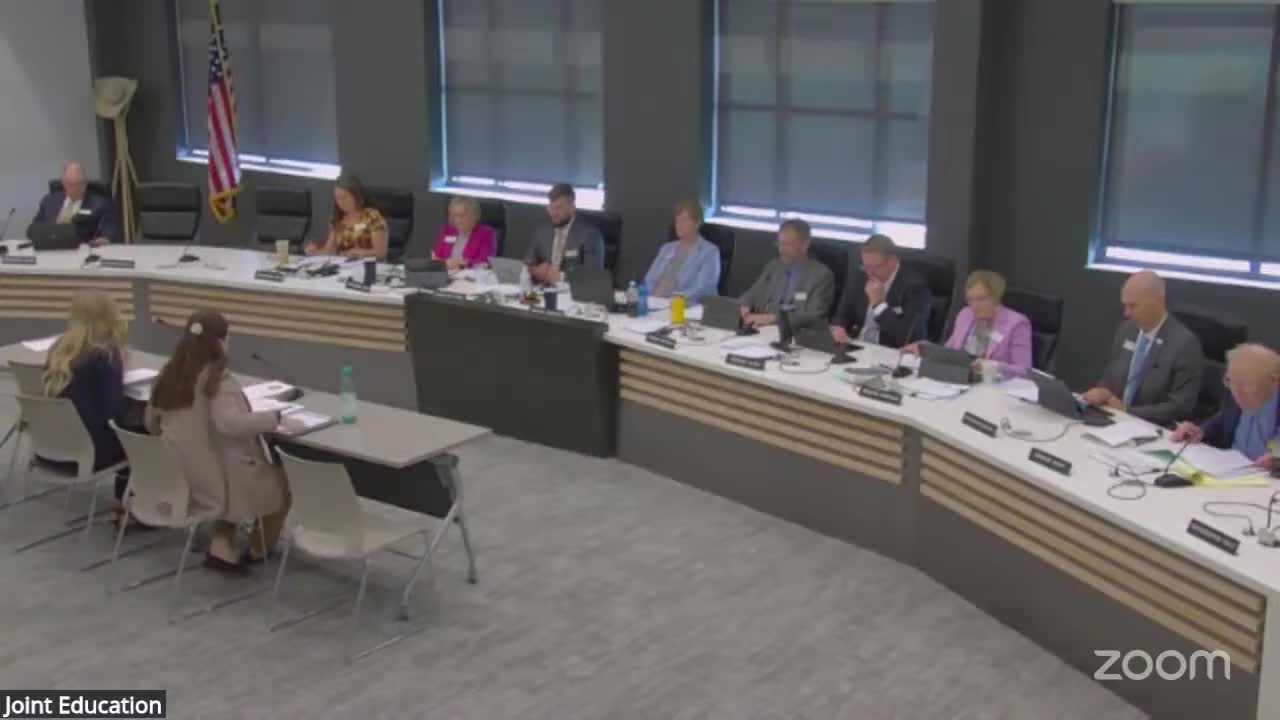
Summary
A draft categorical grant would fund professional development targeting nonacademic barriers to student success; lawmakers and witnesses debated program design, costs, and whether it conflicts with the block grant model. An amendment to limit state share failed and the committee did not carry the bill forward.
A Legislative Service Office draft would create a two‑year, noncodified categorical grant program to fund professional development aimed at improving student success by addressing nonacademic barriers. The draft, 26 LSO 90, sets application deadlines, reporting requirements and allows the Wyoming Department of Education to promulgate rules.
Legislative editor Ashley Phillips told the Joint Education Committee the draft creates a categorical grant for two years and would be outside the education resource block grant model. The proposed grant would fund professional development “for all school district employees who may have an impact on student success,” not just classroom teachers, and would focus on understanding student strengths and addressing nonacademic reasons students may struggle. Districts would apply to the Department of Education by 06/30/2026 and 06/30/2027, and award amounts would be based on average daily membership (ADM) unless the committee instead chooses a flat amount.
The draft requires the Department to notify districts by Aug. 15 of the respective school year and to provide written approval or denial with reasons. Districts would report to the department on outcomes, and the department must report findings and recommendations to the Joint Education Committee. The appropriation language is split so funds would be held until the start of the next biennium; section 3 of the draft would become effective 07/01/2026.
Public testimony focused on programs that could be funded. Brian Farmer of the Wyoming School Boards Association described the BARR (Building Assets, Reducing Risks) program as an example and said some Wyoming districts have piloted it. Teachers and parents testified about observed improvements: Hailey Bowersacks, a fourth‑grade teacher in Douglas, said BARR helped a disengaged student raise attendance to 92 percent by connecting the student to a strength (reading Harry Potter during recess). Jenna Thomas, a parent at Moorcroft Secondary School, said BARR “made me feel like the teachers cared” and credited the program with improved engagement.
Cost and scale were major points of debate. A witness cited a figure of $23 million per year to implement BARR statewide in 48 districts over three years; committee members also discussed vendor capacity and estimates of roughly $80,000 per school per year for some programs. Senator Chris Rothfuss (motion sponsor for a later amendment) proposed a conceptual amendment to fund a 25 percent state match for one school per district with a $1,000,000 appropriation; that amendment failed on a voice/hand count (4 in favor, 8 opposed).
Senator Brennan moved to carry the bill forward to the next meeting after withdrawing an earlier amendment motion; the motion to carry the bill forward did not pass and the committee did not advance the draft at this meeting.
Ending: The committee debated principles—pilot versus statewide rollout, categorical grants versus block grant flexibility, and measurable outcomes—but did not adopt funding, amendments, or carry the bill forward. The draft remains pending and committee members asked for more precise cost figures and program details before further action.