
Ordinance committee approves amended R‑5 senior residential zone; recommends rezoning of three parcels
Get AI-powered insights, summaries, and transcripts
Subscribe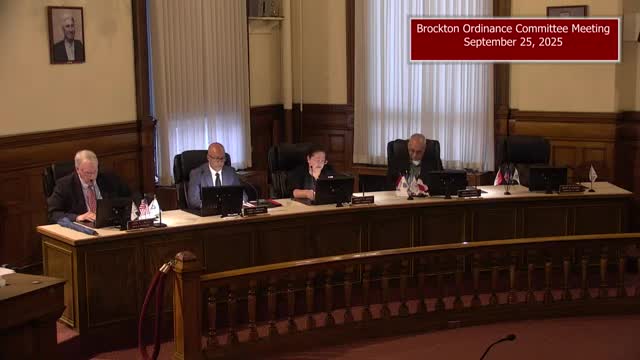
Summary
Brockton City Council’s Ordinance Committee voted Thursday to pass amendments to an ordinance reestablishing an R‑5 senior residential community zone and favorably recommended a zoning‑map amendment to reclassify three identified parcels from R‑1 to R‑5.
Brockton City Council’s Ordinance Committee voted Thursday to pass amendments to an ordinance reestablishing an R‑5 senior residential community zone and favorably recommended a zoning‑map amendment to reclassify three identified parcels from R‑1 to R‑5.
The amended ordinance, introduced and described at the committee meeting by Councilor Jeff Thompson (Ward 5), aims to create age‑restricted housing for residents 55 and older while incorporating aspects of the underlying R‑1 zone. Thompson, a co‑sponsor, said the change "meets this committee's goals of providing age‑restricted housing for our senior population" and removes a previously contentious multifamily‑housing supplement.
Committee members said the change is intended to reduce hardships for seniors who wish to age in place near family, health care and social networks. The committee approved technical amendments by voice vote, then voted to pass the ordinance as amended and to recommend rezoning parcel IDs 133‑002, 133‑003 and 175‑160 from R‑1 to R‑5.
The ordinance text and the amendments read into the record by legislative counsel, Attorney Resnick, revise numerous zoning details. Key changes described at the meeting include adding tenant‑association language (so rental developments could be governed by tenant associations as well as homeowners associations); clarifying allowed dwelling types to include detached and semi‑detached single‑family units as well as apartments; limiting building heights to two stories for semi‑detached units and up to three stories for apartment‑style buildings; and specifying that the primary bedroom for single‑detached units should be on the ground level.
Resnick also said open‑space requirements were modified: "open space shall equal not less than 50% of the total parcel area," and areas with exclusive use (yards, private areas, access roads, driveways, sidewalks and dwelling unit footprints) are excluded from that calculation. Parking requirements were reduced in the amended language from two spaces per dwelling unit to 1.5 spaces per unit.
Committee discussion highlighted two procedural changes and related concerns. First, special‑permit review and certain discretionary relief in the ordinance were shifted to the Planning Board rather than the Zoning Board of Appeals (ZBA). Supporters of that change argued the Planning Board is more involved in site‑plan and engineering review and can postpone or continue technical matters across meetings. Opponents favored the ZBA because its membership can include public‑safety expertise (the committee noted the ZBA typically includes a fire‑safety representative) and because the ZBA historically issues determinations on use.
Councilors also discussed language already present in the existing R‑5 ordinance that gives homeowners associations (HOAs) certain voting rights related to meeting the 55‑and‑older occupancy requirement. One councilor raised a hypothetical concerning an older spouse marrying a younger partner with a minor child, asking whether the current language would require the formation or vote of an HOA or tenant association to allow such a household. Legislative counsel said that restrictive language pre‑exists the proposal and that the council could revisit it; some councilors asked staff to review and, if appropriate, tweak the language before final council action.
Several councilors urged a parallel citywide study of senior housing needs even as they voted to move the ordinance forward. Councilor remarks included support for both advancing the ordinance for developers who are ready to invest and commissioning a study to better quantify seniors’ housing preferences and needs.
On procedure and votes: a motion to accept the package of amendments was made, seconded and approved by voice vote; subsequently a motion to recommend the ordinance favorably as amended was made, seconded and approved by voice vote. Later in the meeting, the committee moved and seconded a favorable recommendation for the zoning‑map amendment to reclassify the identified parcel IDs from R‑1 to R‑5; that motion passed by voice vote.
The ordinance before the committee references local zoning sections (Section 27‑4 and Section 27‑27.6) and would create a base R‑5 zone that incorporates the underlying R‑1 standards for parcels designated R‑5. The committee recorded requests that messages and emails urging a comprehensive study — including a request from the executive director of the Council on Aging and a memo from Planning Director Rob May — be incorporated into the record "as if read." Attorney James Burke (counsel to the original drafter) and Planning Director Rob May were invited to the meeting but were not present.
The ordinance and the zoning‑map recommendation will now proceed to the full City Council for further consideration. Committee members said staff will prepare additional materials before the council meeting, including a memo on which kinds of matters typically go to the Planning Board versus the Zoning Board of Appeals and information about potential costs and scope for a recommended senior‑housing study.
Ending: The committee’s action formalizes an R‑5 zoning framework intended to encourage age‑restricted development in Brockton while preserving many R‑1 characteristics for parcels granted R‑5 designation. Councilors signaled they expect to revisit technical language (including HOA/tenant‑association provisions and any procedural refinements) as the item moves to the full council.