
Kent County Sheriff presents real‑time intelligence center plan using FUSIS and drone feeds; officials stress voluntary camera sharing and audit trails
Get AI-powered insights, summaries, and transcripts
Subscribe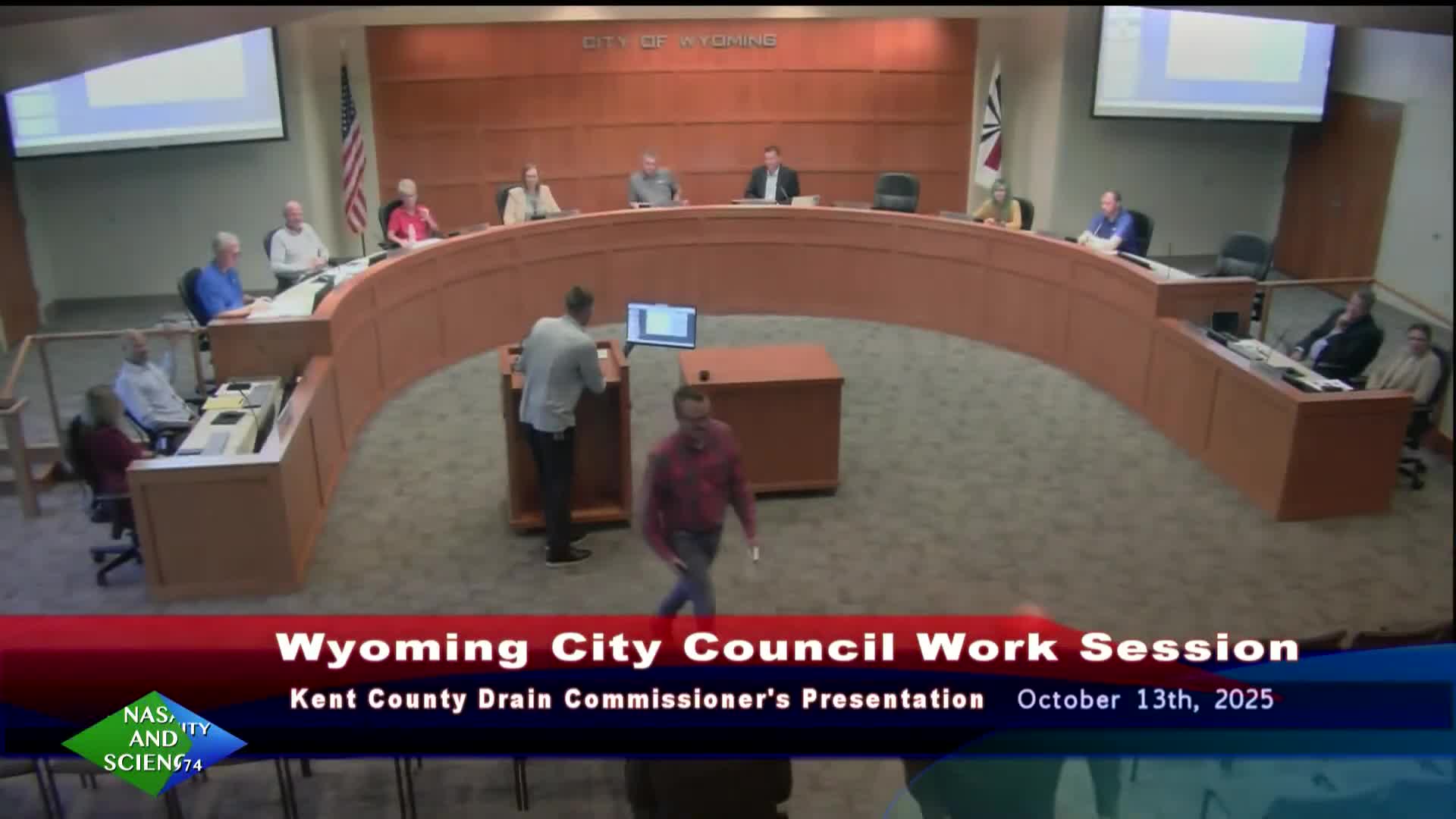
Summary
Kent County Sheriff’s Office told Wyoming council the new Real Time Intelligence Center integrates cameras, license‑plate readers, fleet and body‑worn feeds and drones via a FUSIS platform funded from a school radio grant; officials emphasized voluntary participation, MOUs, audit logs and limited buffering of live feeds.
At the Oct. 13, 2025 City of Wyoming work session, Kent County Sheriff’s Office staff outlined a plan to operate a Real Time Intelligence Center (RTIC) that would integrate multiple camera and sensor feeds, license‑plate readers, fleet and body‑worn cameras and drone imagery on a single platform (FUSIS) to support real‑time response and investigations.
The sheriff’s presenter told council the initiative is cost‑neutral to the city: the office used remaining funds from a roughly $2,500,000 grant for school radios to build the center and expects no ongoing cost ask to Wyoming. The office framed the project as a way to “pull several different technology platforms into one room” so that trained staff can rapidly provide actionable information to officers on scene.
What the system would do: county presenters demonstrated how Axon body‑worn and fleet cameras, selected business and municipal camera feeds (via a FUSIS “core”), drone streams, and other sensors would appear on a single map. Sergeant Ryan Dannenberg showed that the system can display camera locations, feed video, show officer body cam locations and display drone video with address layers; presenters said a Skydio drone can reach roughly a 2.5–3 mile radius under ideal conditions and cruise about 36 mph depending on wind.
Data sources and participation: presenters said the county will ask businesses to opt into direct, secured camera sharing via hardware “cores” rather than ingesting Ring or doorbell feeds. For private ring/doorbell systems the sheriff’s office said it will maintain a registry and, when an incident occurs, request footage directly from owners (for example via a community notification asking residents to check their doorbell camera) rather than directly ingesting those consumer streams. Program participation would be voluntary; businesses can disconnect the core at any time.
Privacy, access and audits: presenters said access will be restricted to credentialed law‑enforcement users within a county consortium and governed by memoranda of understanding (MOUs) with participating agencies and schools. FUSIS will record an audit trail of each access (who clicked into a camera, for how long, and with fields for notes). Presenters said buffering would typically allow access to 36–48 hours of recent footage in the platform for quick review, but they emphasized the county would use standard legal channels to obtain recorded footage intended as evidence and would not retain long video archives without agreements.
Use cases and evidence: presenters cited national examples and studies (Miami, San Francisco, New Orleans) to argue RTICs can increase clearance rates and reduce specific crimes such as auto theft. The sheriff’s office said the center would also support non‑criminal public safety responses (flooding, wildfires, large venues, school emergencies) and that MOUs with school districts would limit access to interior school cameras to defined emergency conditions; school camera access requires an explicit trigger and presents a warning in the system before an operator proceeds.
Questions and council concerns: councilmembers asked whether federal or state agencies would have access (presenters said federal agencies would not have automatic access; access could be facilitated for specific investigations but is not a default). Staff addressed immigration‑enforcement concerns directly, saying the system is intended for local policing and significant criminal investigations (human trafficking, HSI requests), not routine immigration enforcement. Presenters also described how the county will provide MOU summaries and can automatically produce periodic audit reports for participating schools or businesses.
Ending and next steps: presenters said the county will continue outreach to businesses and schools, produce MOUs that define permitted uses, and coordinate training and transparency materials. They asked council to consider participation and public outreach; presenters repeatedly emphasized voluntary participation and auditability.
Direct quotes in this article are taken from remarks by Kent County Sheriff’s Office staff at the Oct. 13, 2025 work session.