Get Full Government Meeting Transcripts, Videos, & Alerts Forever!
Get email alerts on the Sales Tax Ballot Measure topic
No spam. Unsubscribe anytime.
Fort Scott commissioners discuss 1¢ sales tax option, 9-year streets plan and mill-levy cut
Summary
At a Fort Scott City Commission work session commissioners discussed placing on the November ballot either a renewal of the current half-cent sales tax or a proposal to raise it to 1¢, paired with a nine-year streets plan, an advertised reduction of 2 points on the mill levy and a proposed allocation split for streets, parks and public safety.
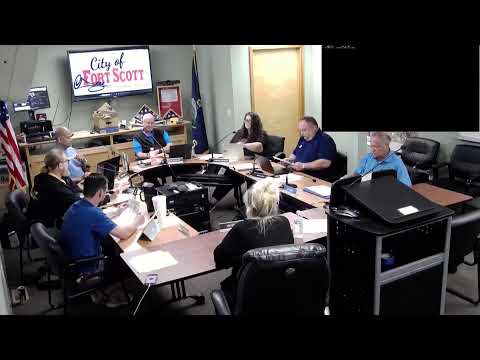
Fort Scott City commissioners met in a work session to discuss whether to place a sales-tax question on the November ballot that would either renew the existing half-cent sales tax or raise it to a full 1¢, paired with a nine-year streets plan and an advertised cut of "2 full points" on the mill levy.
The discussion focused on two ballot approaches: present voters with a single renewal (the half-cent) and a second, conditional question to add the extra half-cent (bringing the total to 1¢) if the renewal passes; or ask only for a single 1¢ question. Commissioners and staff debated the term length (five years versus 10 years), how to advertise specific permitted uses, and transparency and auditing controls for any new funds.
Why it matters: commissioners said the sales tax revenues would be the main funding source for a proposed nine-year streets program the city has drafted. Staff described the plan as aggressive and said it would allow the city to address multiple overdue street projects, reduce borrowing, and free funds for parks and public-safety equipment if voters approve the increase. Commissioners noted the proposal could affect borrowing plans for projects such as Wall Street and East National, and discussed county cooperation on laying asphalt as a cost-saving option.
Key details from the session included a proposed allocation breakdown for the 1¢ option: 80% to streets, 10% to parks and facilities, and 10% to public safety. Commissioners said that change in distribution would accompany a plan to lower the mill levy by "2 full points," which city presenters described as a benefit to property owners while maintaining increased street funding. The commission also discussed alternative allocations and whether the existing half-cent should be reallocated if a renewal is adopted.
Staff presented a draft nine-year street program that lists projects the city would target under the larger revenue scenario. City staff noted unpredictable events — heavy rain this past year was cited as an example — can change priorities and timetables. Staff said an overlay project on Eddie Street (roughly four to five blocks) would cost “a hair over $100,000” as an example of the kind of work the plan would fund. Commissioners repeatedly emphasized the need to make the plan and expenditures transparent to voters and suggested publishing a tracker on the city website and holding town halls to show how tax revenues would be spent.
Officials also discussed operational options intended to reduce cost: a prior interlocal agreement with Bourbon County to lay asphalt (noted at $80 per ton in earlier discussions) could allow the county to perform paving work for the city rather than the city purchasing its own paving equipment. City staff said they would discuss that option with the county commission. Staff also described existing in-house capacity: the street crew has grown from three workers to roughly 14 and now runs several crews, which staff said improves the city's ability to do preparatory work so outside paving crews can lay asphalt efficiently.
Voter history and logistics came up frequently. Commissioners reviewed the March 2, 2021 special election vote on the then-question: 518 total votes, 312 in favor and 206 opposed (about 60%–40%). Several commissioners said turnout and voter attitudes differ for November general elections compared with special elections, and that a public-education campaign and detailed accounting would be important if the city seeks to increase the rate. Staff clarified that the sales tax applies to the same base as current city sales tax collections (including state-collected remote sales delivered to the city) but noted streaming services are currently excluded from local collections.
No formal motion or vote was taken during the work session; commissioners asked staff to check legal and ballot-drafting questions (for example, whether the ballot can present a primary renewal plus a conditional second question) and to confirm whether the county will partner on paving. Commissioners also asked staff to produce clear, itemized materials for public outreach showing the nine-year plan, estimated project costs, and proposed auditing/reporting methods for any new funds.
The session closed with no decision to place a specific question on the ballot; staff will return with legal language options and additional details for a future agenda item where commissioners can make formal motions.
Notes: This article summarizes the Fort Scott City Commission work session discussion on the sales tax and related street plan. It does not report any binding action because none was taken during the work session.