
Street department seeks larger raises; council, administration point to budget limits and Senate Bill 1
Get AI-powered insights, summaries, and transcripts
Subscribe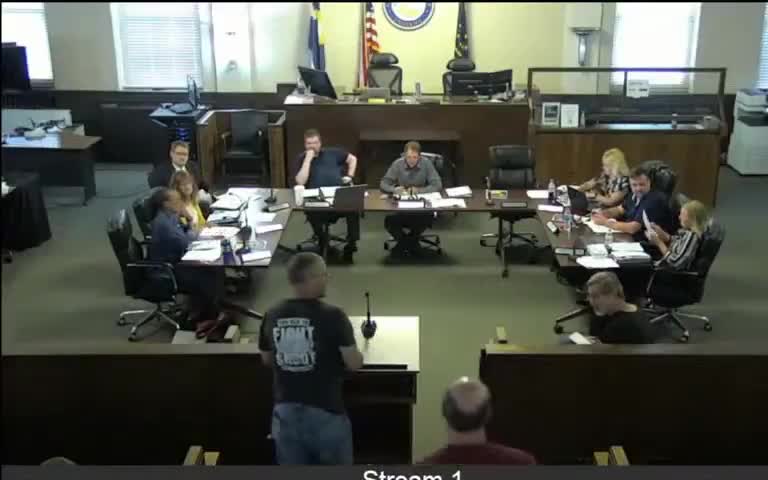
Summary
Street department employees urged the council for larger raises; the administration said the city's 6-5-5 offer was the most the city could reasonably support given budget constraints and uncertainty from Senate Bill 1.
Members of the Terre Haute street department pressed the City Council on Oct. 2 for larger pay increases, asking officials to move an offer of 6-5-5 percent across three years to 10-10-10. Council and administration officials said they had negotiated the highest feasible offer short of police and fire increases and said state law and budget limits constrained the city's options.
Mark Smith, identifying himself as a street department employee, told the council during public comment: "People have been here 10, 15 years. And with the small raises that we've been getting, we our paychecks hasn't changed. I bring home paychecks hasn't changed in 15 years." Smith said employees want a faster correction to stagnant take-home pay and asked the council to consider a 10-10-10 schedule, which Smith estimated would add about $70,000 to the current year's budget, roughly $100,000 in the following year and $115,000 in the subsequent year.
Administration and union negotiation status
City negotiators and the administration described why the current offer (6-5-5) was extended to the street department. Michael (city attorney) explained the administration's stance during negotiations: "The the offer that was made to the street department ... was the only offer that exceeded 5% in any year. ... I think that that was meant to express the sincere efforts that this administration has observed from the employees of the street department." Mike (a city HR/finance official) and the mayor both said the city's fiscal choices are constrained by recent state-level changes and by the need to present a balanced budget.
The mayor told the council: "you cannot correct that in 1 year, let alone 1 contract. The state requires a budget that we can afford, that we can pay." City staff also noted that health-insurance rates were confirmed at 0% increase for 2026, which slightly eased pressures but did not create capacity for larger across-the-board raises.
Union ratification and timeline
City staff said portions of the contracts have been finalized and some units have voted to ratify; fire had completed a vote, and other units were in various stages. The administration said contract ratifications generally must be completed by Dec. 31, and if a union fails to ratify an offered contract the parties would revert to the previous year's terms and the dispute could go to arbitration.
Street ordinance status at this meeting
The Street Department's salary ordinance (Special Ordinance 22 20 25) was presented and discussed at the Oct. 2 meeting but was not approved; council members and administration asked for additional negotiation and clarification and the item was deferred to a future meeting for follow-up. Public comment from street employees and council questions about insurance, specialty pay and parity with public-safety units dominated the discussion.
Why it matters
Councils' decisions on salary ordinances affect employee retention and the city's ability to staff essential services, including storm response and street maintenance. Council members repeatedly noted that street and wastewater crews are frontline responders during storms and emergencies and that long-term pay gaps have made recruitment and retention difficult.
Clarifying details
- Offer on table for Street Department: 6% / 5% / 5% across three years (cumulative ~16%). - Employee request discussed in public comment: 10% / 10% / 10% across three years (cumulative ~33%), with estimated first-year cost to the city of about $70,000 (estimate provided by street employees in public comment). - Administration noted health-insurance rate confirmed at 0% for 2026 by AIM Medical Trust and said future insurance cost changes will depend on claims experience in 2026. - Deadlines: Staff said negotiations and ratification activity are expected to conclude by Dec. 31 for the new contract period starting Jan. 1, 2026.
Ending
Council did not approve the street salary ordinance at the Oct. 2 meeting and deferred final action; staff will continue negotiations with the union and return with updated figures and timeline. The debate highlighted the tension between correcting long-term pay shortfalls and meeting budget constraints imposed by recent state-level tax and levy changes (discussed in the meeting as Senate Bill 1).