Get Full Government Meeting Transcripts, Videos, & Alerts Forever!
UA study updates Pima County curve-number maps; finds post‑fire peak flows rise as much as 21% in some channels
Summary
Professor Jennifer Duan of the University of Arizona presented a study to Pima County staff updating countywide curve‑number maps and estimating post‑fire runoff for the Catalina Mountains burn area, finding localized peak discharge increases as large as 21% in one channel.
Professor Jennifer Duan, a professor of hydraulics and sediment transport in the Department of Civil and Architectural Engineering and Mechanics at the University of Arizona, presented a study to Pima County staff and consultants that updates countywide curve‑number maps and quantifies post‑fire increases in runoff for a Catalina Mountains burn area.
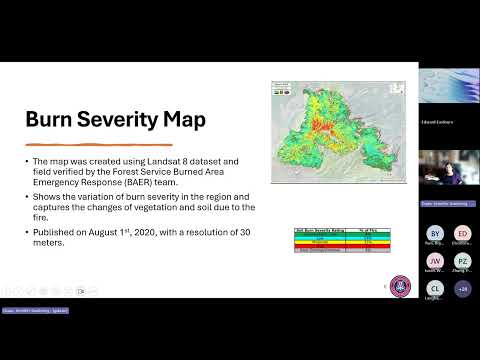
The study, completed last year and funded by the Pima County Regional Flood Control District, produced three main products: (1) a 30‑meter by 30‑meter raster map of curve numbers (CN) for the county derived from LANDFIRE 2020 vegetation type and cover data; (2) a post‑fire CN map for the Bighorn Fire burn area generated using burn‑severity/vegetation‑reduction maps from an interagency burn team; and (3) a 2‑meter by 2‑meter impervious‑area overlay that assigns impervious cells a CN of 98 for urban planning and green‑infrastructure analysis.
Why it matters: CN maps are a standard input for rainfall–runoff methods and many hydraulic/hydrologic models used by engineers and floodplain managers. Duan said the higher spatial resolution and updated vegetation cover better reflect current land use and can change modeled runoff outcomes for small basins and urban design decisions, such as locating rain gardens or evaluating the runoff impact of new development.
Methods and data: Duan described two lookup sources used to assign CN values: the national TR‑55 tables and a continuous CN table used locally (referred to in the…
Already have an account? Log in
Subscribe to keep reading
Unlock the rest of this article — and every article on Citizen Portal.
- Unlimited articles
- AI-powered breakdowns of topics, speakers, decisions, and budgets
- Instant alerts when your location has a new meeting
- Follow topics and more locations
- 1,000 AI Insights / month, plus AI Chat