
Pima County and Universities test GIS method to prioritize neighborhood-scale stormwater parks
Get AI-powered insights, summaries, and transcripts
Sign Up Free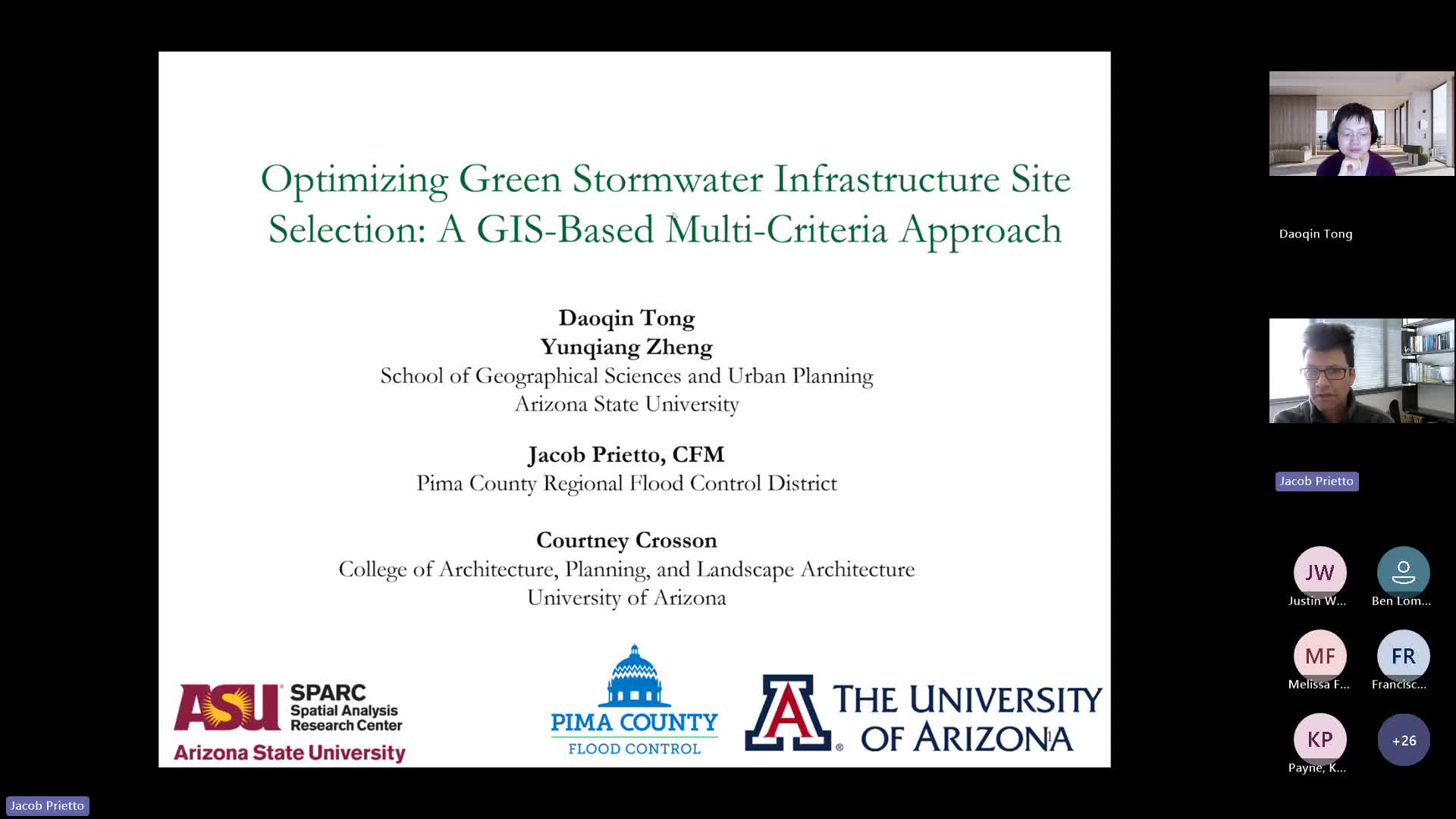
Summary
Pima County Regional Flood Control District and university researchers presented a GIS-based, multi-criteria method to identify neighborhood-scale sites for green stormwater infrastructure to reduce flooding and provide community benefits.
Pima County Regional Flood Control District on Tuesday presented a GIS-based, multi-criteria method to identify candidate sites for neighborhood-scale green stormwater infrastructure, aiming to reduce flood risk and provide co-benefits such as tree canopy and heat relief.
The presentation, delivered by Jacob Prieto, chief hydrologist for the Flood Control District, and researchers led by Dao Xingtong of Arizona State University, described results from year two of a three-year study that applied flow-2D simulations, floodplain layers and socioeconomic, environmental and parcel-level data to score and rank potential GSI locations in three Tucson study areas (labeled A, B and C).
Why it matters: Pima County is required to perform stormwater mitigation analyses to support its MS4 permit obligations. The district and university partners say a parcel- and neighborhood-level scoring tool could help prioritize investments in “stormwater parks” (roughly one-acre basins with small watershed areas) that both capture runoff and expand local green space in flood-prone, heat-vulnerable neighborhoods.
The team described the analytical workflow: assemble datasets (floodplain boundaries, flow-2D flood-area outputs where available, terrain-based accumulation, parcel ownership and size, imperviousness, heat-severity and canopy layers, transit accessibility and CDC-derived social vulnerability indices), normalize those inputs, then compute a composite suitability score for each candidate parcel or grid cell.
For study area A the researchers initially limited candidates to 362 vacant parcels and ran a 5-year precipitation flow-2D simulation, classifying locations inundated at 0.25 feet or more as flooded for that scenario. For study area B they expanded to evaluate every parcel in the subwatersheds (not just vacant parcels) and added an open-space adjacency metric to account for combining neighboring parcels where a single lot’s open area is insufficient.
The analysis explicitly separated two flooding metrics: a frequent-event (5-year) flow-2D flood-area output used for inundation mapping and a 100-year regulatory floodplain overlay. The team also used terrain-based accumulation as a proxy where flow-2D outputs were not available.
Results and sensitivity: the team generated composite maps and lists of top candidate sites and tested at least three weighting schemes that change how much emphasis is placed on flooding metrics, social vulnerability, age of construction and parcel/open-space size. Some clusters of high-ranking parcels in northwest study areas remained consistent across weightings; other candidate parcels shifted when the team increased weight on flooding metrics or on social-vulnerability/age-of-construction indicators.
Project context and next steps: Prieto said this work grew from a watershed-scale assessment the district completed to support its MS4 permit and that year three will produce a complete package for outreach and implementation. The Flood Control District and university partners plan to use stakeholder feedback — captured via a short weighting-preference survey the presenters circulated — to refine priorities and consider producing neighborhood-level GSI opportunity scores for outreach with neighborhood associations.
Quotes: “We aim to do sites that are about 1 acre in size, and then that have watersheds no larger than 1 square mile,” Prieto said when asked about project scale. Dao Xingtong described the multi-factor framework and invited attendees to complete the weighting survey: “We would really appreciate your thoughts and your feedbacks.”
Technical clarifications: the team used a 0.25-foot inundation threshold for the 5-year flow-2D simulations; the regulatory floodplain layer came from county geospatial data and reflects a 100-year flood event. For study area A the team initially analyzed 362 vacant parcels; for study area B they evaluated all parcels within neighborhoods overlapping the target subwatersheds and incorporated an open-space adjacency calculation to identify combinable parcels.
Ending: Presenters encouraged practitioners and community members to complete the survey and said the method can be adapted for other siting decisions to promote urban sustainability. The team noted they will refine parcel-level outputs to better match local stakeholder priorities in year three of the project.