
Pima County: 2024 tortoise monitoring finds most plots occupied, disease incidence low
Get AI-powered insights, summaries, and transcripts
Subscribe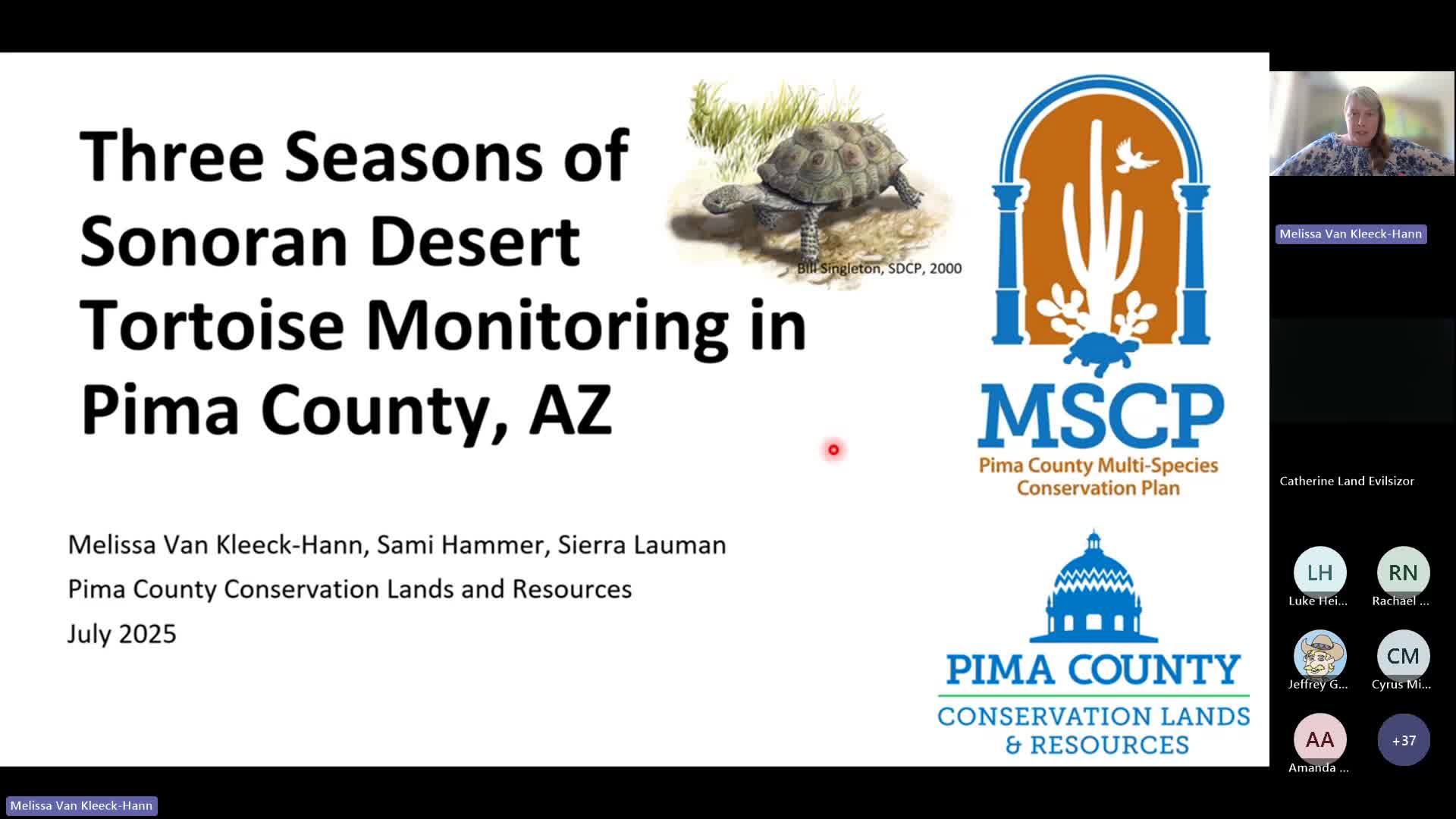
Summary
Pima County ecological monitoring staff reported results from 2024 surveys in Tucson Mountain Park showing 44 tortoises captured on 15 of 20 study plots, overall occupancy improving in some plots and disease incidence lower than 2021; program to continue next in 2027.
Dr. Melissa Van Clickhan, ecological monitoring program coordinator for Pima County's Conservation, Lands and Resources Department, presented findings from the county's 2024 Sonoran Desert tortoise monitoring in Tucson Mountain Park, saying 44 individual tortoises were captured and marked on 15 of 20 long‑term study plots during the summer monsoon season.
The county monitors tortoises as part of implementation of the Sonoran Desert Conservation Plan and its Multi‑Species Conservation Plan (MSCP), obligations the county said help mitigate impacts to covered species across the county's conserved lands. "It is actually just a dream job," Van Clickhan said, describing the fieldwork and the multi‑year survey design used to track occupancy, detection, colonization and extinction rates.
Van Clickhan told attendees the program uses 20 randomly generated plots across roughly 22,000 acres of modeled suitable habitat in Tucson Mountain Park, divided into units including Sweetwater Preserve, Painted Hills and Trails Park. Each plot is visited three times between July and September, producing 60 plot visits per monitoring year. The program has completed surveys in 2018, 2021 and 2024 and plans the next monitoring season in 2027.
Survey methods and results The county's field crews walk 17 transects per plot (each 170 meters long, 10 meters apart) and search under vegetation and in shelters, recording every tortoise encountered and site covariates such as aspect, shelter counts, and ground cover. In 2024 staff captured 44 individuals on 15 plots; incidental observations off plots totaled 61 sightings of 53 individuals. Van Clickhan said 75% of plots were occupied in 2024, and summarizing all years of the study the program estimates about 62% occupancy and a detection probability of about 61% so far. The program has marked 105 tortoises in total to date.
Health, threats and habitat changes Van Clickhan described threats the program monitors, including upper respiratory tract disease, predation, road mortality and invasive buffelgrass. Upper respiratory signs were observed in two individuals in 2024 (named in the presentation as Honeydew and Edith), down from six in 2021 and comparable to two in 2018; Van Clickhan said one previously symptomatic tortoise recaptured in 2024 ("Pancake") no longer showed signs of illness. On disease and handling protocols, Van Clickhan said, "we do not treat them in any way. When we find the upper respiratory infections and things like that, we just note it," and staff follow hygiene protocols—wearing gloves and sanitizing equipment—to limit spread and report clusters to the U.S. Fish and Wildlife Service where appropriate.
The presentation documented large increases in buffelgrass between 2018 and 2021 (described as roughly tenfold, equivalent to increases on the order of thousands of square meters in some areas), with slower growth by 2024. Van Clickhan credited restoration partners for buffelgrass removal work but said continued invasive grass expansion remains a concern because it reduces nutritious native forage and increases fire risk.
Statistical patterns and recaptures Program staff reported that the percent of a plot facing east and the number of shelter sites were the strongest predictors of tortoise occurrence; east‑facing slopes warm earlier in the morning and appear to increase detectability and use. The county has recaptured 34 previously marked tortoises (out of 105 marked overall); for example, five tortoises first captured in 2018 were recaptured in 2024 and 13 originally captured in 2021 were recaptured in 2024.
Community engagement and partnerships Van Clickhan described partnerships with the National Park Service, U.S. Fish and Wildlife Service, Arizona Game and Fish Department and local volunteers and interns. She noted outreach examples including members of the public reporting marked tortoises (one landscaper at Star Pass shared regular sightings) and a hiker who found a marked tortoise and later got a tattoo of that tortoise, illustrating public interest in the program. Van Clickhan said the program uses unique visual ID plates plus notching when practical and keeps a photographic catalog to help identify unmarked juveniles later.
Public guidance from the Q&A In response to questions from meeting attendees, Van Clickhan and a colleague, identified in the meeting as Sammy, gave practical guidance: if a member of the public finds a marked tortoise, they should email program staff to report the sighting; if a tortoise is in immediate danger on a road, Arizona Game and Fish guidance is to move it a short distance in the direction it was traveling to get it out of traffic and keep the animal level and facing its prior direction. Van Clickhan reiterated that staff generally do not remove or treat sick individuals in the field and that the program instead documents clinical signs and follows sanitary procedures to reduce disease transmission.
Why it matters The monitoring contributes to the county's MSCP obligations and long‑term population data that resource managers and partners can use to evaluate conservation actions, restoration priorities and potential future listings. Van Clickhan emphasized the multi‑decadal nature of the study: "This is a long term study," she said, noting the species' longevity and that more years of monitoring will increase the statistical power to detect trends.
Looking ahead The county plans to repeat intensive monitoring in 2027, continue partnerships with federal and local agencies and expand data sharing to support regional comparisons. Van Clickhan thanked volunteers and partner agencies for contributing staff time and expertise to the effort.