
Sioux Falls School District 49-5 board approves minutes, agenda and consent items and votes to enter executive session
Get AI-powered insights, summaries, and transcripts
Subscribe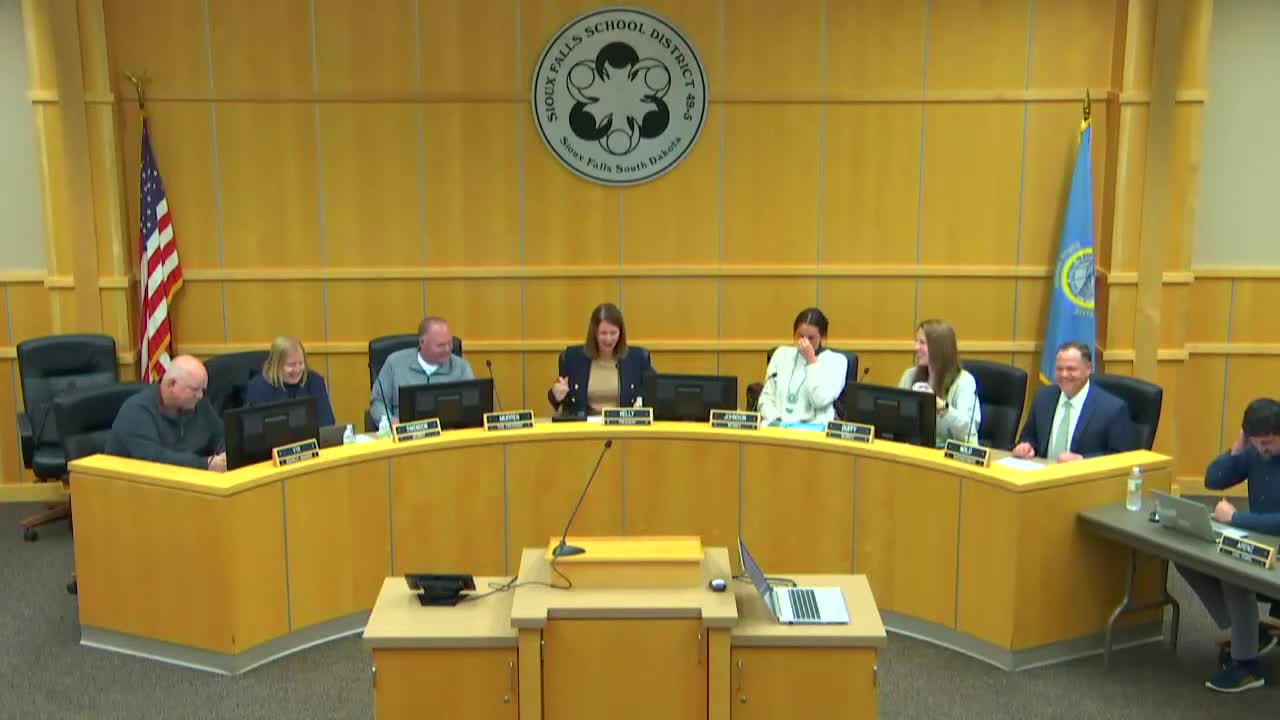
Summary
The Sioux Falls School District 49-5 Board of Education approved minutes from prior meetings, adopted the day’s agenda and consent agenda items, and voted to enter an executive session citing South Dakota Codified Laws 1-25-2(3). Voice votes were used and roll-call tallies were not recorded in the transcript.
The Sioux Falls School District 49-5 Board of Education approved minutes from prior meetings, adopted the meeting agenda and consent agenda items, and voted to enter an executive session citing South Dakota Codified Laws 1-25-2(3), according to the meeting transcript.
The presiding officer asked for approval of the minutes and read the motion aloud: “May I please get an approval for the minutes of the meeting held at 09:22 25 and 10 dash 1 dash 25.” The presiding officer then called for a second and, after a voice vote, stated, “All in favor? Aye. Opposed? That passes.”
The board next approved the meeting agenda after a motion and second. The presiding officer then moved approval of the consent agenda items “items a, b, c, d, and e,” which likewise passed on a voice vote with no roll-call tally provided in the transcript.
Later in the meeting, the presiding officer moved that the board go into executive session and cited state law: “Can I please get a motion to go into executive session, South Dakota codified law 1 dash 25 dash 2 subsection 3? So moved. Second. All in favor? Aye.” The transcript records that the motion to enter executive session carried on a voice vote; no further details of the executive session’s subject matter or any roll-call vote were provided in the transcript.
The transcript did not identify individual movers or seconders by name, and it does not record numerical vote tallies or any substantive debate on the consent agenda items or the minutes. Because executive sessions are closed to the public under state law, no public discussion of the executive session’s content appears in the transcript.
The board’s procedural actions in this excerpt consist of approvals by voice vote and a motion to convene an executive session under SDCL 1-25-2(3).