
Steering council urges talks on consolidating Sedgwick County fire services, cites tax and safety gaps
Get AI-powered insights, summaries, and transcripts
Subscribe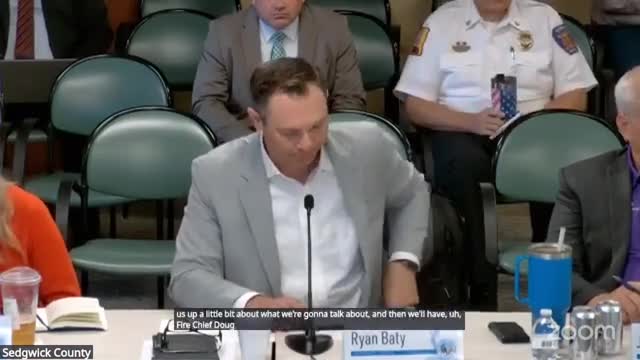
Summary
A Fire District Steering Council resolution asked the county to pursue consolidation discussions and review mutual/automatic aid agreements, citing taxed-area disparities and safety concerns when volunteer turnout is low; county officials said they will begin outreach and data collection with affected cities and townships.
The Sedgwick County Fire District Steering Council delivered a resolution asking the county to initiate discussions about consolidating fire services and to review mutual- and automatic-aid agreements after members raised concerns about tax inequities and firefighter safety, county officials said at an Oct. 14 staff meeting.
Why it matters: council members said some residents inside the fire district pay a dedicated mill levy for professional fire services while neighboring jurisdictions receiving response assistance do not contribute the same tax; county fire personnel and steering council members also described incidents in which volunteer turnout was low and Sedgwick County professional crews took command of calls outside the district, creating safety and legal concerns.
"These steering council members are all in, and it is very important to them what the fire district does and how it's funded," said Commissioner Beatty, summarizing the council's perspective that response location affects taxpayers and expectations.
Katie Tennell, chair of the Fire District Steering Council, said the resolution sought to "jump start" conversations with small cities and townships that are not in the fire district but regularly receive services under aid arrangements. "When I drafted this resolution, it maybe wasn't drafted in a way where those conversations were viewed as preliminary," Tennell said. "But I think the important part right now is to jump start those conversations so that we can hopefully produce more efficiencies, better services for the folks in the fire district, and outside the fire district."
Fire Chief Doug Williams and steering council members told commissioners they are concerned about unequal responsibility under some current arrangements. Williams described instances when county crews arrived to find low volunteer turnout and a professional commander facing decisions without the expected level of on-scene personnel. "When we go out and they have a total of four people show up on a scene and we only send three, it creates a fire scene that's grossly understaffed," Williams said, adding that NFPA staffing expectations and safety considerations underpin the concern.
County legal staff said statutory and procedural constraints affect how territory can be added to the fire district. Justin Wagoner, county counselor, said cities can adopt inclusion actions through their legislatures and that property owners in unincorporated areas can petition to enter the district. Deputy county counselor Kirk Sponsor said a petition process for unincorporated territory typically requires petitions from a portion of property owners (the meeting cited a parliamentary reference to a provision described as "19 30 six-04B").
Tennell and other steering council members pointed to tax differences: meeting remarks noted the fire-district mill levy for 2025 as 17 mills for professional fire services, and staff later provided a finance table estimating how inclusion of certain cities could change the district mill levy. County staff also noted the modelling challenges because municipal budgets sometimes hide fire-related costs in other funds, making direct comparisons difficult.
Next steps: commissioners directed staff to begin outreach and information-sharing with the small cities and townships named in the resolution, reexamine mutual/automatic aid agreements, and compile detailed response and fiscal data (response counts, turnout by department, jurisdictional breakdown of injury/fatal incidents and a clearer fiscal model) for future policy discussion.
Ending: County officials said they would pursue a conversation-led approach rather than a unilateral change. Tennell and Chief Williams said the goal is better-coordinated coverage and safer, clearer response roles; the steering council acknowledged that consolidation is one of multiple possible outcomes after discussions and data review.