
Calvert County planners start Huntingtown master-plan update; residents press to keep town’s rural character
Get AI-powered insights, summaries, and transcripts
Subscribe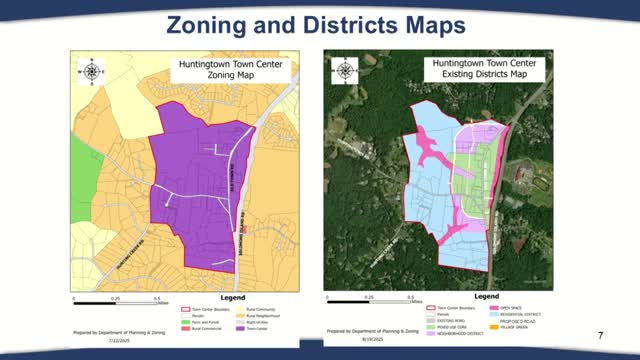
Summary
Calvert County planning staff presented options for updating the Huntingtown Town Center master plan and sought public feedback on whether the area should remain a town center, become a rural commercial district, or be reclassified as a minor town center. No formal actions were taken; staff will compile feedback for the Planning Commission in Nov.
Calvert County planning staff on Tuesday presented options for updating the Huntingtown Town Center master plan and asked residents for feedback on whether the area should remain a town center, be designated a rural commercial district, or be recast as a smaller "minor" town center.
Jason Brinkley, director of planning and zoning, opened the meeting by calling it “a community conversation. We wanna hear feedback from you all,” and said the presentation represented an early step in a months‑long process that will return to the Planning Commission in November and to the Board of County Commissioners in December.
The master-plan update is part of a newly condensed county process adopted in February 2025 that combines separate town‑center master plans into a single Master Plan of Town Centers with a chapter for each center, staff said. Tay Harris, a long‑range planner, described the relationship between the county comprehensive plan, functional plans, small‑area (town center) plans and the zoning ordinance. “The Calvert County comprehensive plan is the guiding policy document for the county,” Harris said, adding that the state requires the county to update it every 10 years; Calvert’s plan was last updated in 2019 and amended in 2022 and again in 2025 for zoning consistency.
Staff presented baseline data for Huntingtown: the town‑center area contains 81 parcels across about 304 acres; the U.S. Census American Community Survey estimate cited by staff showed a population of 3,029 in 2020 and 2,634 in 2023 for the Census‑designated place. Survey respondents (staff reported 389 participants) said the top draws to the town center are basic services and convenience retailers, plus a “small‑town” community character. Harris summarized that survey respondents also flagged traffic congestion on Route 24, unsafe intersections, a lack of sidewalks and trails, empty or turnover-prone storefronts, and division in the community over future designation.
Staff outlined four broad options under consideration: keep Huntingtown as a town center; reintroduce a major/minor town‑center distinction (with Huntingtown as a possible minor town center); convert the town center to a rural commercial district and adjacent residential district; or create a new small‑town district, such as a village or community use district. Harris described differences in permitted uses between town centers and rural commercial districts and noted that rural commercial rules are intended to keep businesses “small, low key, and neighborhood in nature consistent with the rural character of the area.”
Residents used the public‑comment period to press staff on specific consequences. Michael Bresnahan, a business owner who said he has operated in Huntingtown more than 30 years, told staff, “You realize you're eliminating several businesses that are already operational here?” and warned that some uses listed as not permitted in a rural commercial designation — automotive dealerships, boat dealers, self‑storage — already exist in Huntingtown. Tara Murphy asked whether existing businesses would be grandfathered; planning staff replied that the county would seek to avoid large numbers of nonconforming uses but that definitions and permitted uses could be adjusted if the Planning Commission or Board of County Commissioners directed a different approach.
Other residents asked for clarity about where potential new uses would be sited, noting map areas shown as open space and asking whether those strips could be redeveloped. Michelle Belt asked whether a theater or other large use might be placed on narrow undeveloped strips; staff responded that where new businesses could locate depends on the community’s vision and whether currently undeveloped parcels are chosen for redevelopment. Myra Gowans, speaking on behalf of Calvert Citizens United, asked about a thin road segment shown on an older map; staff said that road appeared in a 1993 vision and that they would research the origin and post answers in FAQs if necessary.
Several commenters said outreach needs strengthening. June Fisher said she had not received a postcard and asked how residents can ensure their views are heard; staff acknowledged postcards had not reached all intended recipients, encouraged residents to sign up for the county’s “notify me” feature on the master plan web page, to use the planning email towncenterupdate@calvertcountymd.gov, and to share the survey and materials via social media and civic groups. Scott Deacon suggested contacting homeowners associations and neighborhood groups to broaden notice.
Planning staff emphasized there were no decisions at the meeting. Jason Brinkley repeated that the session was an early step and that staff will compile public feedback and present it at the Planning Commission in November and the Board of County Commissioners in December, followed by more local workshops. “This is a complex multi layer process,” Brinkley said. He invited residents to follow the county’s master plan web page and to contact staff directly.
Discussion highlighted key tradeoffs for residents: preserving Huntingtown’s rural, small‑town character; limiting high‑density housing; retaining existing small businesses; and addressing traffic and pedestrian safety. Staff said many permitted uses referenced in handouts already exist in the town center zoning or could be addressed through adjustments to district definitions if the elected and appointed bodies so directed.
No formal motions or votes were made at the workshop. Staff recorded public comments and survey results to inform future ordinance and map options that would return to the Planning Commission and the Board of County Commissioners for formal consideration.