
Trustees briefed on bond and override spending; bond authority exhausted as of 06/30/2025
Get AI-powered insights, summaries, and transcripts
Subscribe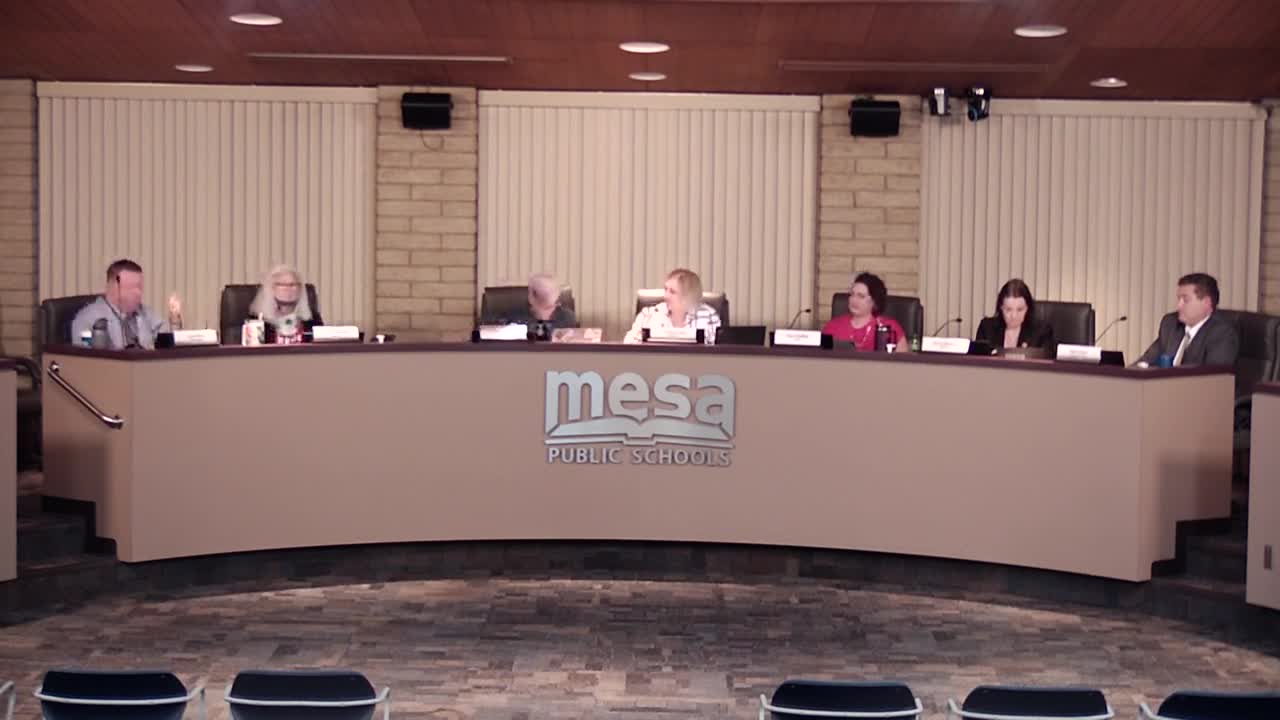
Summary
Board received an informational presentation showing $19 million in bond expenditures in FY25 and that remaining bond authority is zero as of June 30, 2025; staff outlined differences between bonds and capital overrides and flagged constraints on future revenue options.
Mesa Unified District finance staff presented the board with the district’s FY25 bond and override expenditure report during a special meeting on Feb. 24, 2025. The presentation was informational; there was no board action tied to the item. Staff summarized bond spending, remaining authority, and how the district is using override funds for salaries and security.
Mister Alexander, a finance staff member, reported the district spent just over $19,000,000 in bond proceeds during fiscal 2025. He said roughly $11.8 million of that was for construction and renovation and about $7,000,000 was spent on technology; the district did not purchase transportation vehicles with bond funds that year. Alexander noted that as of June 30, 2025, remaining bond authority was zero. “No money left as of 06/30/2025,” he said, noting the district has used bond proceeds over multiple years across 102 schools and buildings.
Override funding: staff described that the voter-approved maintenance and operations (M&O) override collected about $63,000,000 in FY25 and is being used to retain staff, support competitive salaries, school safety and security, and other operational needs. Finance staff translated that $63 million into an equivalent of roughly 731 teacher positions (including benefits) and said that without the override the district’s average class sizes would be higher. Alexander and Moore also described how Auditor General reporting rules affect average-teacher-salary comparisons and that changes in methodology can shift the district’s average on the state chart.
Board discussion centered on future capital funding options and constraints. Staff outlined the difference between bonds (debt instruments with principal and interest) and a capital override (a straight property-tax authorization without debt service interest, typically limited to seven years). They said a capital override could generate an estimated $40,000,000 per year under current figures, but would not provide interest-bearing debt; conversely, bonds can fund very large projects but incur interest costs. Staff also reminded trustees that state processes (including the State Facilities Board) and a recent court ruling challenging the state’s capital funding formula (referenced in the meeting) may affect future capital support but that any funding change from that litigation could be years away.
Trustees and staff discussed practical constraints: the district is at the 15% cap for M&O override capacity under state rules, limiting some specialty-override options; capital override rules and the district’s current funding mix will influence whether the district pursues a bond, a capital override, or other options. Several trustees requested additional education for the board on the State Facilities Board application process and more detailed analysis of denied/approved state applications.
There was no public comment on the item. The board closed the information item and proceeded to adjourn the meeting.