
Mesa Unified District approves 2024-25 annual financial report; board hears key budget highlights
Get AI-powered insights, summaries, and transcripts
Subscribe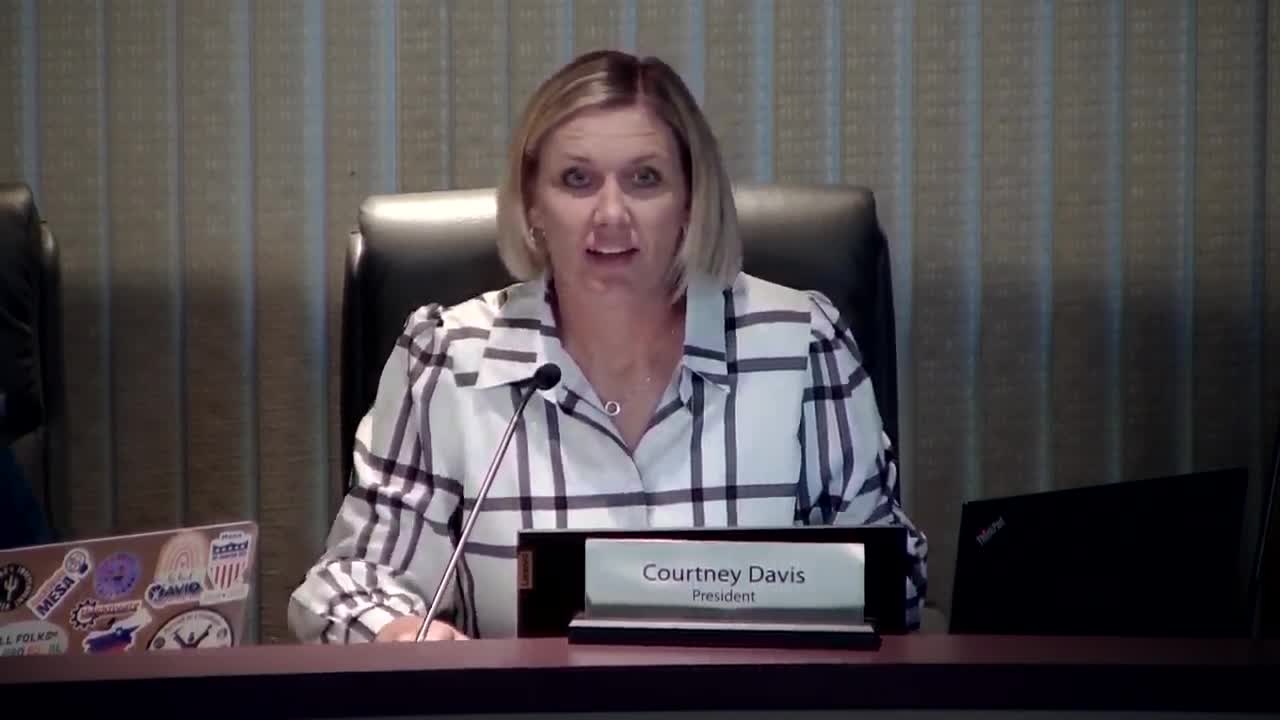
Summary
The Mesa Unified District board voted unanimously to approve the 2024-25 annual financial report and received a staff presentation summarizing reserves, capital spending pressures and risks to federal and sales-tax driven funds.
The Mesa Unified District Board of Trustees approved the 2024-25 annual financial report at a special board meeting on Feb. 24, 2025. The vote followed a presentation from district finance staff that summarized the district’s budget- and cash-controlled funds, capital spending and reserves. The report is required by state statute and will be submitted to the Arizona Auditor General and the Arizona Department of Education.
Board President Davis opened the meeting and noted the agenda included the annual financial report. Finance staff member Mister Moore led the presentation and said the annual package contains five reports that must be filed with state authorities. Moore told trustees the AFR shows the district carrying forward $47,000,047.05 in budget capacity while the cash balance tied to that budgeted capacity is approximately $33,000,000, creating what he described as a cash deficit relative to the budgeted carry forward. “That 47,000,000 represents 9% of our budget,” Moore said, noting best practice is often a 10–12% reserve given economic uncertainty.
Why it matters: the AFR documents how the district used state, local and federal funds during the fiscal year and is the official accounting that underpins later budget and outreach decisions. Trustees and staff focused on the district’s ability to absorb one-time costs, the sustainability of pay decisions funded from one-time or sales-tax-dependent sources, and upcoming capital needs.
Key figures and fund notes from the presentation: - Budget carry forward: $47,000,047.05 (reported as 9% of the FY25 budget). - Cash balance tied to that carry forward: about $33,000,000 (Moore said the district can spend up to the 47.5M budget capacity despite lower cash on hand). - Compensated-absence liability: roughly $22,000,000 (accrued paid-leave obligations). - Classroom Site Fund ending balance: about $52,000,000; per-pupil state allocation for that fund has risen from roughly $425 in FY21 to over $800 in more recent years. - The district currently obligates about 16.8% of a teacher’s salary from the Classroom Site Fund; the board used one-time Classroom Site Fund dollars for a $900 stipend in the past year to avoid creating ongoing obligations.
Moore explained the distinction between budget-controlled funds (formula-driven pools such as maintenance and operations, capital outlay and some grants) and cash-controlled funds (revenues minus expenditures, including rental revenue, school activity funds and long-term lease proceeds). He highlighted examples of cash-controlled fund uses: incentives to schools to increase facility rentals (a 70/30 split to return revenue to schools), long-term lease revenue (cell towers and other leases) applied to administrative capital needs, and Medicaid reimbursement used to offset eligible salaries. Moore also noted uncertainty in federal reimbursement levels and sales-tax volatility, which affect several cash-controlled funds.
Trustee questions and follow-up requests centered on bond and override reporting, the Auditor General’s reporting methodology and the long-term sustainability of using one-time funds for ongoing salary commitments. Member Hutchinson asked staff to clarify how voter-approved bond and override proceeds are shown in the AFR; Moore said that the AFR is cumulative and suggested a deeper dive in the following presentation. Hutchinson also requested a future report on energy savings from HVAC work funded with ESSER dollars; Moore agreed to provide that in a later update.
Public comment: none. Missus Chaffee announced, “We do not have anyone signed up to speak tonight.”
Board action: Trustee Jaffe moved to approve the 2024-25 annual financial report; the motion was seconded and passed by unanimous voice vote (five ayes). The board directed staff to file the AFR with the Auditor General and Arizona Department of Education and to provide follow-up information requested by trustees.
The presentation and discussion also flagged longer-term issues — notably, that capital expenditures are beginning to exceed state-allocated capital budgets and that reserves and carry-forward balances are being used to bridge gaps. Moore said those pressures and federal funding uncertainty will be topics in upcoming community budget meetings and future board budget discussions. “We are working to prepare the ’27 budget and will bring recommendations on how to align capital plans with our new budget reality,” Moore said.
The board adjourned the matter and moved to the information item on bond and override expenditures.