Finance committee pauses action, asks staff to prioritize revenue and cost options after forecast shows multi-year shortfall
Loading...
Summary
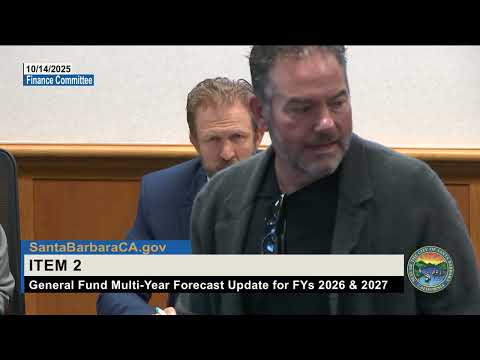
City finance staff told the Santa Barbara City Finance Committee on Oct. 14 that the general fund faces a growing multi-year deficit despite Measure I and presented a prioritized list of revenue and expenditure options; the committee voted to continue the discussion next week and asked staff to prioritize high-impact items for further study.
City finance staff told the Santa Barbara City Finance Committee on Oct. 14 that the general fund faces a growing multi-year deficit despite the recent passage of Measure I and recommended a mix of revenue and expenditure options for the committee's consideration.
Finance Director Keith Demartini and Budget Manager Natalia Glusick presented the city's multi-year forecast and a staff-prepared list of more than 200 ideas narrowed into three tiers of recommendations. The presentation said Measure I, a half-cent sales tax approved by voters and expected to generate just over $15,000,000 annually for essential services, helps in the short term but does not close projected gaps in fiscal years 2026 and 2027.
Staff reported a current general fund projection showing a use of reserves of about $1.6 million in the current year and an estimated deficit that staff now project could grow to roughly $10,000,000 for fiscal year 2026. Demartini told the committee that expenditures are growing faster than revenues, and that recent collective bargaining agreements for public-safety units (police and fire) cost more than the assumptions built into the adopted budget. Staff also flagged uncertainty about future FEMA disaster recovery funding, rising insurance and procurement costs, and an underfunded self-insurance reserve.
Glusick summarized staff recommendations grouped into tiers: small, quick-to-implement items (tier 1); items needing more study (tier 2); and longer-term or ballot-dependent options (tier 3). Examples included fee adjustments, reallocation of certain positions to enterprise funds, parking and waterfront pricing changes, reorganizations to increase revenue-generating capacity (for example, library rentals and merchandise), fleet and procurement efficiencies, and potential ballot measures such as a real property transfer tax, transient occupancy tax adjustments, or a vacancy tax. Staff noted the transfer tax concept would likely produce ongoing revenue; a vacancy tax is designed more to change behavior and is administratively complex.
Public commenters voiced a range of views. Several speakers urged a dedicated revenue stream for affordable housing and recommended pursuing ballot measures early because they require long lead times. Speakers with ties to Measure C's oversight urged the city to avoid using Measure C as a substitute for new voter-approved funds. Others urged caution in advancing major policy decisions (for example, rent stabilization) without clear funding plans.
Committee members asked staff to narrow priorities and to return next week with more focused analyses. The committee voted unanimously to continue the discussion to the regularly scheduled meeting next week, to keep public comment open for that meeting, and to provide staff direction on several near-term priorities and on which items the committee did not want pursued. Staff said they would prepare a Q1 fiscal 2026 report (to be presented Nov. 18 to the Finance Committee and Dec. 2 to the full City Council) that incorporates committee direction and more current Q1 financial data.
Committee members and staff flagged specific potential ballot measures to study further (including a real property transfer tax as a near-term option), recommended early outreach to affected commissions and stakeholders for enterprise fund changes (for example, harbor slip fees), and asked staff to return cost estimates for priority items. No formal votes on new revenues or cuts were taken; the committee's action was to continue and prioritize analysis.