Get Full Government Meeting Transcripts, Videos, & Alerts Forever!
Get email alerts on the Wetlands Bylaw topic
No spam. Unsubscribe anytime.
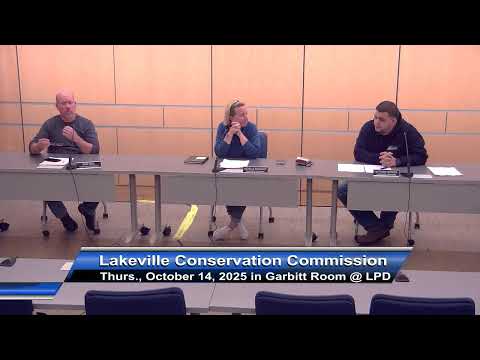
Lakeville conservation commission debates local wetland bylaw, agrees to start by ratifying state law
Summary
At its Oct. 14 meeting, the Town of Lakeville Conservation Commission discussed a proposed local wetland bylaw and the contested idea of a 25-foot "no-touch" buffer. The commission agreed to pursue adopting the Massachusetts Wetlands Protection Act locally first and to do outreach before proposing additional restrictions at a future town meeting.
The Town of Lakeville Conservation Commission discussed a proposed local wetland bylaw at its Oct. 14 meeting at the Lakeville Police Station, focusing on whether to adopt only the state Wetlands Protection Act or to add local rules such as a 25-foot "no-touch" buffer for shorefront properties.
Commissioners and staff described a split on the commission and in the community over how far local rules should go. Mark Minton, the commission's conservation agent and acting chair for the meeting, said the commission's first priority should be to "adopt and ratify the state Wetlands Protection Act" so the town has enforcement authority at the local level. "If we do not do that in town, we can't find individuals," Minton said, arguing that without a local bylaw the commission has limited enforcement options and must rely on the Massachusetts Department of Environmental Protection (DEP).
The discussion centered on two main options: (1) adopt the state law and associated DEP regulations as the town's bylaw, giving the commission local enforcement authority, or (2) adopt the state law plus additional local restrictions such as a 25-foot no-construction/"no-touch" buffer adjacent to resource areas. Several commissioners said a full 25-foot prohibition is likely to provoke strong opposition from lakefront property owners and could cause the measure to fail at town meeting.
Commissioners who opposed a strict local buffer urged a phased approach — "crawl, walk, run" — beginning with adoption of the Massachusetts Wetlands Protection Act and later considering targeted, narrowly defined local standards. Several speakers stressed the importance of clear definitions and exemptions, notably a definition of "new construction" and grandfathering rules for preexisting houses and small lot redevelopments. One commissioner suggested an exemption for long-standing preexisting uses and another recommended defining new construction to mean development of previously undeveloped land or consolidation of many small lots into larger, newly developed parcels.
Speakers also raised enforcement and legal concerns. Commissioners noted that any local buffer must be grounded in a demonstrated benefit to the resource to withstand legal challenge; one participant advised the commission to review case law and guidance (for example, materials available through the Massachusetts Association of Conservation Commissions) before drafting a stricter local rule.
Panel members discussed outreach and education as part of the strategy. The commission agreed to prepare comparative information about neighboring towns' bylaws and any local additions to DEP standards (commission staff agreed to prepare a table of surrounding communities and how they have implemented wetlands protections). Commissioners said outreach should explain that the goal is to protect drinking-water resources, reduce flooding risk, and improve water quality — not to "weaponize" enforcement.
The bylaw discussion also referenced recent enforcement-related matters the commission is monitoring. The commission continued a public hearing on a septic replacement at 4 Court Circle to Oct. 28 so the applicant can obtain an assigned DEP file number before the commission takes further action; Minton noted "there has not yet been a DEP number assigned to this project" and the hearing was continued to allow DEP input. Commissioners also said they will monitor a separate matter on Captain's Way that was handled as a constructive denial and is under DEP review (the commission discussed a 75-day review period following DEP's site visit).
The commission did not vote on a final draft bylaw at the Oct. 14 meeting. Members agreed to keep the wetland bylaw on future agendas, to conduct targeted outreach and comparative research on neighboring municipalities, and to consider a limited proposal at a future town meeting only after those steps.
Votes at a glance: - Opened public hearing for 4 Court Circle (notice of intent for septic replacement): motion carried (voice vote). Outcome: hearing opened. - Continued the 4 Court Circle hearing to Oct. 28, 2025, 6:30 p.m. at the Lakeville Police Station to await DEP file number: motion carried. - Accepted meeting minutes from July 22, 2025: motion carried; one commissioner abstained saying they were not present at the July meeting. - Added "new business" and "old business" as standing agenda items going forward: motion carried. - Voted to place reorganization (chair/vice chair discussion) on the Oct. 28 agenda: motion carried (roll call recorded: LeBlanc — aye; Knox — aye; Bouchard — aye; Matthew Ferrerra — aye; William LeBlanc — aye). - Motion to adjourn: carried.
What happens next: The commission set its next meeting for Oct. 28 at 6:30 p.m. at the Lakeville Police Station, where the hearing on 4 Court Circle will be continued and the commission expects to continue the bylaw discussion after staff compiles information about neighboring towns and DEP guidance. The commission also agreed to consider holding an informational session or special meeting to explain what adoption of the state Wetlands Protection Act would mean for property owners before presenting any local additions at town meeting.
Sources: discussion and motions recorded at the Town of Lakeville Conservation Commission meeting, Oct. 14, 2025 (audio transcript).