
Council Bluffs schools report stronger fall NWEA MAP baseline; leadership flags groups needing added support
Get AI-powered insights, summaries, and transcripts
Subscribe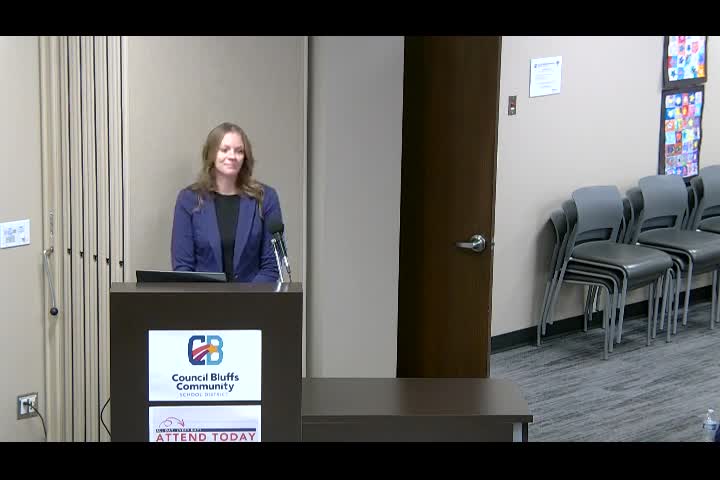
Summary
Council Bluffs Community School District Superintendent Dr. Murillo introduced a presentation of the district’s fall 2025 NWEA MAP baseline results and invited Dr. Matthews to present key findings to the board on Sept. 23.
Council Bluffs Community School District Superintendent Dr. Murillo introduced a presentation of the district’s fall 2025 NWEA MAP baseline scores and invited Dr. Matthews to present the data to the board at the Sept. 23 meeting.
Dr. Matthews told the board the MAP screener is administered three times a year and that the district would use the fall baseline to measure growth later in the year. She said the district set a stretch goal of 65% of assessed students scoring in the top bands on reading, math and science and presented the current baseline figures.
The nut graf: The district reported a stronger-than-recent start in fall 2025 after declines in 2023–24. The districtwide percentages in the top three performance bands were 60.11% in mathematics, roughly 59.7% in reading and just under 60% in science. Board and staff said the results show progress districtwide but that English-language learners (ELL) and students with individualized education programs (IEPs) remain the groups with the lowest performance and will be prioritized for targeted supports.
Dr. Matthews said the district is examining grade-by-grade and subgroup patterns. She reported that ninth grade was a notable strength (roughly 68.4% math and about 74.16% reading at the high school start), while second grade tended to show lower percentages in district fall screens. For science, she said the fall MAP administration begins in 2021 and that variability across grades has been smaller than in other subject areas.
On subgroup results, Dr. Matthews said students identified as ELL and students with IEPs had the lowest average performance across the three tested subjects. She described the district’s ongoing response: continued use of multi-tiered systems of support (MTSS), learning walks to align intervention with core instruction, and professional learning to address domain-specific gaps.
For next steps, the presenter described planned uses of a state comprehensive literacy grant for district-level planning, audits of literacy resources and additional professional learning. On mathematics she said the district has completed elementary math learning walks, is piloting new secondary materials for grades 6–12 and will continue aligning interventions to core instruction. For science she said curriculum maps were updated to reflect revised state standards and that the district has developed targeted professional learning based on ISASP domain analysis.
Board members and staff asked for additional reporting detail. One board member asked what “domain” meant; Dr. Matthews replied that elementary improvement work will focus on Earth science, middle school on life science and high school on physical science. Another board member suggested the board would like to see spring-to-fall transitions and growth comparisons once winter/spring assessments are available.
The presentation concluded with board praise for teachers and staff for progress since the pandemic-era declines and with the superintendent thanking classroom and building teams.
Ending: District staff said these fall baseline results will be used to target supports and to measure growth after winter and spring MAP administrations; staff and the board requested follow-up reports comparing spring-to-fall and year-to-year growth as data become available.