
Principals highlight report-card gains and push ‘no new instruction’ time to boost K–3 literacy
Get AI-powered insights, summaries, and transcripts
Subscribe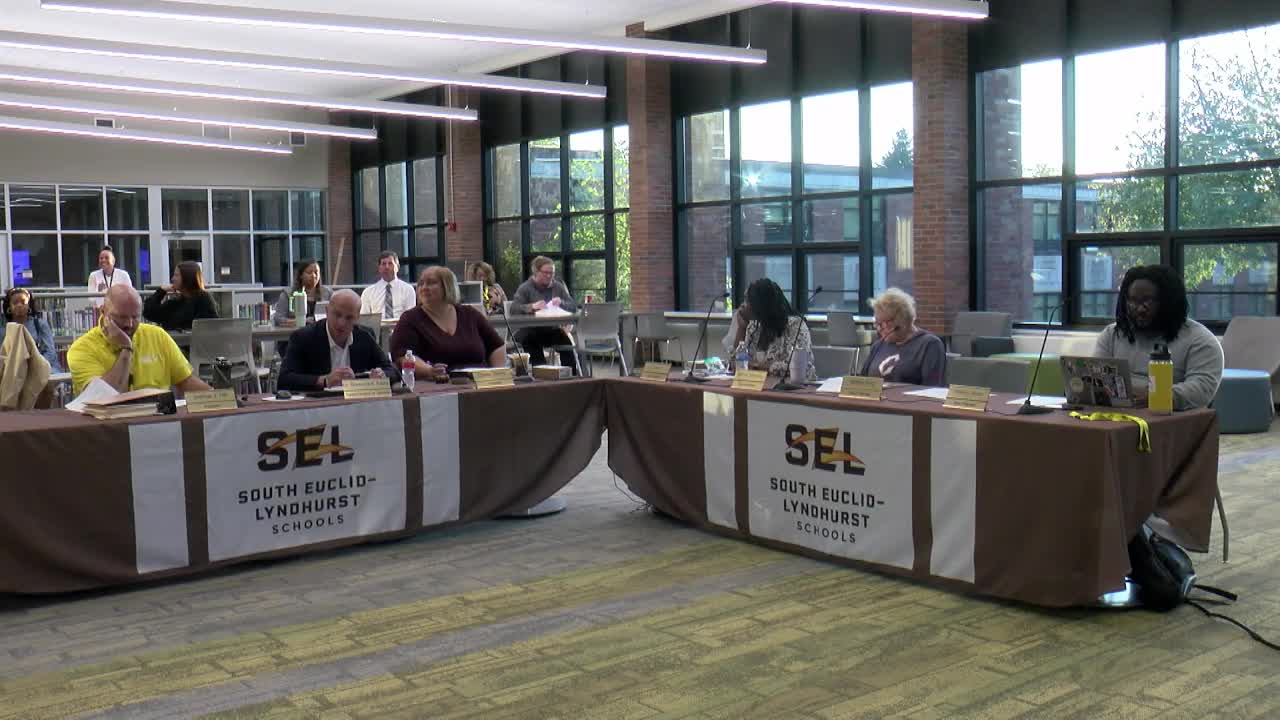
Summary
Principals for South Euclid-Lyndhurst City schools presented school-by-school report-card results Oct. 14, 2025, celebrating gains in several buildings, identifying gaps in K–3 literacy, and emphasizing a districtwide “No New Instruction” block to accelerate movement from limited/basic to higher performance bands.
South Euclid-Lyndhurst City Board of Education heard presentations from building principals on Oct. 14, 2025, detailing school report-card results and planned interventions to raise student proficiency.
The principals said the district’s emphasis this year will be on K–3 early literacy and a structured “No New Instruction” (NNI) block to provide real-time intervention and enrichment. Doctor Dominic Capel, Superintendent (as cited in the meeting introduction), opened the segment and asked principals to describe building strategies and outcomes. Principal Mark Lasky of Adrian Elementary said, “We earned 4 out of the 5 stars,” and reported an 89.7% performance-index score for Adrian, three-tenths of a percent short of a five-star rating.
Why it matters: State report-card star ratings and performance-index (PI) measures are used widely in Ohio to summarize school performance; moving students from limited to basic and from basic to proficient yields the largest gains on the report card. Principals emphasized fidelity to adopted curriculum materials, targeted small-group work during NNI, progress monitoring, and family engagement as levers to close gaps.
Key school highlights reported to the board: - Adrian Elementary (Principal Mark Lasky) — Reported 4 of 5 stars, PI 89.7%; school leaders flagged early-literacy (K–3) summer learning and chronic absenteeism as areas to address. - Roland Elementary (Principal Sylvia Marshall) — Characterized Roland as a “story of growth,” reporting a 24-point PI increase over four years and noting 71 students on literacy ramps who require targeted support. - SunView (Principal Erica Taylor) — Reported 4.5 stars, meeting 23 of 23 measures that contributed to a five-star achievement component; nearly half of students reached the “advanced” performance band in some grades. - Greenview (Principal Megan Young) — PI 69.9%, 0.1 percent shy of a three-star rating; successful acceleration programs for some students were cited, while leaders stressed co-teaching and equitable access to high-quality texts. - Memorial Middle School (Principal Doctor Fuller) — Reported gains including 100% Algebra I passage among students who took that exam and improved seventh-grade writing proficiency; introduced a literacy lab to support students not meeting benchmarks. - Brush High School (Principal Marnice Harris) — Reported a graduation-rate increase from roughly 90% to 94.4% and growth in certification completion (from 63% to 70.25%); leaders are adding career-technical offerings including a pre-nursing pathway.
Program and instruction details: Assistant athletic director Mark Jackson described a student leadership program (ARC Captaincy Student Athlete Association) focused on five core values — sportsmanship, respect, positive mental attitude (PMA), leadership, and hard work — that student-athletes developed and presented. Principal Fuller and others said the program pairs leadership development with school-improvement initiatives.
Principals and district curriculum leaders described instructional practices tied to growth: consistent use of HMH curriculum, text-dependent writing, I-Ready diagnostic pathways, progress monitoring, teacher common planning, and targeted intervention during NNI. Multiple principals stressed that “No New Instruction” time is intended to be a daily, consistent block used to pull small groups, monitor progress, and provide enrichment rather than introduce new grade-level material.
What the board heard as remaining challenges: across buildings, principals identified early-literacy ramp movement (K–3), chronic absenteeism, summer learning loss, and the need for consistent progress monitoring and fidelity to curriculum as the main barriers to higher star ratings.
No formal board action was taken on instructional programming during the presentations; the segment was informational and intended to set priorities for the year.
Ending: Board members and administrators said they will continue to monitor NNI implementation, fidelity to curriculum, and progress monitoring and will report back to the board on outcomes later in the school year.