Get Full Government Meeting Transcripts, Videos, & Alerts Forever!
Get email alerts on the Municipal Budget 2026 topic
No spam. Unsubscribe anytime.
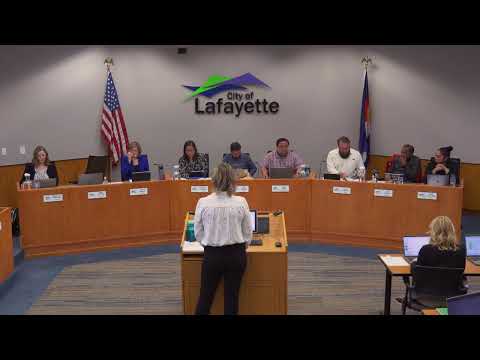
Lafayette council adopts $145 million 2026 budget; public urged greater climate-resilience funding
Summary
City Council held a public hearing Oct. 14, received budget presentation from staff, heard public comments urging more climate-resilience funding, and adopted Resolution 2025-62 setting the 2026 budget and mill levy and approved Ordinance 21 (first reading) appropriating funds for 2026.
The Lafayette City Council on Oct. 14 held a public hearing on the proposed 2026 budget, reviewed a staff presentation outlining a recommended $145 million budget, heard public comment urging greater funding for climate resilience, and unanimously approved Resolution 2025-62 adopting the 2026 budget and establishing the mill levy. The council also approved Ordinance No. 21, Series 2025, on first reading to appropriate funds for fiscal year 2026.
City staff presented a high-level overview of the recommended $145,000,000 budget, describing roughly $117,000,000 in supporting revenue and nearly $92,000,000 in dedicated utility and enterprise funds. Staff said sales-and-use-tax revenue was budgeted modestly — about 2% above the 2025 revised projections for retail sales — and property-tax revenue was estimated at about $14,300,000, a projected 4% increase over prior year due in part to reassessment cycles.
The presentation reviewed priorities including maintaining core services, conservative revenue forecasting, capital investments targeted at multimodal transportation and street rehabilitation (about $6 million proposed for pavement and safety projects), utility capital (water treatment planning and stormwater drainage work), public-safety planning (preliminary design for Fire Station 1), and facility lifecycle projects (boiler replacements, generator work, LED conversions). Staff said several limited new positions are recommended, including a sustainability-funded building-energy-code compliance position, converting a part-time court clerk to full time, and a part-time open-space programming position.
During public comment, Miranda Fan (vice chair, Sustainability and Resilience Board, speaking as a resident) repeated an earlier request that the council elevate three high-impact items from the adopted Climate Action Plan for budget priority: CR 3.2 (resilience hubs), CR 3.3 (enhanced emergency preparedness), and CR 3.4 (Boulder County vulnerability assessment implementation). Fan told council the budget “doesn't adequately fund the climate actions we committed to when we adopted the climate action plan last year” and urged placing those items in the capital plan and operational budget to improve community resilience.
Council members asked staff for clarifications on several points including midyear actuals for water and water-reclamation funds, assumptions behind revenue projections, and how resilience measures could align with capital projects (for example, the rec-center renovation). Staff said the city would provide supplemental information ahead of the Oct. 28 second-reading and budget-adoption meeting and that some budget elements (fee updates, the parks and recreation fee study) would return to council for further action.
Motion and votes: Councilor Barnes moved and another councilor seconded to approve Resolution 2025-62; the motion passed unanimously with “none opposed.” The motion to approve Ordinance No. 21 on first reading also passed unanimously. (Council members present recorded no opposition during roll call votes.)
Why it matters: The budget sets service levels, capital investments and staffing for the coming fiscal year and includes funding choices — notably conservative revenue estimates and planned investments in streets, utilities, and public safety — that will guide council decisions on fees and capital projects in coming weeks. Public-comments during the hearing flagged resilience hub development and emergency-preparedness items as priorities that some residents want funded before the Oct. 28 final adoption.
Next steps: The council will return Oct. 28 for a second reading, fees adoption, and final budget approval. Staff committed to providing additional financial detail and responding to council questions before that meeting.