
Englewood board receives annual ethics training from New Jersey school boards representatives
Get AI-powered insights, summaries, and transcripts
Subscribe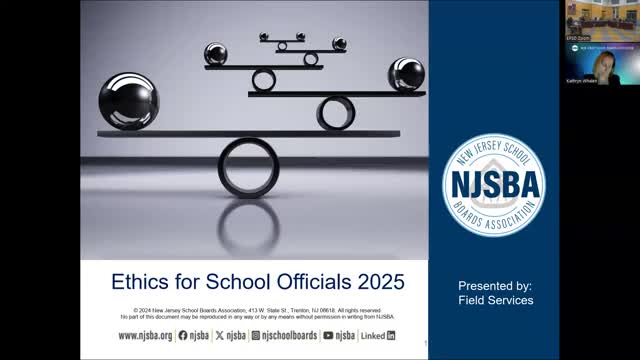
Summary
Board members attended mandatory ethics training from the New Jersey School Boards Association covering the School Ethics Act, disclosure requirements, advisory opinions, conflicts of interest, social media guidance and penalties for violations.
Charlene Peterson of the New Jersey School Boards Association and Kathy Whalen, director of the NJSBA legal department, led the Englewood Board of Education through the board'required ethics briefing during the Aug. 14 meeting, telling trustees this training is part of state mandates for elected school officials.
The session reviewed the School Ethics Act and the role of the New Jersey School Ethics Commission, disclosure and mandatory-training deadlines, the difference between abstention and recusal, conflicts of interest involving relatives and union members, guidance on volunteering and social media, and possible penalties for violations.
The training matters because board members are elected public officials whose decisions affect every student in the district and because the School Ethics Commission may issue advisory opinions and enforce the statute. Peterson told trustees, "you are elected public officials," and emphasized that the act holds members to a standard that includes avoiding not only actual conflicts but conduct that creates a justifiable impression of impropriety. Whalen walked the board through recent advisory opinions and concrete conflict scenarios.
Peterson outlined the key disclosure and training deadlines: new board members must complete an initial training within 90 days of taking office, with additional governance modules required in subsequent years; disclosure statements for potential financial or relative conflicts are public records filed with the commission; and advisory opinions may be requested in advance of a contested situation. She also summarized enforcement outcomes the commission can recommend to the commissioner of education, from reprimand and censure to suspension or removal.
Whalen discussed how conflicts involving relatives employed by a district are analyzed, noting that the commission's recent advisory opinions extend scrutiny even where a relative is not a union member because compensation and benefits can create shared interests. She explained the practical difference between abstention and recusal: "a recusal generally stated is when a board member has a legal conflict which prohibits them from being involved in the discussion or the vote, and abstention is something different," and urged members to ensure minutes reflect which applies. Both presenters urged trustees to obtain advisory opinions when unsure and to provide full facts to board counsel when relying on legal advice.
The training moved beyond legal technicalities to routine governance practices: limits on board members' involvement in employment matters, the chain-of-command expectation that complaints be addressed administratively before board action, and guidance about board members volunteering in schools (which may be permissible but can raise conflicts depending on duties and authority). Peterson and Whalen also reviewed social-media guidance: officials may speak on personal topics but should avoid posting about board business without clear disclaimers; if a disclaimer is used and then followed by board-related commentary, the disclaimer may be treated as ineffective.
Several examples and advisory-opinion summaries were cited during the presentation to illustrate common pitfalls: a board member who continued involvement in school activities after appointment; a former employee who becomes a board member and then publicly campaigns against the superintendent; and situations where a board member's relative appears on an employment list. Peterson noted the commission sometimes delays publicizing advisory opinions when it lacks a quorum of members to make them public.
Board President Bill Feinstein thanked the presenters; Peterson noted she is retiring from New Jersey school boards after 12 years of service. The board asked questions during and after the presentation; presenters encouraged trustees to contact the NJSBA legal office for follow-up and for advisory opinions when facts are uncertain.
The training concluded with a reminder that the statute is meant both to guide behavior and to preserve public trust in local boards of education.