
Auditor issues modified opinion after Englewood district data breach; board hears fund-balance breakdown and corrective actions
Get AI-powered insights, summaries, and transcripts
Subscribe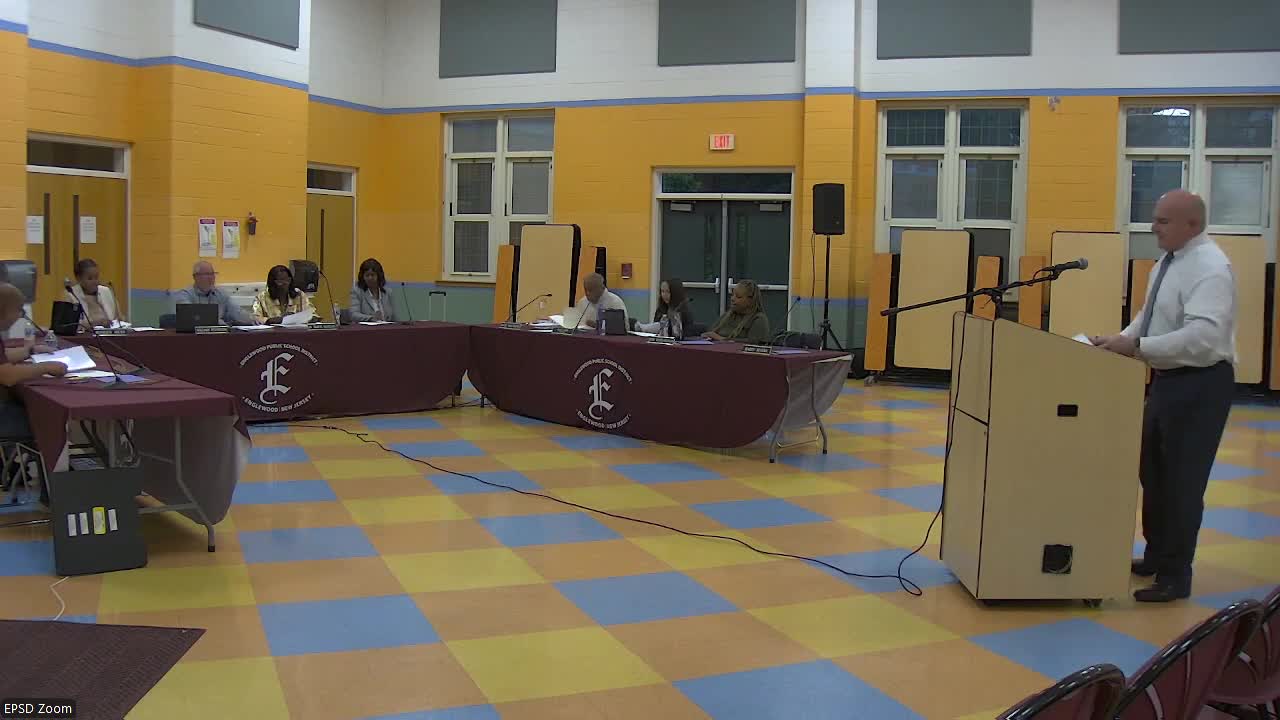
Summary
Auditor Andrew Parente presented a certified audit for Englewood Public School District's 2023-24 fiscal year, reporting a $13.9 million fund balance and a modified opinion tied to payroll reconciling issues caused by a data breach. The board reviewed recommendations, heard public concerns, and voted on a consent agenda that included acceptance of
Andrew Parente, the engagement partner from accounting firm Lurch, Vinci & Bliss, presented the certified audit for the Englewood Public School District for the year ended June 30, 2024, and said the district ended that year with a fund balance of $13,934,000.
The auditor said the firm issued a modified opinion on the financial statements because reconciling items and payroll allocation issues for April through June 2024 had to be estimated after a cyberattack. "That's a modified opinion," Parente said, adding the payroll totals were charged in full but the allocations among accounts had to be reconstructed because of the data breach.
The presentation and subsequent board discussion spent the bulk of the special meeting reviewing how the district arrived at that fund balance and how portions of it were designated and used. Parente walked members through the general fund budgetary comparison schedule and the components of the $13.9 million fund balance, including designated or reserved amounts for excess surplus ($1,000,006.90), a $3,000,000 designation that was used as operating revenue in 2024-25, capital reserves (about $1,000,006.82 plus $3,000,000 designated for a boiler project), maintenance reserves (about $428,000 plus $100,000 designated), encumbrances (approximately $1,300,000) and an unassigned fund balance roughly equal to the permitted 2% figure.
Parente said the district used about $8,000,000 of the 06/30/2024 fund balance as revenue in the 2024-25 fiscal year: roughly $3,000,000 to support operations, $3,000,000 for the middle school boiler replacement and other capital uses, and smaller amounts from maintenance and emergency reserves for projects and the cyberattack deductible. He said the district appropriated $250,000 of the emergency reserve in 2024-25 to address cyberattack-related costs.
Board members repeatedly sought clarification about how the $8 million figure was reached and whether the designation of funds had been planned when the 2024-25 budget was adopted. Parente and district staff explained that the "designated for subsequent years' expenditures" lines in the audited schedule represented amounts reserved in the 2023-24 audited year that were budgeted to be used in 2024-25. Parente said the encumbrances included in that total are purchase orders entered before year-end that will be paid in the subsequent year.
Parente described how the data breach affected audit procedures. Because the district's financial systems were compromised in April 2024, payroll and certain records for April through June were reconstructed from available documents and estimates. "Payroll information for the last three months of the year had to be estimated in terms of charging to the different accounts," Parente said. That reconstruction is the principal reason the auditors issued a modified opinion rather than an unmodified opinion.
The auditors' management report included recommendations and a corrective-action plan. Items tied directly to the data breach included documenting and implementing an IT disaster-recovery plan; completing payroll deduction ledgers and monthly bank reconciliations for the payroll agency account; reconciling federal payroll tax remittances to payroll records; retaining payroll records to support charges to payroll accounts; and enhancing internal controls to ensure encumbrances and purchase orders are reviewed and canceled if no longer valid. Other recommendations not related to the breach addressed timely grant reimbursement requests, food service fund controls, and student activity accounting.
Members of the public urged the board to clarify past communications and to move quickly on the auditors' recommendations. Donovan Rodrigues thanked the auditor for clarifying the numbers and called for implementation of the IT recommendations: "I'm just surprised, though, that we never had an IT disaster recovery plan," he said. Amy Bullock, a Highlander resident, asked the board to outline how it will reduce discretionary spending without cutting classroom instruction: "I would like to hear ... where we're gonna tighten our belt and not in areas that impact student education," she said.
Board members and district administrators noted that the 2024-25 year remains open; the business office will produce an unaudited estimate of the fiscal year ending 06/30/2025 fund balance after closing activity and accounting for encumbrances, likely between August 1 and September 1. Parente told the board that if 2024-25 operations were similar to 2023-24 the district could add roughly $2.3 million to fund balance; he also warned the board the number could be lower if operations produced a deficit.
The meeting included a consent-agenda roll-call vote after the board returned from executive session. The board administratively removed two consent items (25P92 and 25P93) before the roll call. The consent agenda as amended included, among other items, acceptance of the 2023-24 audit report (25F107) and approval of an acting business administrator (25P94). Several board members recorded exceptions to one or more consent items during roll call; recorded roll-call responses are reflected in the actions list below.
Votes at a glance The board moved and seconded the consent agenda as amended and conducted a roll-call vote. Individual members stated preferences on specific consent items during roll call; the board proceeded with the agenda after the roll call. See the actions section for the board's recorded votes on the consent motion and the audit acceptance and acting business-administrator items.
What happens next The audit report and the auditors' management recommendations are now part of the district's public record; the district included a corrective-action plan in the board packet. District staff said they will implement changes tied to the data-breach recommendations and will provide follow-up to the board as corrective steps are taken. The business office will close the 2024-25 year during July/August and provide an unaudited fund-balance estimate; the formal 2024-25 audited financial statements will be available after the auditors complete next year's engagement and present their report.