
Legislators Hear Plan to Let Claremont Tap Future State Aid to Cover $5M School Deficit
Get AI-powered insights, summaries, and transcripts
Sign Up Free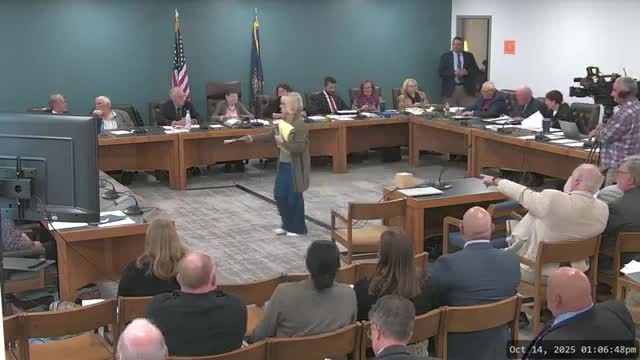
Summary
Senate Education Committee held a public hearing on legislation (amendments to HB 292 and HB 2978/3004h) that would let the Claremont School District borrow against future state adequacy payments to cover short-term cash shortfalls after auditors discovered roughly $5 million in unrecorded liabilities.
Senate Education Committee Chair Senator Rebecca Ward convened a public hearing Tuesday to consider emergency legislation that would allow the Claremont School District to access a revolving fund secured by its future state adequacy payments as it works to cover an estimated $5,000,000 deficit and keep schools open through the year.
The hearing centered on a proposed “adequacy revolving loan fund” included in a senate amendment (2978s) to House Bill 292 and an expanded house amendment (3004h). Jamal Shaughnessy, attorney for the Claremont School District, told the committee the district faces an immediate cash-flow crisis after auditors and new administrators identified years of accounting breakdowns and unrecorded vendor obligations.
"The district spent millions of dollars that they never had," Shaughnessy said, summarizing findings compiled by interim district leaders and the new business administrator, Matt Angel. "We are asking for a revolving mechanism to access funds the district is already entitled to receive under current state law."
Why it matters: the district, which receives approximately $16 million in state adequacy aid annually, has used a short-term reimbursement anticipation note (RAN) from Claremont Savings Bank to meet payroll and vendor obligations this fall. That RAN is limited to $4,000,000 and must be repaid in April, leaving the district vulnerable to a repeat cash squeeze in spring and early summer when teacher contracts and commitments for the next school year are issued.
Nut graf: The legislative amendments would let Claremont draw against future adequacy distributions on a temporary basis, with interest set by the state treasurer and reporting requirements to the Department of Education and state treasury. Supporters say the change is narrowly tailored to prevent school closures and protect students; critics warn it could create precedent and want stronger safeguards and broader policy reforms to avoid similar crises elsewhere.
What the district reported
Shaughnessy and Matt Angel, the district’s business administrator, described a chain of problems the new leadership encountered after taking control of the SAU 6 business office this year. Angel told the committee that when he began reconstructing the general ledger and bank reconciliations, he found unpaid vendor invoices and accounting entries that left the district unable to reconcile its bank balance with its reported fund balance. "One document showed a $390,000 fund balance while the bank account for the same period showed a negative $2,500,000 balance," Shaughnessy said.
Angel said the current working estimate of the gross deficit is about $5,100,000 and that, after aggressive operating cuts and other actions, the district now projects an approximate $1,900,000 year-end shortfall. Contributing items included special education costs, unrecorded health insurance and retiree health obligations, grant reimbursements denied for filing noncompliance, and earlier misstatements that set the 2025 local tax rate too low.
Actions already taken
The district has closed Bluff Elementary School, reduced staff through nonrenewals and layoffs (about 40 positions cited), paused many extracurricular expenditures, and relied on community donations to fund some athletics and arts activities. The Stevens High School Alumni Association is serving as a fiscal sponsor for donations; Angel reported approximately $93,000 raised for athletics and $52,000 for music and arts, plus a $100,000 gift from Claremont Savings Bank.
Proposed state mechanism
Under the amendment language discussed (2978s, with house changes in 3004h), the state would create a Claremont School District Adequacy Revolving Loan Fund administered by the state treasury. Districts would be able to borrow against up to a capped share of their future adequacy payments; the state treasurer would set an interest rate "based on the state's current cost of borrowing," and the department and treasurer would require monthly reporting of deficit status, cash flows and audit progress. The house draft adds a provision that the Department of Education and treasurer may withhold further loan advances if the district fails to comply with reporting terms.
Treasurer Monica Mizzapalli said the mechanics would use municipal market yields as a proxy for interest and that advances would be repaid by offsetting future adequacy disbursements. "When it's time to disperse the actual aid, those funds will be subtracted from what's owed, principal and interest," she said. She and Mark Manganel of the Bureau of School Finance said the amount placed in the revolving authority would be set by conversation among the district, DOE and the treasurer and that Claremont would likely seek advances on next fiscal year adequacy to cover the April–September cash window.
Accountability and oversight
Supporters including state and local education representatives emphasized urgency to prevent another disruption to students. "This is not a giveaway," Representative John Cloutier said, calling the proposed fund a repayable loan to keep schools open.
Several legislators and witnesses urged stronger statewide controls and clearer guardrails. Representative Lisa Topovich and others pressed for broader policy reforms, including tighter state oversight of audits and financial reporting to prevent similar failures. Shaughnessy and DOE staff noted the district has contracted independent reviews, is finalizing outstanding audits, and is implementing internal controls such as two-factor approvals for disbursements and completed health-insurance reconciliations.
Public testimony
Megan Tuttle, president of NEA New Hampshire, testified in support of the amendment, citing community donations and staff efforts to keep classrooms functioning. Community members and several local and state representatives described the situation as unprecedented for Claremont and urged passage with accountability conditions.
Questions and timeline
Committee members asked about interest rates (the five-year municipal yield was cited near 2.3% as a proxy) and how much the district could draw and when. Officials said Claremont has already received its first adequacy payments for the year and that the pressing window for cash is April through August, when the district must repay the bank RAN, issue contracts and pay summer obligations. The amendments as discussed include sunset and repayment dates that were modified during the hearing.
Committee disposition
At the close of the hearing the Senate Education Committee did not enter executive session; the chair said members would consider the testimony and schedule executive session at a later date. The committee will also consider amended language adding monthly reporting requirements to the treasurer and DOE and an enforcement mechanism to withhold future advances if reporting is not provided.
Ending
The proposed revolving fund is narrowly aimed at providing Claremont a bridge against short-term cash flow shocks while the district completes audits and implements controls. Lawmakers on both sides signaled willingness to act quickly to avoid another school-year disruption, but many also called for broader review of school finance oversight to reduce the chance of repeating Claremont's experience.