
Zionsville BZA denies variance to waive public water, sewer for proposed duplexes at 7615 Fayette Road
Get AI-powered insights, summaries, and transcripts
Subscribe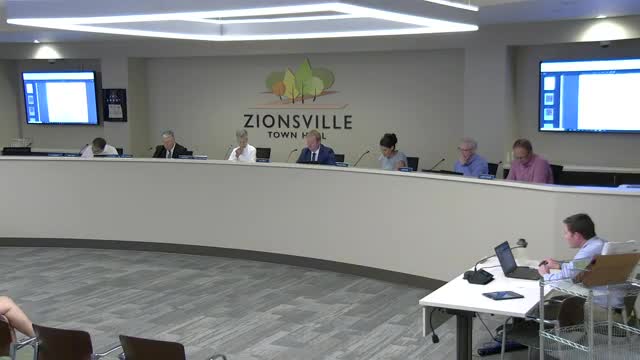
Summary
The Town of Zionsville Board of Zoning Appeals denied a petition to waive the requirement for public water and sewer for a proposed duplex development at 7615 Fayette Road after neighbors raised concerns and board members questioned the claimed hardship.
The Town of Zionsville Board of Zoning Appeals on an October evening denied a request to waive the zoning requirement for public water and sewer for a proposed duplex development at 7615 Fayette Road.
The petition sought a development standards variance that would allow up to five two-family dwelling buildings (ten dwelling units) on the roughly 8.5-acre site without connecting to public water and sewer. A board member moved to deny the variance and another member seconded; the board voted to deny the petition as presented.
Staff described the request as a development standards variance, not a rezoning, and said the petitioner would still need health-department permits for wells and septic even if the variance were granted. "This is not a rezoning," the staff member told the board, and added that the Boone County Health Department issues permits for wells and septic and that any well/septic work must meet that agency's standards.
Staff told the board it viewed the three required variance criteria as met: it did not expect an injurious public-health impact because health-department permits are required, it did not expect adverse impacts on adjacent property values, and staff believed an unnecessary hardship existed because public utilities are not available without approvals from Whitestown and state authorities. The staff report cited the zoning ordinance (Table 4, §194-82) as the source of the public water/sewer connection requirement for two-family and multifamily dwellings.
The petitioner and project engineer told the board the property lies outside Whitestown's certified utility territory and that Whitestown is not extending service at this time. The petitioner said separate wells and septic fields were planned for each building and that a preliminary soil test submitted to Boone County had been favorable. "We've had 1 small report already completed and submitted to Boone County Health Department and it's favorable," the petitioner's representative said.
Neighbors who spoke at the hearing strongly opposed the variance. Karen Everett, who lives directly across the road and owns adjacent acreage, said she was concerned about introducing higher-density, well-and-septic development into the area and questioned whether the soil would support multiple septic fields. "If Zionsville opens up to micro developments like this one, where does it stop?" Everett asked. Sally Myers, another adjacent resident, told the board the area is in drought and neighbors are concerned about the water table. "We are all very concerned about the water table right now because it's low," Myers said.
Several board members said they were sympathetic to the petitioner's position but not persuaded that an unnecessary hardship existed because the property could be developed under the zoning ordinance without the requested variance. Staff and the petitioner both noted the zoning district allows two-family dwellings if public utilities are available; board members observed the parcel also could be subdivided and developed with single-family homes that meet the town's two-acre minimum for single-family lots.
After discussion the board denied the variance. The record shows neighbors raised concerns about septic feasibility and groundwater during the public hearing; staff noted the petitioner had one favorable test but would require additional county health approvals, and the petitioner said Whitestown is not prepared to extend services now.
The board's denial leaves the property's existing development options intact: the zoning allows two-family dwellings only where the development standards for public utilities are met; absent that, the owner would need to pursue single-family subdivision or await an extension of public utilities.
Votes at the meeting and motions are recorded in the board minutes.