Get Full Government Meeting Transcripts, Videos, & Alerts Forever!
Get email alerts on the Public Meetings topic
No spam. Unsubscribe anytime.
Sarasota commissioners receive training on Robert’s Rules, Sunshine Law and charter roles
Summary
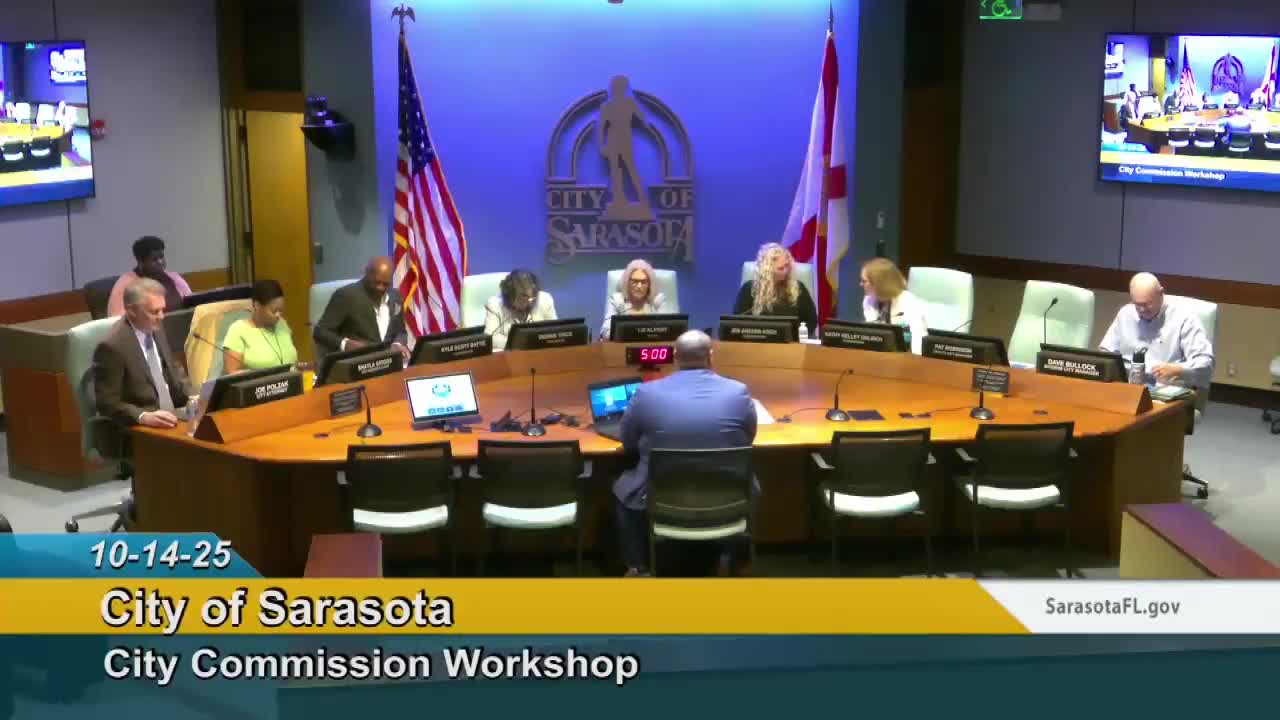
At a City Commission workshop Oct. 14, attorney Randy Mora gave a training on ethics, open‑meetings requirements and meeting procedure, emphasizing public trust, limits on private discussions and the roles of charter officers. No formal votes were taken.
Sarasota — At a City Commission workshop on Oct. 14, 2025, the commission invited attorney Randy Mora to deliver a training on Robert’s Rules of Order, the Sunshine Law and related ethics and meeting‑management topics.
Mora, who described himself as certified by the Florida Bar in city, county and local government law and as a city attorney in Pinellas Park, framed the session around the idea that "a public office is a public trust," and urged commissioners to let that principle guide meeting conduct and decision making. The presentation was introduced by City Attorney Joe Polozak and attended by Mayor Alpert and commissioners.
Mora told the commission the session was intended to help officials and staff build shared expectations about how meetings should run, and to explain where Robert’s Rules fits among constitutions, statutes, the city charter and the commission’s own rules. "Robert’s Rules is last," Mora said, explaining that constitutional and statutory requirements — including open‑meetings and public‑records laws — take precedence over standardized parliamentary manuals.
Why it matters: Mora emphasized that open government rules are designed to preserve public trust and to prevent decisions behind closed doors. He reviewed Florida’s constitutional mandate that municipal meetings where public business is transacted be open, cited the state ethics code (Chapter 112) and the public‑records statute (Chapter 119), and described the Open Meetings/Sunshine Law (Chapter 286) as broadly construed to prevent evasive devices that close deliberations to the public.
Key points covered
- Public trust and conflicts: Mora said public officials must avoid actions where private interests would "tend to lead to disregard of a public duty." He distinguished lawful advocacy for community goals from conflicts requiring recusal.
- Charter officers and organization: Mora outlined the roles of the commission and charter officers under the city charter — city manager, city auditor/clerk and city attorney — stressing that the commission sets policy while the manager administers day‑to‑day operations.
- Meetings and notice: Mora reviewed basic meeting requirements (reasonable notice, public location, minutes, and a reasonable opportunity for public comment before official action). He warned that local "workshops" or "work sessions" are still public meetings under the law and, depending on local rules, may require the same legal safeguards.
- Sunshine Law risks: Mora repeated judicial guidance that the law applies to any gathering of two or more board members where matters that could foreseeably come before the body are discussed, and said commissioners should avoid serial or indirect communications that achieve what a quorum could not do in public. He quoted a judicial admonition he said became well‑known in recent cases: "If ever you are in doubt that you are at a legitimately held public meeting ... leave. Leave."
- Quasi‑judicial hearings and evidence: He explained the difference between legislative and quasi‑judicial matters, urged commissioners to focus on the established criteria and on "competent and substantial evidence" in quasi‑judicial hearings, and noted that abstentions are sometimes appropriate in quasi‑judicial matters when a commissioner cannot be impartial.
- Agenda, motions and amendments: Mora reviewed meeting flow — agenda, staff presentation, public comment, debate, motions, amendments and votes — and reminded the body that only one motion is properly pending at a time and that amendments that materially alter a proposal should prompt renewed public comment on the changed issue.
Questions and operational notes
Commissioners raised practical questions about how workshops handle public comment, whether the commission’s clerk or other staff should take minutes or deputize minute takers, and how to treat written materials submitted before hearings. Mora advised uniformity in public‑comment practices and said written evidence intended for the record should be submitted in advance according to published rules so it is part of the evidentiary record.
Mora also addressed a recent state court decision affecting open carry rules and noted local attorneys and policing organizations are seeking legislative fixes; he urged the commission to follow guidance from the city attorney’s office as the statutory landscape evolves.
Training follow‑up and next steps
Mora said the session was not a substitute for required ethics or Sunshine Law training and noted the Florida League of Cities offers a four‑hour webinar; he said he will provide additional, tailored trainings for the commission’s boards and panels and hopes to present similar sessions annually. No formal action or votes were taken during the workshop.
Ending
The workshop provided commissioners with a refresher on the legal foundations and practical mechanics of municipal meetings, from ethics rules and charter‑defined roles to the Sunshine Law and parliamentary practice. Mora urged commissioners to err on the side of transparency and to use their charter officers — manager, clerk and city attorney — to preserve orderly, legally defensible decision making.