Get Full Government Meeting Transcripts, Videos, & Alerts Forever!
Get email alerts on the Commission Governance topic
No spam. Unsubscribe anytime.
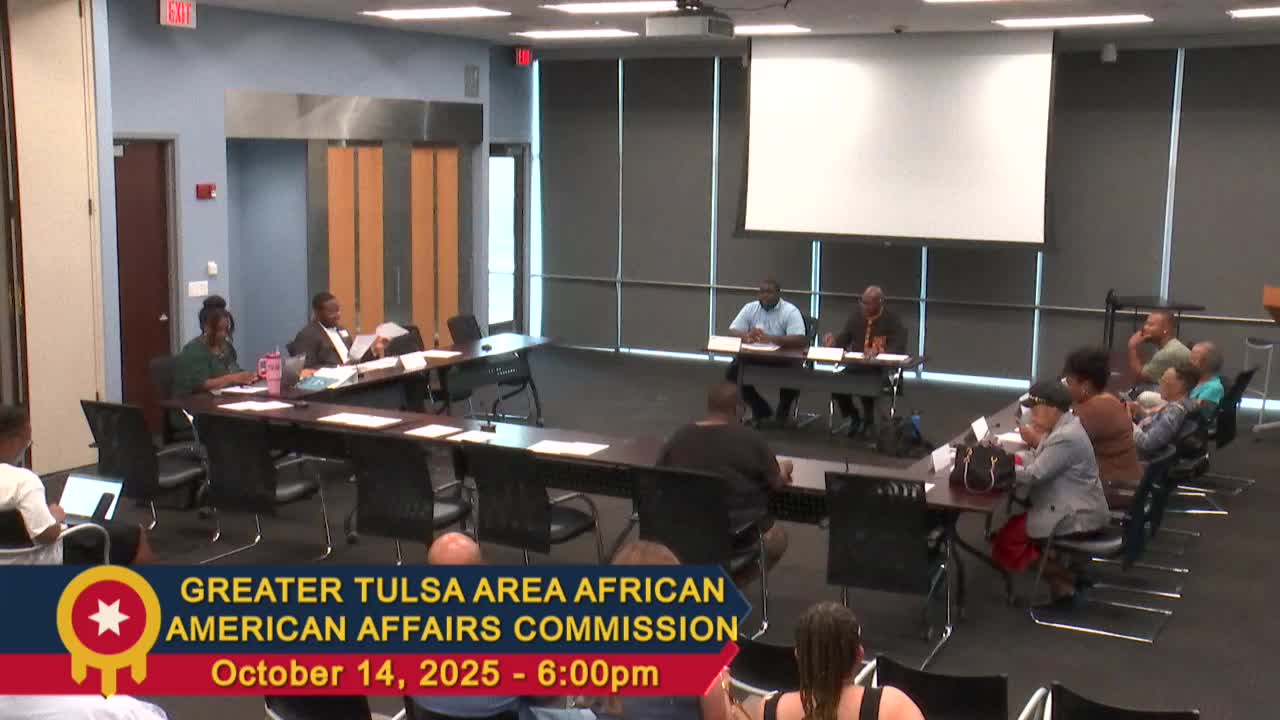
Tulsa African American affairs commission outlines nominating-timeline, urges stronger committee engagement; discusses changing organization seats
Summary
The Greater Tulsa African American Affairs Commission discussed leadership succession planning, stepped-up committee outreach and the limits on changing organization seats during its most recent meeting.
The Greater Tulsa African American Affairs Commission discussed leadership succession planning, stepped-up committee outreach and the limits on changing organization seats during its most recent meeting.
Chair Dr. Dickens told commissioners the nominating committee that will assemble candidates for the next chair and vice chair will be selected at the commission's November meeting and that the full commission will vote on officers in January. "We will have a nominating committee that will be selected at the next meeting, in November," he said, noting the nominating group is typically three people.
The chair framed the discussion in the context of stronger committee work and community engagement. "The committees are where the work happens," Dr. Dickens said, urging commissioners to use committee meetings to develop proposals and bring community voices forward rather than trying to do that only at the full-commission meeting.
Why it matters: the nominating timeline determines who will set the commission's agenda next year; strengthening committee processes shapes how the commission develops recommendations and conducts outreach in Tulsa's African American communities.
Commissioners described concrete steps committees are taking and the value of cross-committee networks. Commissioner Love said she and others would support a new chair and remain engaged as past leaders; Commissioner Humphrey and Commissioner Dennis both praised efforts to invite community experts into committee work so the commission can better understand technical issues and avoid relying only on personal opinion. "When we invite the community in to give their feedback... it helps us to be able to understand complex systems a little bit better," Commissioner Dennis said.
Culture and outreach work: Larissa (identified in the meeting as the culture committee chair) and Kim McCullough reported on an updated newsletter and distribution plans. Kim created an email list for commissioners and community members; the committee is exploring library branches and other locations to distribute physical copies and plans an in-person event after moving away from a previously planned spoken-word contest. The culture committee listed a set of Othello performances and confirmed planning work for a community event on Friday, Oct. 17, with details to follow.
Education committee: Commissioners said the education committee is working on an op-ed and outreach about chronic absenteeism, and that Tulsa Public Schools staff have offered to present the district strategic plan to commission committees at a future meeting.
Organization-seat rules and process limits: the commission discussed empty or inactive organizational seats and the difference between recommending changes and making them. Dr. Dickens explained that the ordinance that established the Greater Tulsa African American Affairs Commission sets the number and type of organization and individual seats; changing an organization seat to an individual seat requires an ordinance change and action by the mayor and City Council. "Even the mayor saying we're gonna change it, it doesn't work. The mayor is the one who's making the recommendation to the city council," he said, adding that while chairs can recommend changes to the mayor, the ordinance and council review are required for formal seat changes.
Commissioners noted several practical constraints: some organizations said they cannot name a representative until 2026; other organizations are inactive; and council review panels evaluate nominees' attendance records and reasons for service when recommending appointments to the mayor. The chair said the commission will prepare lists of recommended individuals and organizations for the mayor to consider and that staff will distribute the current seat list to commissioners.
Public events and recognition: commissioners highlighted upcoming and recent community events, including an educator awards ceremony scheduled for Oct. 28 at 6 p.m. in the city council chambers and a planned Human Rights Commission event in December to honor Commissioner Wallace. Commissioners encouraged attendance and participation in community programs, and several speakers described civic and cultural events run by partner organizations.
What the meeting did not do: no ordinance or membership rule changes were adopted at the meeting; the discussion of seat conversions remained a procedural update and set of recommendations to be forwarded to the mayor and city council as required by the ordinance.
Ending: commissioners agreed to continue the committee-driven approach and to provide the mayor with recommended nominees and organization updates as the commission refines its membership roster.