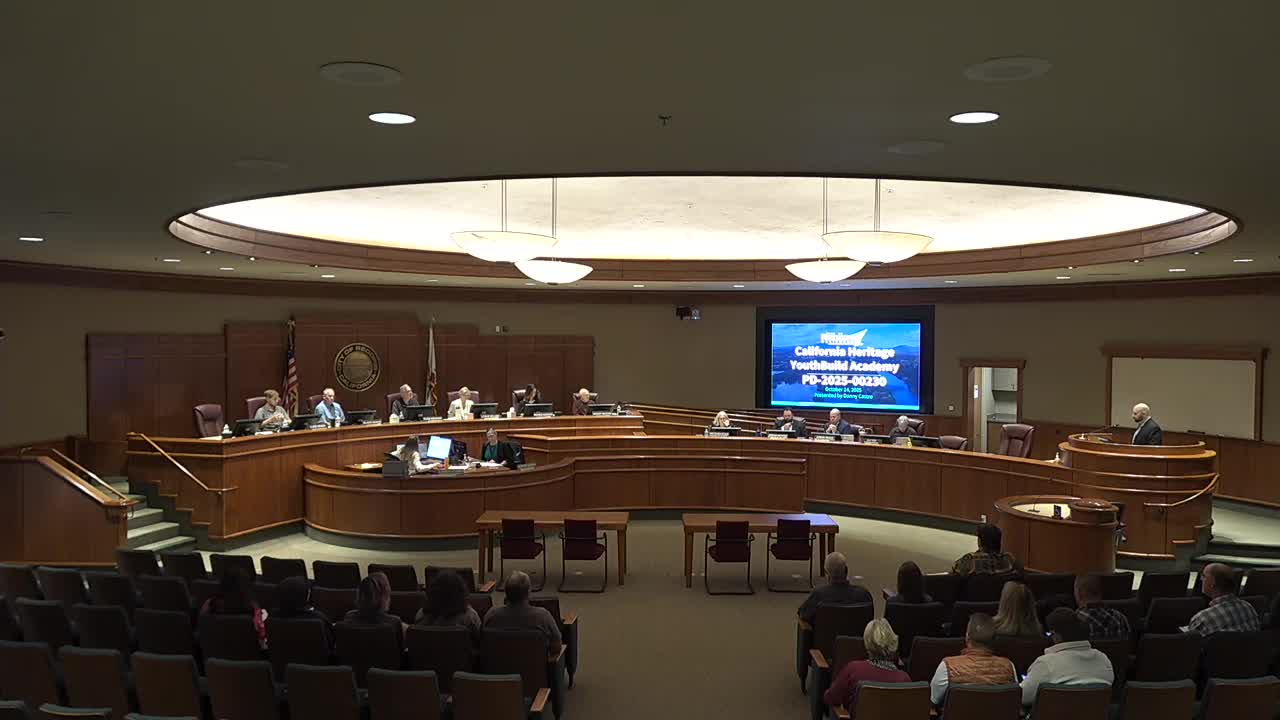
Planning commission approves CHIBA charter high school at 1400 Industrial Street with mitigation, fencing and lighting conditions
Loading...
Summary
The City of Redding Planning Commission approved a plan-development application for the California Heritage Youth Build Academy (CHIBA), a proposed 36,000-square-foot charter high school at 1400 Industrial Street, adopting a Mitigated Negative Declaration and conditions addressing tree protection, a 10-foot buffer yard, fence standards and future,
The City of Redding Planning Commission on a unanimous voice vote approved a plan development application (PD 2025-230) for the California Heritage Youth Build Academy, a proposed 36,000-square-foot charter high school at 1400 Industrial Street that would include classrooms, offices, a dining area and a gym.
Staff presented the project as a grant-funded charter high school with a maximum enrollment of 290 students and an anticipated maximum of about 130 students on campus at any given time. The site plan includes a parking area, a soccer field and basketball courts and will require a box culvert crossing over Little Churn Creek for Industrial Street access. Staff recommended adoption of a Mitigated Negative Declaration under the California Environmental Quality Act and a mitigation monitoring program; the commission accepted that recommendation and approved the application with added conditions.
The school site is zoned RM-9 PD (residential, multifamily, planned development overlay) and has a General Plan designation for 6–10 units per acre. Staff said the zoning allows schools in RM districts and that the plan-development overlay provides discretionary review because the parcel abuts single-family neighborhoods. The city’s presentation noted that the project would support pedestrian and bicycle connectivity by grading and preparing segments of a future city-funded bike/pedestrian trail that will link Del Monte and Alfredo/Industrial corridors.
Commissioners and staff discussed circulation, tree impacts, buffering and fencing. Staff said the site currently contains 294 trees, of which 81 are proposed for preservation and about 213 would be removed because of grading needed to create a large “super pad” for the building. To reduce impacts to adjacent single-family lots, the conditions require a 10-foot buffer yard along the north and east property edges with a “solid” six-foot barrier and additional landscaping; staff explained that, because this is residential-to-residential adjacency, the director has discretion to allow a solid wood fence rather than a concrete block wall when the director finds it adequate.
The commission added two explicit, written conditions to the approval after discussion: that any future security fencing be “decorative and placed near the edge of or interior to the area of hardscape improvements,” with final fence design subject to the Development Services Director’s approval; and that any future outdoor facility (stadium-style) lighting meet the city’s commercial lighting requirements in the zoning code (section 18.40.90 referenced in staff comments). Staff and applicant representatives said the project as proposed has no stadium lighting and that public uses of fields would be evaluated later.
Environmental review: staff reported a Mitigated Negative Declaration addressing potentially significant impacts, including to birds and bats, and that mitigation measures are incorporated into the project’s mitigation monitoring program. Staff noted no on-site wetlands but said some off-site work occurs in the Little Churn Creek corridor; that off-site work was previously covered under the Center of Hope project’s adopted environmental review.
Public comments: a neighbor raised concerns about noise, vandalism and wildlife displacement and preferred a taller, masonry wall to reduce noise and dust during construction. Project representatives said they had answered the neighbor’s questions and that some concerns (for example, a specific tree) were addressed by the plans. The applicant’s project team said the project expects to rely on multiple grants including funds from the Office of Public School Construction and that the applicant has financing in place for the next step: "We have a 30,000,000 grant. Half of it is loan, half of it is grant," the applicant said during the hearing.
Outcome and next steps: the commission adopted the Mitigated Negative Declaration, the Mitigation Monitoring Program and approved PD 2025-230 subject to the staff conditions as amended at the hearing (including the added fencing and lighting language). Staff and the applicant will next complete construction plan review and required permit approvals, and the project will coordinate the culvert/Industrial Street improvements with the separately permitted Center of Hope street work.
Why it matters: the decision clears the way for a new charter high school campus in an infill location adjacent to existing neighborhoods and links the site to planned bicycle and pedestrian improvements; the commission’s added conditions reflect neighborhood concerns about buffering, fencing, lighting and long-term campus security.