Get Full Government Meeting Transcripts, Videos, & Alerts Forever!
Get email alerts on the Utah Olympic Park topic
No spam. Unsubscribe anytime.
Planning commission delays decision on Utah Olympic Park development agreement amendment after public concerns
Summary
The Snyderville Basin Planning Commission took public testimony Wednesday on a proposed Fourth Amendment to the Utah Olympic Park (UOP) development agreement and agreed to continue consideration to Nov. 25 after residents raised questions about parcel locations, visibility, traffic and wildlife.
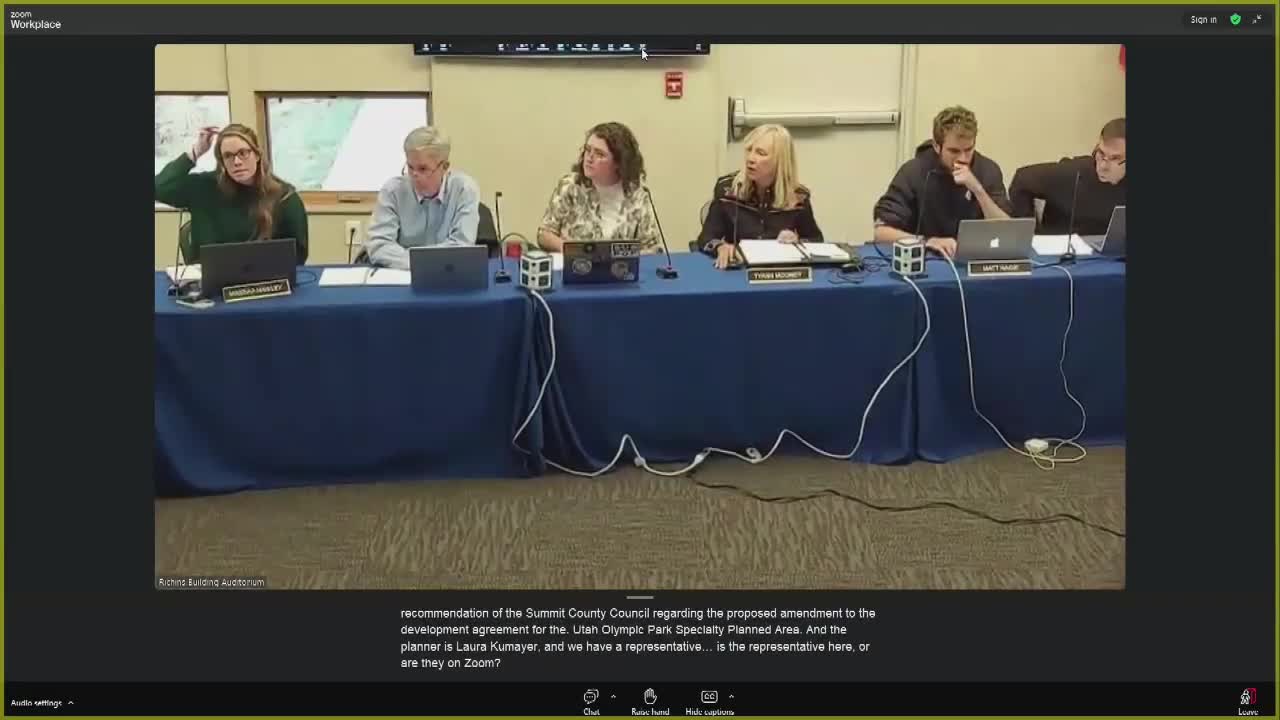
The Snyderville Basin Planning Commission on Oct. 14 heard a lengthy presentation and public testimony on a proposed amendment to the Utah Olympic Park (UOP) development agreement and agreed to continue the item to Nov. 25 for more study and public outreach.
The change the applicant seeks would consolidate and relocate several developable parcels, set new maximum building area limits, designate additional ski runs and lifts, clarify where a hotel and support facilities could be built, and request that the county designate the park a state-recognized "major sporting event venue" to enable potential tax-increment financing tools.
Planning staff explained the amendment updates a master conceptual plan that originally established development rights in 2013 and that the applicants are asking the commission to clarify how those rights are exercised today. Laura Kuhmyer, the county planner on the item, told commissioners the most consequential outstanding technical question is how "maximum gross building area" (a term used in the original development agreement) should be interpreted for modern floor-area calculations; she said staff and the applicant have different readings and that legal counsel and council will need to resolve that interpretation. The applicant described a reduced commercial footprint compared with earlier plans and said much of the new square footage would be athlete support, workforce housing and a hotel and conference center to support park operations.
Applicant representatives said the amendment is intended to make the park financially sustainable and to support athlete training, community recreation and year-round programming. They presented a conceptual buildout that includes a roughly 120-key hotel and related conference space, roughly 230,000 square feet of commercial/lodging floor area (applicant estimate), and additional athlete and workforce housing and shop/support areas. They said the hotel would be condominiumized and would be managed by a hospitality partner; proceeds or tax tools tied to the venue would be used to offset park operating deficits. The applicant also emphasized that the proposal reduces some previously envisioned office/medical space and increases on-site housing, which the traffic consultant said may reduce overall vehicle trips compared with older approvals.
Residents who live near the park raised a range of concerns during public comment: visibility and massing of new buildings on the upper parcels, potential impacts on a known moose birthing and wildlife corridor, construction and long-term traffic impacts (including potential shortcutting through the Bear Hollow/Back Gate area), impacts to training programs if the freestyle pool or other facilities are taken offline during construction, and the broader question of how hotel and commercial revenue models would make the park sustainable. Several speakers asked for clearer financial projections and for evidence that the proposed uses would generate lasting net revenue rather than shifting costs to taxpayers. Others asked for stronger guarantees that sensitive ridgelines and wildlife habitat would be protected.
Commission members asked for clarification of the square-footage accounting and of how the parcel changes differ from the 2013 approvals. Planning staff noted that some of the exhibits provided late in the packet required additional review. Commissioners also pressed the applicant for more detail on phasing, construction impacts and how the park would manage use of the Bear Hollow back gate and construction routing to minimize neighborhood impacts. Applicant representatives offered to hold additional open houses and said they would work with staff on revised traffic and affordable-housing calculations tied to the commission's interpretation of floor-area entitlement.
After public comment and applicant rebuttal, commissioners agreed more time was needed for staff analysis, community outreach and final legal clarification of the entitlement math. The commission voted unanimously to continue the matter to a date certain: Tuesday, Nov. 25, 2025, to allow the applicant and staff to provide clarified exhibits, updated traffic and affordable-housing calculations keyed to the floor-area interpretation, and a public outreach plan that addresses wildlife, construction routing and pool access. The motion passed with a unanimous vote.
The Nov. 25 date will give staff and the applicant time to present revised materials to the commission and to hold community open houses; the commission will then decide whether to recommend the amendment to the Summit County Council.