Get Full Government Meeting Transcripts, Videos, & Alerts Forever!
Get email alerts on the Court Administration topic
No spam. Unsubscribe anytime.
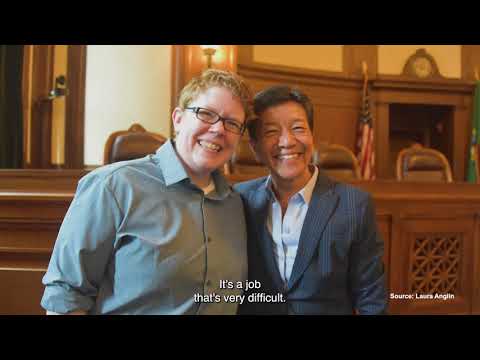
Colleagues praise Erin’s leadership as clerk of the Washington State Supreme Court
Summary
Several speakers at a recorded meeting highlighted Erin’s reforms as clerk of the Washington State Supreme Court, citing work on filing procedures, job descriptions, hiring, and a statewide language-access plan.
Colleagues and court staff praised Erin’s work as clerk of the Washington State Supreme Court during remarks recorded in a meeting. Speakers said Erin strengthened procedural fairness, changed hiring practices, and helped advance a language access plan for the state appellate courts.
Speakers emphasized procedural stewardship as a core part of the clerk’s duties. “As the clerk of Washington State Supreme Court, it's the skeletal function of the court. It can't stand up and it can't function without the clerk,” said Speaker 2, a speaker at the meeting. Speaker 1 added that the clerk’s office “oversees procedural justice for the court and has a big impact on making the parties feel like they've been treated fairly in the process.”
Why it matters: Speakers tied Erin’s administrative changes to access and fairness. Remarks credited changes to job descriptions and hiring practices that removed unnecessary credential barriers and broadened perspectives in the clerk’s office. “She's worked on revising job descriptions to get rid of credentials that aren't actually necessary to qualify for the job and focus on the skills needed,” Speaker 3 said.
Speakers described specific outcomes. One cited correction of how Rule 15.2 was applied to fee-waiver requests, saying litigants had been incorrectly told they were entitled to waivers. Speaker 3 said Erin “could see that it was really big for the individuals affected, and she got it changed.”
Several speakers highlighted Erin’s role in creating a language access plan across the appellate courts. “It’s not typical for appellate courts to have language access plans,” Speaker 5 said. Speaker 5 credited Aaron Lennon as a driving force in creating a plan for the state court of appeals and state supreme court and said Erin’s collaborative approach helped the plan receive a “nine-zero vote from the Supreme Court.”
Speakers also praised qualities they said made Erin effective: bluntness in communication, a detail-oriented approach, and persistence in pursuing access-to-justice goals. “Part of the reason she's so effective is she has a huge heart, and she has this very detail oriented lawyer mind and a huge capacity to do things that are boring,” Speaker 4 said. Speaker 1 summarized the long-term work of access to justice as: “You have to keep believing it can be done. Keep trying it.”
No formal actions, votes, or directives were recorded in the provided transcript excerpt; speakers offered retrospective praise and described administrative changes attributed to Erin’s leadership. The remarks concluded with expressions of thanks to those working on access and court administration.