
Assemblymember Chris Rogers outlines North Coast bills, flags costs of SB 707 and hurdles to single‑payer health care
Get AI-powered insights, summaries, and transcripts
Subscribe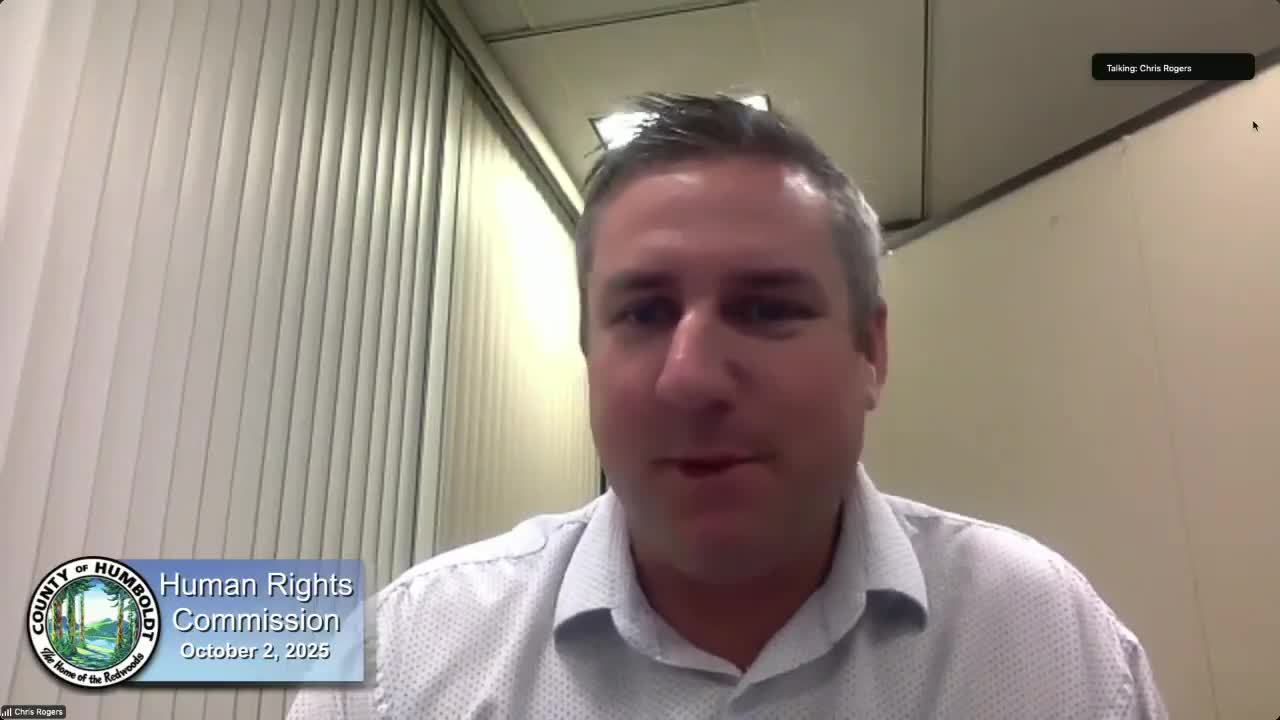
Summary
Assemblymember Chris Rogers, who represents California’s North Coast Assembly District (Sonoma County to the Oregon border), spoke to the Humboldt County Human Rights Commission about legislative items affecting Humboldt County and the broader coastal region.
Assemblymember Chris Rogers, who represents California’s North Coast Assembly District (Sonoma County to the Oregon border), spoke to the Humboldt County Human Rights Commission about legislative items affecting Humboldt County and the broader coastal region. Rogers summarized bills sent to Gov. Newsom, described one bill already signed related to tributaries of the Klamath River, and flagged implementation and funding concerns for other measures including SB 707 and health‑care reforms.
Rogers said a bill he described as “specifically for the tributaries to the Klamath” has been signed and will extend interim protections for about five years while the state develops permanent regulations. He said the measure sought to balance water use among tribal communities, commercial fishers and farmers and to correct historical exclusions of tribal voices.
Rogers outlined other items in his package, including bills that have been sent to the governor (he said 10 went to the desk this year and one had been signed at the time of his remarks). He identified four priority areas that drive his agenda—poverty, climate change, children and health—and described several enacted or pending bills that reflect those priorities.
On immigration and enforcement, Rogers said the Legislature passed bills restricting ICE access to sensitive locations and requiring law enforcement to identify themselves. He said one bill that would make it easier for a court to allow a friend or family member to represent a child when a parent is detained by ICE was awaiting the governor’s signature.
Rogers also discussed what he described as a two‑year effort to remove restrictive terms from a federal discount drug program that, he said, limit rural clinics’ ability to serve their networks. He said pharmaceutical companies have pushed restrictions since 2022 that can force a clinic system to use a single pharmacy for the program—an arrangement that, he argued, can leave parts of a multi‑county clinic catchment area unable to access the program in practice.
On remote participation rules, Rogers addressed SB 707 (a bill discussed by commissioners during the meeting). He said he did not support SB 707 as written because it imposed new requirements (including translation and mandatory Zoom capability) without funding and because local governments had experienced “Zoom‑bombing” and other operational problems. Rogers cited Santa Rosa’s local experience, saying compliance there cost about $500,000 a year and that many rural jurisdictions lack the staff and tools to enforce new rules without state support.
Rogers described his long‑standing support for single‑payer health care but said federal constraints make full implementation in California impossible at present. He noted that a federal waiver would be required for California to move toward a single‑payer model and that the current federal administration is unlikely to approve such a waiver. As interim measures, he described efforts to protect clinic funding and to consider employer assessments—what he called a “McTax”—to offset the cost of employees who enroll in Medi‑Cal. Rogers said Medi‑Cal represents roughly one‑third of the state budget and described worries about the program’s fiscal strain.
Rogers said he and his staff have prioritized constituent outreach—he listed 12 district town halls since taking office—and introduced staff members on the call, including District Director Scott Alonzo and local staffer Heidi McHugh, whom he identified as working on Humboldt County matters.
When commissioners asked about the durability of sanctuary status and protections for immigrant communities, Rogers pointed to SB 54 (the existing state law governing local law‑enforcement interactions with ICE) and said the Democratic caucus and the governor would defend those policies. He told commissioners that Humboldt County would not be alone if larger jurisdictions were targeted and that he saw willingness in Sacramento to stand with sanctuary jurisdictions.
Rogers ended by inviting commissioners to contact his office for help on state‑level problems and to leverage local staff support in Humboldt.