Get Full Government Meeting Transcripts, Videos, & Alerts Forever!
Get email alerts on the Pedestrian Bicycle Safety topic
No spam. Unsubscribe anytime.
Greenbelt, SHA discuss safety upgrades for Maryland Route 193 and Kenilworth Avenue
Summary
City council and State Highway Administration District 3 staff discussed a range of pedestrian and bicycle safety measures for Maryland Route 193 (Greenbelt Road) and Kenilworth Avenue, including planned studies, physical treatments and near-term lighting work.
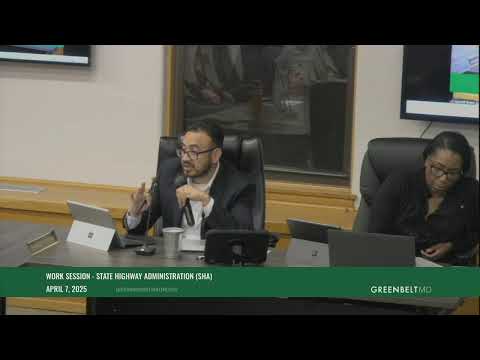
At a Greenbelt City Council work session, city elected officials and representatives from the State Highway Administration District 3 discussed planned and proposed safety improvements for Maryland Route 193 (Greenbelt Road) and Kenilworth Avenue.
City officials pressed SHA on a string of safety issues that residents and council members have raised for years: failing intersections at Hanover Parkway and Greenbelt Road, pedestrian crossing timing at the shopping-center crosswalk, high vehicle speeds on Kenilworth Avenue and several locations where cyclists and pedestrians lack protected facilities. "SHA is committed to improving safety for our vulnerable road users, including pedestrians and bicyclists, along our state roadways," a State Highway Administration District 3 representative said during the meeting.
The exchange included a mix of near-term maintenance and longer planning steps. SHA said it is conducting a targeted traffic and safety study at the intersection of Maryland 193 and Hanover Parkway, with results expected in spring–summer 2025. SHA told the council it is coordinating with Pepco to install lighting at the northwest corner of Hanover Parkway and Maryland 193; Pepco has completed electrical design and construction was scheduled for later spring 2025.
SHA described several roadway treatments under consideration or in planning for the Route 193 corridor: installation of flex posts (sometimes called flex or Lehi posts) in shoulder areas to discourage motorists from using shoulders as through lanes; double-wide edge lines and targeted quick-curve treatments; oversized speed-limit signs between Greenbelt Road and Kenilworth; and adding crosswalks and new lighting at signalized intersections. The agency said flex posts are a relatively low-cost, short-term countermeasure to keep motorists in the travel lane, though they do not physically stop a vehicle.
On bicycling and shared-use paths, SHA said it has prepared a feasibility study for the Greenbelt East Trail: a shared-use path along the north side of Maryland 193 from Hanover Parkway east to the Glendale Splash Park. SHA said that study is under review and a final study is expected later this year. SHA also said Kenilworth Avenue is a designated PSAP (Pedestrian Safety Action Plan) corridor and that the corridor is in early data-collection stages; planning work will follow, including public outreach. SHA representatives said that where Purple Line project work includes ADA-compliant sidewalks, the state would pursue "complete streets" improvements after construction to add sidewalks and bicycle amenities where feasible.
Council members asked about painted bike lanes vs. protected lanes. SHA said there is an active push for separate bicycle amenities on state roads but that tradeoffs include limited right-of-way and the potential need to acquire land to widen corridors for protected lanes. SHA noted that some treatments (green paint, protected markings, bollards or flex posts) can improve visibility and behavior, and that a mix of short-term and longer-term measures is under consideration.
The agency confirmed a funded project to install rectangular rapid-flashing beacons (RRFBs) at the Greenbelt Road intersection with Rhode Island Avenue within College Park, and said it will also install flex-post treatments on segments of 193 from Cunningham Road toward Kenilworth where motorists continue to treat the shoulder as an auxiliary lane.
Council members raised enforcement questions, including whether speed cameras could be installed. SHA said speed camera requests must be initiated by the local police agency and that SHA works with law enforcement to determine if cameras are warranted.
On signal timing and pedestrian crossing times, SHA referenced the Manual on Uniform Traffic Control Devices (MUTCD) pedestrian guidance and said typical pedestrian timing uses a 3.5 feet-per-second baseline, with flexibility to increase time for slower walkers; SHA said it has the ability to implement signal-timing changes and leading pedestrian intervals at locations where warranted.
The council asked for more specific timelines and follow-ups on the studies and installations discussed; SHA agreed to provide updates after completing its studies and to share proposed timelines as they are confirmed.