
Public commenter alleges Open Meetings Act violations and raises concerns about board responsiveness
Get AI-powered insights, summaries, and transcripts
Subscribe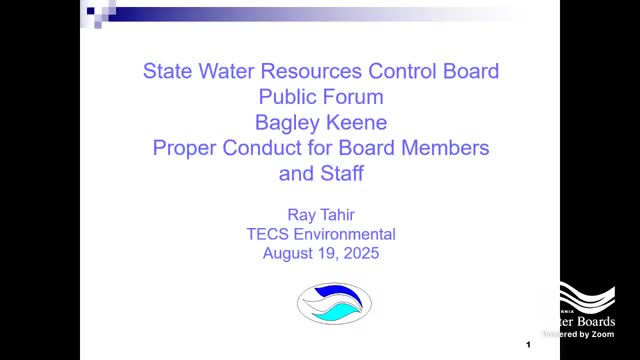
Summary
A public forum speaker criticized the State Water Board’s handling of public comments, alleging improper ex parte communications, deficiencies in the 2024 integrated report and nonresponsive staff, and asked for written answers to questions within 10 days.
At the Aug. 19 State Water Resources Control Board public forum, Ray Tahir (transcript spelling varies) delivered extended remarks alleging the board has acted to restrict public access and accused staff of evasive responses to records requests and disagreements over interpretation of statutory changes.
Tahir told the board he believes public forum is a right (not an opportunity) and referenced provisions of the Brown Act (open‑meetings law) and Porter‑Cologne-style provisions (he cited "Port Of Cologne section 13287" and S.B. 9625 in the transcript) to argue that the public is entitled to information and that willfully depriving the public of such information could constitute a misdemeanor under some statutes.
He asked for multiple formal responses from board staff within 10 days, including: whether the Legislature amended the cited section, why the board’s chief counsel allegedly opposed lifting permissible ex parte communications for certain stormwater permits, and why monitoring and sampling results from MS4 permittees were not measured against water-quality standards for the 2024 Integrated Report (he argued Appendices A, B and J and the related 303(d) listings are defective as a result).
Tahir also criticized staff responses to his public records requests and described the board’s public‑comment response process as unfair, saying staff have two days to prepare replies and the public is not afforded a timely rebuttal. He asked the board to answer his written questions within 10 days and said he intends to pursue the matter further with the state committee on environmental quality.
Why it matters: Tahir’s comments raise governance and transparency questions that, if substantiated, could require staff clarification and possibly policy or procedural adjustments to how the board handles public records, public‑comment responses and the integrated reporting process.
Board response
Chair Esquivel thanked Tahir for his comments. Chief Counsel Michael Laufer’s name appears in the transcript as a person Tahir referenced; later in public forum board staff said they would respond to records‑request concerns at a subsequent meeting. The board did not announce immediate formal action in response to Tahir’s requests during public forum.
Ending
Tahir concluded by reiterating his expectation of written answers and saying he would continue to pursue the matter through administrative and legislative channels. The board acknowledged his remarks but did not commit to the specific 10‑day timeline on the public record.