
State Water Board adopts drinking water SRF intended-use plan, prioritizes failing and at-risk systems
Get AI-powered insights, summaries, and transcripts
Subscribe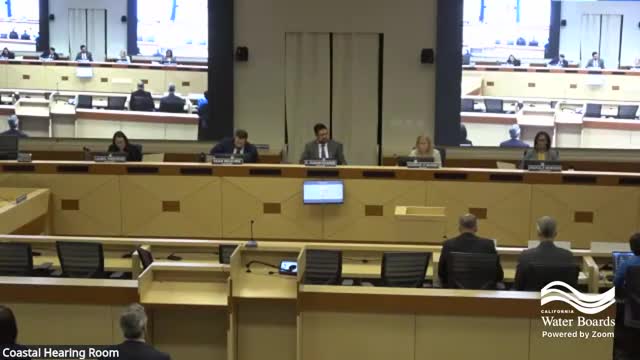
Summary
The State Water Resources Control Board on Aug. 19 adopted a revised Drinking Water State Revolving Fund (DWSRF) Intended Use Plan that prioritizes projects serving systems classified as "failing" or "at risk," raises some grant caps for small systems and directs staff to refine SAFER alignment and staff guidance before next year’s plan.
The State Water Resources Control Board on Tuesday adopted an amended Drinking Water State Revolving Fund Intended Use Plan (IUP) that prioritizes projects addressing systems the board or Division of Drinking Water (DDW) considers "failing" or "at risk," while giving Division of Financial Assistance (DFA) staff limited discretion to fund projects that appear to be failing-equivalent even if not yet categorized as such.
Board Chair Joaquin Esquivel said the board received a long staff presentation and public comment before members voted unanimously to adopt the resolution and two change sheets that adjust grant caps and add implementation direction for staff.
The vote, taken by roll call, was 5–0 (Board members Laurel Firestone, Sean McGuire, Nicole Morgan, Vice Chair D’Adamo and Chair Esquivel voting aye). The board also postponed the related fund-expenditure plan to a later meeting.
Why it matters: The IUP sets which projects may receive federal capitalization grants and state SRF dollars and establishes eligibility and prioritization rules the DFA will use to invite and commit funds. The adopted changes reflect the board’s direction to focus limited grant and principal-forgiveness resources on systems with the most urgent public-health, reliability or capacity risks while adding operational flexibility to avoid leaving urgent projects stalled by categorization mismatches.
Most important points
- Funding available: Staff said approximately $1,040,000,000 is available for DWSRF projects in FY 2025–26, with additional federal capitalization grants conditioned on submittal of the IUP.
- Project prioritization: Staff recommended (and the board adopted) Option 1 — aligning project eligibility and prioritization with the SAFER program’s "failing" and "at risk" designations and continuing to prioritize consolidations. The board added language directing staff to work with stakeholders to evaluate criteria before next year’s IUP.
- Increased caps and limited deputy-director discretion: The board adopted changes that raise maximum grant/principal-forgiveness thresholds for projects serving 200 connections or fewer and allow the DFA deputy director limited authority (up to 20% above the stated maximums for projects with 200 or fewer connections) to approve higher grant amounts for ‘‘good cause’’ (for example, consolidation of state small systems or projects serving domestic wells).
- Emerging contaminants, lead service lines, ASADRA: Staff reported separate supplemental IUPs for emerging contaminants (PFAS, 1,2,3‑TCP, 1,4‑dioxane, perchlorate, manganese, etc.), lead service line replacement funding, and Additional Supplemental Appropriations for Disaster Relief Act of 2019 (ASADRA) funds for wildfire-impacted systems. Staff said demand for some EC and lead funds remains lower than current allotments; DFA will not apply for this year’s lead-service-line allotment because California does not yet have sufficient eligible applications to consume the allocation.
- Implementation and technical assistance: DFA staff highlighted the program’s expanded investments in technical assistance and planning work to help small and disadvantaged communities prepare construction-ready projects. Staff also announced an SRF stakeholder meeting scheduled for Sept. 4 and said the changes will enable DFA to issue invitations under an expedited DWSRF grants program.
Public comment and stakeholder input
Multiple water systems, trade associations and community groups spoke in favor of the adopted approach but urged continued flexibility and clarity. Commenters who addressed the IUP included Willis Hahn (representing the city of Los Banos on hexavalent chromium compliance planning), Nick Blair (Association of California Water Agencies), Jennifer Capitillo (California Water Association), and Eric Orellana (Community Water Center). They generally supported the SAFER emphasis but asked for clearer avenues to avoid unintended consequences for projects that are miscategorized or that need short-term fixes without jeopardizing long-term funding.
How the board resolved implementation friction
Board members debated two options. Option 1 (staff’s recommended approach) targeted failing/at‑risk systems and consolidations; Option 2 would have retained broader historical project categories while signaling prioritization for failing and at‑risk systems. After deliberation the board adopted Option 1 plus a new resolved clause directing staff to work with the DWSRF advisory group, the SAFER program, water systems, technical assistance providers, environmental justice groups and affected communities to evaluate whether the SAFER criteria are appropriate and to propose adjustments before the next IUP.
In addition, the board changed two footnotes (footnote references in the IUP) to clarify that the DFA deputy director may fund projects that are not formally categorized as failing or at risk when the deputy director determines the project will address a risk of failure; the board instructed DFA management to issue a written memorandum to staff explaining how that discretion should be applied to avoid unnecessary sequencing delays in consultation with DDW and local primacy agencies.
Actions recorded
- Motion to adopt board meeting minutes (earlier in the session): Adopted by roll call (unanimous). The minutes motion and second were not verbally attributed on the record.
- Motion to adopt the DWSRF IUP as amended (Option 1 with Change Sheet 2 and the added resolved clause, plus footnote edits): Moved by Board member Nicole Morgan and seconded (second not verbally attributed). Roll-call vote: Firestone — Aye; McGuire — Aye; Morgan — Aye; Vice Chair D’Adamo — Aye; Chair Esquivel — Aye. Outcome: adopted.
What the board asked for next
The adopted resolution directs staff to: 1) implement the IUP as amended; 2) issue written guidance to DFA staff clarifying how deputy‑director discretion should be used to fund failing-equivalent projects without unnecessary delay; and 3) work with stakeholder groups and the SAFER program to assess the appropriateness of the SAFER criteria and propose any needed adjustments before the next IUP is presented.
Ending
Board members and commenters repeatedly emphasized the large statewide need for upgrades to small and disadvantaged systems and asked DFA and DDW to continue prioritizing technical assistance, consolidation pathways and timely project management. DFA staff said they will report back in the coming year and that the board’s action enables DFA to begin submittal of federal grant paperwork and to start committing funds under the revised IUP.