
Tacoma proponent’s visibility/accessible-housing appendix fails after cost and scope concerns
Get AI-powered insights, summaries, and transcripts
Subscribe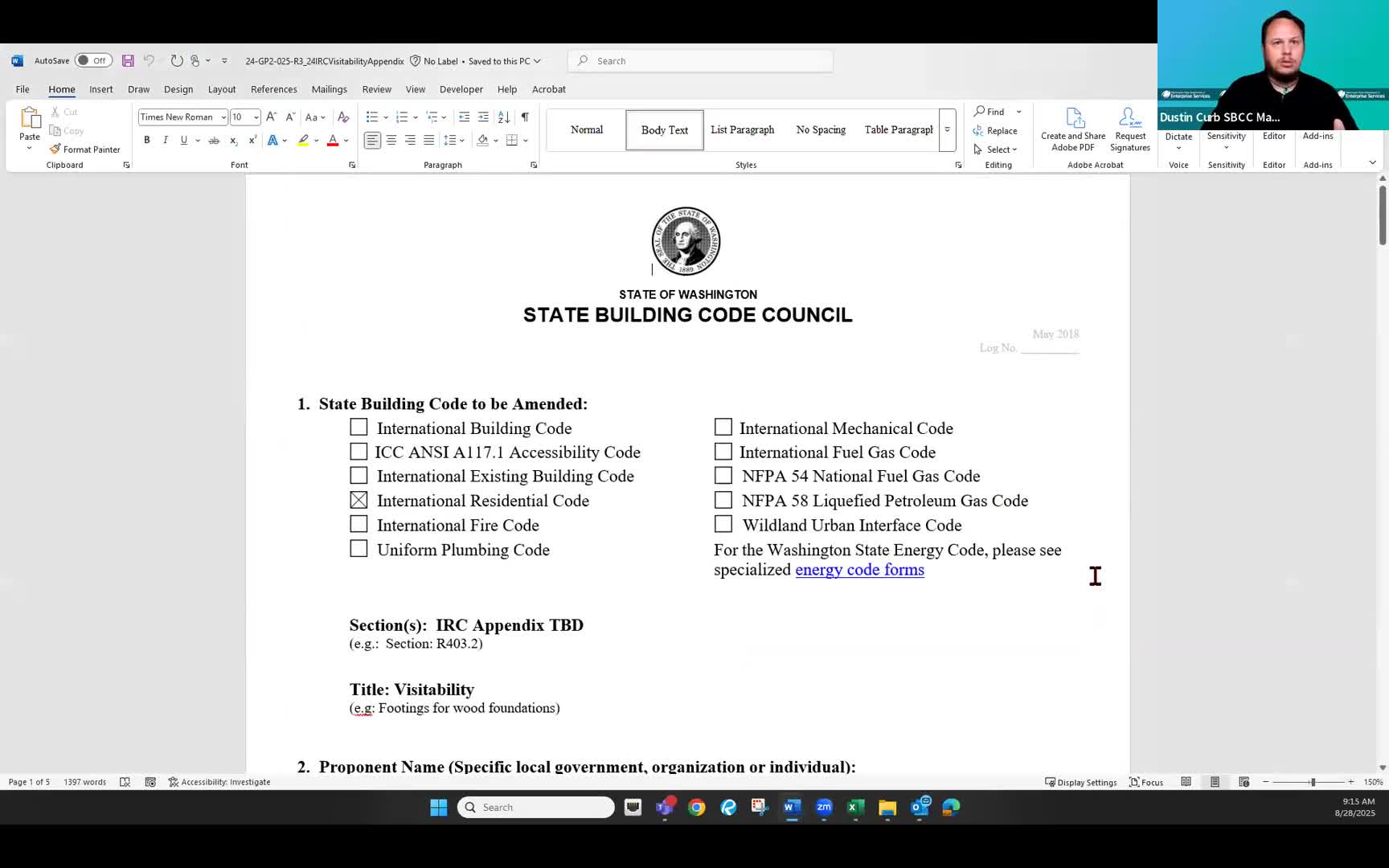
Summary
The IRC tag on Aug. 28 declined to move forward with a proposed optional “visibility” appendix from the city of Tacoma that would have encouraged minimal accessible units (type C). Members raised questions about applicability, enforcement discretion for building officials, and potential cost impacts; the motion to not move the proposal forward was
At the Aug. 28 meeting of the IRC tag, the group voted to not advance an optional “visibility” appendix proposed by the city of Tacoma that would have given jurisdictions a model to require a small number of minimally accessible (type C) dwelling units on multi-unit sites.
The proposal was presented by Lucas Shattuck, client examiner for the city of Tacoma, who said the draft was intended as “a tool in the toolbox” for jurisdictions that want to increase access and equity in housing and that it principally adopts existing, minimal type C provisions from ICC model material. Shattuck said the appendix includes multiple exceptions intended to reduce the cost impact on builders, such as exemptions where steep topography, flood-hazard elevation requirements, or certain townhouse/garage configurations make an exterior circulation path impractical.
Tag members said the exceptions and the proposal’s scope left too many open questions about when the requirement would apply and how building officials would exercise discretion.
Why it matters: The appendix was framed as a low-cost way to create a small share of more accessible units (Shattuck noted the proposal’s quantity provision mirrors a 5% metric in the draft). Members warned that ambiguous applicability could expand the rule to single-family lots or small ADU projects and could raise costs that ultimately pass to buyers or renters.
Discussion highlights
- Scope and applicability: Several members, including Jenny Luke and Patrick Hanks, asked whether the proposal would apply to every single-family site or only to sites with multiple dwelling units. Shattuck said the draft intends to apply when a site contains three or more dwelling units and that section 103 in the draft sets the required quantity (he referred to “five” units in that context). Tag members said the text was unclear and recommended adding an explicit phrase such as “sites containing three or more dwelling units” to the applicability paragraph.
- Exceptions and cost: Shattuck emphasized that the exceptions were targeted at exterior-path costs (grading, ramps) while keeping interior, relatively low-cost accessibility features. Members, including Angela Haupt and Patrick Hanks, expressed concern that leaving the determination of “impracticability” to the building official could produce inconsistent outcomes and shift costs to consumers.
- Relation to state law and authority: Micah (staff) warned that local code officials have limited authority to alter ADA applicability and that some aspects of the proponent language replicate authority already found in state statute and chapter-one authority; he urged caution about creating local standards that conflict with state rules.
- Practicality and likely impact: Some members, including Patrick Hanks, noted that even if the appendix produced a few type C units, the units would only be useful if the right household occupied them; others said the interior improvements could be added later by owners, whereas exterior circulation costs are typically the most expensive items to require up front.
Outcome and motions
- Motion: A tag member moved to not move the proposal forward for public comment (motion text: “not move it forward / disapprove the proposal”). The motion was seconded. - Vote: The motion to not move the Tacoma visibility appendix forward was approved by voice vote.
What was left unresolved
- The tag discussed options including further revision, formation of a small work group, or carrying a correlated version to the model-code correlation step. The proponent said he would accept whatever the tag decided but objected to rewriting the underlying accessibility standard itself (he stressed the draft merely points to the existing type C standard).
What comes next: The tag voted to not advance the appendix at this meeting. Members discussed possible follow-up options — additional revision by the proponent with explicit applicability language, work-group review, or revisiting during a future meeting — but made no binding direction to staff beyond the disapproval vote.
Ending note: The proponent said he had worked on the proposal for two years and presented it as a low-cost option jurisdictions could pick up; after the vote he said he would review the tag’s feedback.