Get Full Government Meeting Transcripts, Videos, & Alerts Forever!
Get email alerts on the Emergency Communications 911 Resilience topic
No spam. Unsubscribe anytime.
City officials outline 911 contingency steps after statewide outage; fire boxes, alternate lines cited as backups
Summary
At a Boston City Council hearing, public-safety officials described the June 18, 2024 statewide NextGen 911 outage, measures taken since, and remaining gaps including training, language access and dependency on state systems.
The Boston City Council Committee on Public Safety and Criminal Justice held a hearing Tuesday on ways to ensure continued operation of the 911 system and contingency plans in the event of another outage.
The session centered on a June 18, 2024 statewide NextGen 911 outage that temporarily prevented residents from calling 911. City emergency officials told the committee the outage lasted about two hours, was traced to a firewall malfunction in the state-managed system and prompted multiple local workarounds to maintain emergency response.
Committee chair Councilor Henry Santana opened the hearing by saying the docket would examine operations of the 911 system and contingency planning. "This hearing is being recorded," Santana said at the start of the session.
Why it matters: City officials said the outage exposed dependencies on the Commonwealth's NextGen 911 infrastructure and the private vendor that operates it, and showed how local backups — including Boston's municipal fire alarm boxes and newly installed alternate phone lines — can limit service disruption. Councilors pressed officials on public notification, language access, staffing and training.
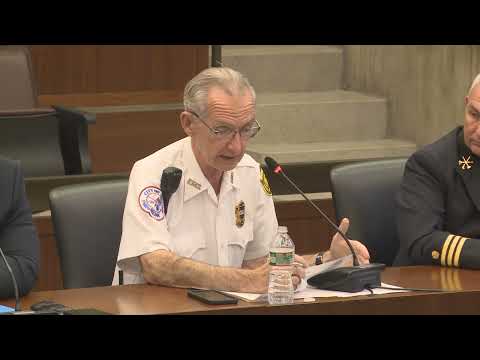
Boston EMS Chief James Hooley described how calls flow in the city and what happened during the outage. "When a 911 call is placed in Boston, it's first received at a public safety answering point or the PSAP at Boston Police Department," Hooley said. He told the committee Boston EMS has 440 EMTs and paramedics supported by 32 nonuniform staff, responds to about 140,000 clinical incidents a year and transports roughly 93,000 patients. Hooley said Boston averages about 16 emergency medical calls per hour and recorded 33 EMS incidents during the two-hour outage.
Officials' account of the outage and immediate actions
Officials uniformly described quick coordination among Boston Police Department operations, Boston Fire Department alarm operations and Boston EMS dispatch. Steps taken during the June 18, 2024 outage included: notifying the state 911 office; assigning additional staff to handle callbacks; posting alternative contact information through media relations; directing field units to increase visible patrols; and relying on the municipal fire alarm boxes as a backup reporting method.
Deputy Superintendent Christopher Walsh of the Boston Police Department said the department has installed an alternate telephone call-handling system in the police operations division and that similar capability exists for EMS. "It's currently in place. We're waiting on one more number to be set up by Horizon to ensure that the system works from end to end," Walsh told the committee, adding that the alternate numbers will ring across up to 20 phones on call-takers' desks so multiple staff can answer.
The panel also described a later CAD (computer-aided dispatch) outage that required call takers to use paper and manual methods. Officials said that CAD outage lasted about seven-and-a-half hours; 99 calls were manually captured and later entered into CAD to preserve records.
State role, vendor and third-party routing
Witnesses said the Commonwealth provides and manages the NextGen 911 platform through a vendor, Comtech. City officials said the state has contracted with a third-party, out-of-state call center that will receive calls if the state system becomes unavailable and transfer those calls back to local 10-digit lines so municipal dispatch centers can accept them.
Dispatch, backup and interoperability
Hooley and other panelists stressed that Boston's CAD system is shared across police, fire and EMS and that the city maintains a fire alarm backup center at Boston Fire Alarm. Deputy Chief Christopher Burke of Boston Fire Department reiterated that pulling a municipal fire alarm box will generate a dispatch. "If you pull a firebox, we're coming," Burke said.
Language access and training
Councilors raised concerns about notifying non-English speakers during outages. Officials said the city uses the municipal language-line and the city's language and communication access teams; dispatch centers can conference in interpreters when necessary. Hooley said Boston EMS currently has two staff who "speak Cantonese fully"; the police operations division reported one Cantonese speaker on duty; the fire alarm division reported none.
On training and equipment, the union representative for EMS urged legislative recognition of EMS as an essential service at the state level, citing pending state legislation (listed in testimony as bill H4120 introduced by Representative Davis) to create dedicated EMS funding. The union speaker said that additional training and investment in equipment and infrastructure are needed to reduce the chance of a future failure causing major service disruption.
What the city has not yet specified
Officials said they would provide the exact count of municipal fire alarm boxes upon request. They also noted a remaining technical step: one outbound number must be finalized and tested with the alternate call routing to complete end-to-end verification.
No formal votes were taken during the hearing. Committee members thanked the witnesses and said they would continue oversight and coordination with state partners.
The hearing record: Councilor Santana opened the hearing on docket 0322 and committee members including Councilor Aaron Murphy, Councilor Ed Flynn and Councilor John Fitzgerald questioned city public-safety leaders about the outage, local backups and next steps. The hearing concluded with thanks from the sponsors and adjournment.
Ending note: City officials said lessons from the outage spurred new backups and further planning but acknowledged continued reliance on the Commonwealth-managed NextGen 911 platform and vendor agreements. Several councilors urged ongoing transparency about testing, multilingual outreach and training as the city completes the alternate-line testing.