Get Full Government Meeting Transcripts, Videos, & Alerts Forever!
Get email alerts on the Groundwater Protection topic
No spam. Unsubscribe anytime.
Marathon County converts fields to prairie to protect Athens wells; staff proposes EIF seed-money pilot for more communities
Summary
Conservation staff described a 60-acre prairie/pasture conversion around the Village of Athens municipal wells paid at $200/acre, funded in part by a $30,000 EPA prize; staff proposed a one-time $20,000 allocation from the county Environmental Impact Fund as seed money for future municipal wellhead protection projects.
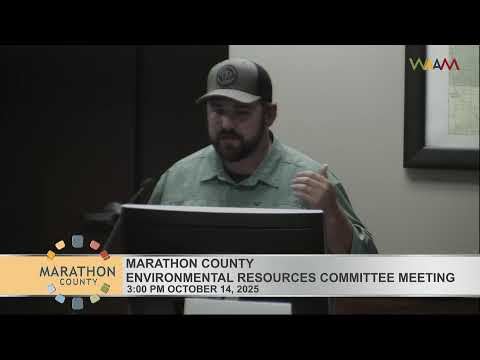
Marathon County conservation staff described progress on municipal wellhead protection work during a special Environmental Resources Committee meeting Oct. 14, highlighting a 60-acre conversion from row crops to perennial vegetation near the Village of Athens municipal wells and early discussions with the Village of Rib Mountain about a similar approach.
Staff said the Athens work began after the Wisconsin DNR flagged rising nitrate levels in municipal wells. The county and partners used a combination of tools — groundwater recharge mapping, private-well testing and outreach — to focus conservation actions on fields closest to the municipal wells. Staff said they secured a $30,000 award from the U.S. Environmental Protection AgencySmall Communities, Big Challenges program and used those funds to buy seed and pay the first year of rent for the village, which eased an immediate budget timing problem for Athens.
The landowner agreed to convert 60 acres around the wells: 30 acres seeded to native prairie (pollinator- and perennial-dominated mix) and 30 acres managed as pasture with light grazing farther from the wells. Staff said the village offered $200 per acre rent in the contract, higher than the $150 per acre the landowner had been receiving from a farm operator, to incentivize the land-use change. Seeding was completed in May 2025.
County staff estimated an estimated cost of more than $2 million to install a reverse-osmosis treatment system for the entire Village of Athens; they presented the prairie conversion as a lower-cost, preventive approach that could reduce nitrates over time. A county-convener told the committee that a groundwater consultant presenting at a recent Health and Conservation Summit used Athens as a case study and predicted nitrate trends should improve in coming years because of the conversion.
Staff also reported ongoing discussions with the Village of Rib Mountain. They said the Rib Mountain village board has voted to fund rental payments to landowners to convert fields in wellhead protection zones, but negotiations with landowners remain in progress.
To help other municipalities replicate this work, conservation staff proposed that the committee consider a one-time allocation of $20,000 from the county Environmental Impact Fund (EIF) to create “seed money” for future municipal wellhead protection initiatives (seed purchases, initial rent payments). Staff said they were not asking the committee to vote on the proposal at the Oct. 14 meeting; if the committee and HR/Finance recommend the idea it would still require full county board approval.
Why it matters: Municipal water-supply nitrate levels have regulatory and cost implications. The DNR and EPA use a 10 mg/L nitrate (as nitrogen) threshold to trigger costly treatment obligations. Staff said proactive land-use changes in sensitive well recharge areas can reduce the long-term need for centralized treatment and spread costs across partners rather than all residents bearing the full expense.
No formal action was taken Oct. 14; staff requested committee feedback and asked members to consider outreach and education ahead of any formal EIF request.