Get Full Government Meeting Transcripts, Videos, & Alerts Forever!
Get email alerts on the Public Art topic
No spam. Unsubscribe anytime.
Syracuse, NYSDOT and Parks officials begin coordinated planning to place public art along I‑81 Almond Street boulevard
Summary
Syracuse public art commissioners, city parks staff and New York State DOT representatives discussed options to place sculpture, plantings and murals in the proposed Almond Street boulevard as part of the I‑81 corridor project and agreed to form a joint task force to align designs, site dimensions and responsibilities.
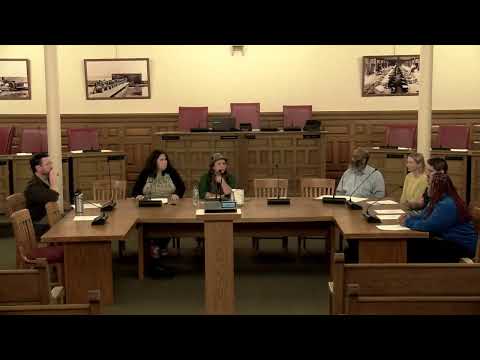
Syracuse City Public Art Commission members, Parks Department staff and New York State Department of Transportation (NYSDOT) representatives met to discuss integrating public art and plantings into the Almond Street boulevard section of the I‑81 reconstruction.
The meeting focused on locating sculpture pedestals and planting zones within the boulevard right-of-way and on a potential program to loan existing sculptures from universities, museums and art parks for multi‑year displays. "Sculpture seems to be the preferred way to go, just because we don't have walls," said Emmanuel Carter, city planner and member of the Public Art Commission, describing the project's constraints and scale considerations.
Why it matters: the Almond Street segment (described in the meeting as running from Erie Boulevard to Van Buren Street and part of NYSDOT contract 8) is still in preliminary design for the boulevard-at-grade option. Commission members said now is the time to align DOT design dimensions, Parks Department planting needs and the Public Art Commission's placement goals so artworks fit available median and intersection spaces without interfering with traffic or turning lanes.
Participants discussed two approaches to providing sculpture: (1) borrowing existing works on 2–3 year loans from regional institutions, with the city assuming transport, insurance and pedestal construction; and (2) commissioning new works funded by grants and managed through the Syracuse Parks Conservancy. Carter said the loan model arose because the city currently lacks funds for large-scale commissions and because loaned works could be rotated to keep the corridor dynamic.
A NYSDOT representative described internal caution about public art on state highways and noted that, "New York State DOT doesn't actually have a policy about public art." The DOT representative said DOT engineering, legal and executive teams will need a clear process and approval pathway before the agency can commit to installations on state-controlled right-of-way.
Speakers stressed process details that must be settled before installations proceed: who builds and maintains pedestals; which party insures and transports works placed on DOT land; how review and approval by the Public Art Commission and DOT will be coordinated; and how community input and letters of support will be gathered. Saisha Berg, Commissioner of Parks, noted that the city typically becomes responsible for maintenance if a work is sited on city-owned land; jurisdictional lines are less clear when works are on state highway property.
Commissioners and DOT staff agreed on immediate next steps: assemble representatives from the Almond Street Corridor design team, the Parks Department, the Public Art Commission and NYSDOT to review the contract 8 conceptual drawings and identify specific block-by-block opportunities and constraints. Tina Zagiva, chairing the meeting, said the commission will use a task‑force approach to keep technical discussions public and targeted. "I think we need to get all these different groups together, so we can all at least be working off of the same concept of what's available," Zagiva said.
The group also discussed mural opportunities on retaining walls and bridge abutments along the broader I‑81 corridor; presenters said some proposed mural panels would be polycarbonate panels expected to last decades and be modular for replacement if damaged. DOT cautioned that high‑speed stretches north of I‑690 will require designs that minimize driver distraction, while lower‑speed sections on the south side could accept more detailed compositions.
Action items assigned during the meeting included: (1) DOT to provide available contract 8 conceptual drawings and median dimensions; (2) the Public Art Commission and Parks Department to compile examples and case studies (local, national and international) of successful highway-related public art programs; and (3) formation of a joint task force or standing agenda item to coordinate design, permitting, community outreach and maintenance responsibilities.
The commission and DOT agreed to continue the dialogue; no formal commitments to specific artworks or funding allocations were made at the meeting.
Ending: Participants said they expect follow-up technical sessions and a task-force meeting that will be open to the public. The dialogue will inform whether the city pursues loans, grant-funded commissions, or a mixed approach for the Almond Street boulevard.