Get Full Government Meeting Transcripts, Videos, & Alerts Forever!
Get email alerts on the Farm To School topic
No spam. Unsubscribe anytime.
Tennessee Department of Education reviews Farm to School programs, grants and competitions
Summary
Tennessee Department of Education staff gave a statewide Farm to School training covering gardens, local procurement, grants, the Junior Chef competition and outreach resources; presenters said every county now reports at least one Farm to School activity and highlighted a USDA grant closing Dec. 6 with a $100,000 minimum.
Lindsay Paul, the Tennessee Department of Education’s farm to school and grant specialist, told an online training audience that the department’s Farm to School work now reaches every county in Tennessee and reviewed tools for school food authorities to expand gardens, local procurement and student nutrition education.
Paul opened the presentation by saying the session would be “a general fun overview of Farm to School,” and she outlined the program’s three core elements: school gardens, classroom and culinary education, and local procurement.
Why it matters: Paul said Farm to School activities can increase student exposure to fresh foods, support local farmers and bolster community economies. “Farm to School enriches the connections communities have with fresh, healthy food and local producers by changing food purchasing and education practices at schools and early care and education sites,” she quoted from the National Farm to School Network and later noted that, “as of 2025, we are completely green. Farm to school is officially in every single county.”
Overview and scope
Paul described three common Farm to School components and how districts can adopt any one or multiple elements: hands-on gardens (including hydroponics and greenhouses), classroom nutrition and culinary education, and purchasing local food for cafeterias, taste tests or classroom use.
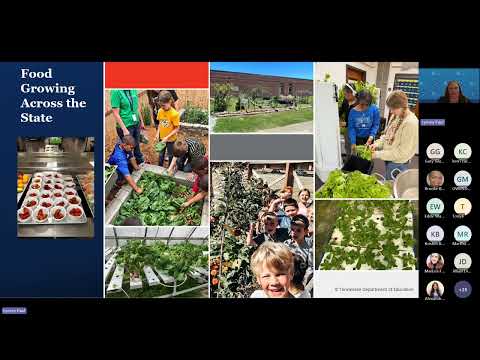
She said the department tracks Farm to School participation using its census and that participation has grown each year since 2019. Paul gave examples and photos from districts across the state, including greenhouse-grown strawberries in Cumberland County, school gardens in Murfreesboro City and Marshall County, a hydroponics program in Fayetteville City, and lettuce production tied to an agricultural department in Humphreys County. Paul described the Humphreys County output as about “1,200 heads of lettuce at a time” (approximate), grown in high-school greenhouses and shared with the cafeteria.
Education and student engagement
Paul recommended activities such as taste tests (for example, cooked versus raw carrots), classroom lessons on food and nutrition, farm visits and assemblies. She suggested districts contact their county extension agents and referenced programs such as EFNEP (Expanded Food and Nutrition Education Program) as available options for nutrition education.
Junior Chef competition
Paul described the Junior Chef competition as a statewide cooking contest for ninth- through 12th-grade students. Teams of two to four must create a student-friendly, school-nutrition-compliant recipe that includes at least two local ingredients and one USDA commodity item; plates must meet school nutrition standards and present a three-component meal. The judging process first evaluates recipe submissions and then advances up to eight teams to an in-person cooking round. Paul said the competition’s cooking portion will be held March 6 in Nashville (Nashville State) and that the top three teams receive scholarships to culinary school. She cited last year’s first-place team from Hamilton County (Ooltewah High School) and runners-up from DeKalb and Morgan counties as examples.
Local procurement and the department’s resources
Paul urged school food authorities to define “local” in whatever way best suits district goals — by county, region, state or mileage — while warning against contracting definitions that would unreasonably limit competition. She advised starting with a menu audit to identify items already sourced locally, substituting local items where feasible, offering local products on salad bars and instituting a “Harvest of the Month” program. Paul said the department has prepared a 12-month Harvest of the Month program with free social-media graphics, classroom activities and QR-coded recipes for districts to download.
Where to buy local and grants
Paul pointed attendees to the Pick Tennessee website (a program of the Tennessee Department of Agriculture listing Tennessee producers) as a starting point for locating growers. Other procurement channels she listed include produce auctions, food hubs or co-ops, direct purchases from producers, school gardens, processors and farmers markets. She noted that being listed on Pick Tennessee does not necessarily indicate a producer’s willingness to contract with schools and that the department is working with the Department of Agriculture to add indicators for producers interested in working with schools.
Paul highlighted the USDA Farm to School grant stream as currently open and closing Dec. 6; she said the 2025 grant cycle requires larger projects and that the minimum award level increased to $100,000 this year (previously $50,000). She told attendees they can contact her with questions about grants and said she would share any updates about webinars or guidance the department receives.
Resources, upcoming events and follow-up
Paul said the presentation slides, links and resources would be posted to Teach All within a few days and that she would send a follow-up email with the Harvest of the Month materials and social-media graphics. She announced three Farm to School Institute dates in February: Feb. 11 in Nashville, Feb. 18 in Jackson (West Tennessee) and Feb. 25 in Knoxville (East Tennessee), and said the department is accepting presentation proposals for one-hour sessions. She also invited districts to share photos of Tennessee Crunch Day activities; during the training she noted October is Farm to School Month and later said Tennessee Crunch Day is “on the ninth.”
Quotes and attributions
“Farm to School enriches the connections communities have with fresh, healthy food and local producers by changing food purchasing and education practices at schools and early care and education sites,” Paul quoted from the National Farm to School Network.
“‘As of 2025, we are completely green. Farm to school is officially in every single county,’” Paul said when summarizing the department’s county-level participation data.
Lexi Vaughn, the department’s professional development and training coordinator, opened and closed the session and reminded attendees that recordings are restricted on state resources and that generative-AI tools are not permitted for these meetings.
What the training did not decide
The presentation was informational; no formal policy changes or binding procurement requirements were adopted during the training. Paul and department staff offered guidance and resources and invited districts to adopt or adapt Farm to School practices according to local needs.
Contacts
Paul closed by offering her contact information for follow-up questions and encouraged attendees to submit Harvest of the Month interest forms if they want printed posters.