Get Full Government Meeting Transcripts, Videos, & Alerts Forever!
Get email alerts on the Transportation topic
No spam. Unsubscribe anytime.
Golden Gate plan advances with traffic-calming, gateways and multimodal options
Summary
A consultant presented detailed designs and options for traffic calming, sidewalks, parking and multimodal connections in Golden Gate, highlighting trade-offs on Indian Street, roundabouts and shade-tree placements; the CRA plans further community engagement and cost estimates.
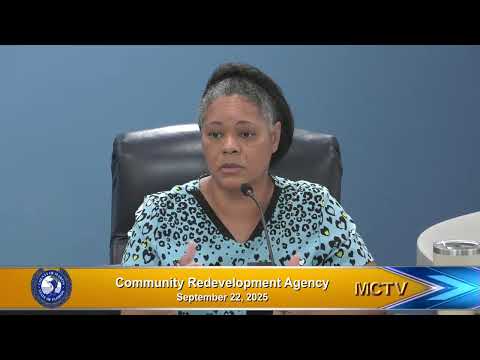
Wen Dang, the transportation engineer for DDEC, gave the Martin County Community Redevelopment Agency (CRA) a detailed update on the Golden Gate Neighborhood Improvements project on Sept. 22, outlining traffic-calming strategies, typical street sections and gateway concepts intended to slow traffic, add shade and improve pedestrian and bicycle connections.
The presentation matters because many planned changes — raised crosswalks, mini roundabouts, parking reconfigurations and a possible multiuse trail in the roadway median — would alter street geometry, parking and landscaping across multiple Golden Gate blocks and affect travel and access for residents and businesses.
Dang said the project team is testing a mix of measures rather than a single fix. “A stop sign is not traffic calming,” she said, explaining the team favors vertical deflections (raised crosswalks), series-spacing of devices and gateway elements that reduce speeds by design. She pointed to the El Camino Trail plan, where raised crosswalks are proposed at trail crossings, as an example of combining pedestrian protection with speed-reducing devices.
The consultant walked the CRA through several “typical sections” for 50-, 75-, 80- and 100-foot right-of-way streets. For narrower residential blocks the team recommended parkway-style sidewalks and bulb-outs to create planting strips and buffer space between pedestrians and vehicles. For wider corridors such as Indian Street and Jefferson Boulevard the team explored options that include a 10-foot multiuse path, dedicated bike tracks, on-street parking configurations, and center medians that could host a trail linking to the El Camino network.
Dang described trade-offs for the center-median trail concept — which would place a multiuse path between parking lanes and vehicle travel lanes — noting potential safety and operational concerns (midblock crossings, people accessing parked cars) as well as benefits (separation from homes, parking consolidation and continuity with other trails). She said the design team will consider midblock crosswalks and additional protective measures if the community prefers the median option.
Board members raised operational and safety concerns. “This concept on Indian Street, I’d be a little concerned about because it is well traveled,” Board member Rex said, citing heavy traffic and multifamily parking needs. CRA staff and Dang said parking lanes and striping can be shifted to respond to local driveway patterns and that some designs can be flipped so parking is on the outside of the roadway instead of adjacent to a center trail.
Members also asked about cul-de-sacs, turn radii and utility conflicts. Dang said many Golden Gate streets have constrained geometry and limited right-of-way, so typical cul-de-sac turn radii are not feasible in several locations. She noted that underground and overhead utilities affect where trees and planting strips can be placed and said those conflicts will be resolved in final design; in some cases, she said, residents adopt trees on private property to increase shade where planting in the right-of-way is constrained.
The team discussed mini roundabouts, noting design must accommodate large vehicles and trailers via a mountable inscribed circle. Board members suggested staff review recent local roundabouts as examples; Dang said the team would catalogue candidate locations and return with site-specific recommendations.
Dang said the team conducted outreach materials for the neighborhood — including 11-by-17 flyers — and will return to the community and the CRA with refined designs, cost estimates and locations where roundabouts or gateways could fit. She also showed architectural gateway inspirations tied to Golden Gate’s historic Mediterranean-style buildings and recommended narrowing a long list of options into a smaller set for detailed design.
Next steps are additional community touchpoints, refinement of typical sections, and cost estimating before the CRA advances projects to final design and permitting. Dang and CRA staff said they will present targeted location maps when they return to the board.