
Parents urge Newton County Schools to allow remote monitoring of student CGMs; board urges policy review
Get AI-powered insights, summaries, and transcripts
Subscribe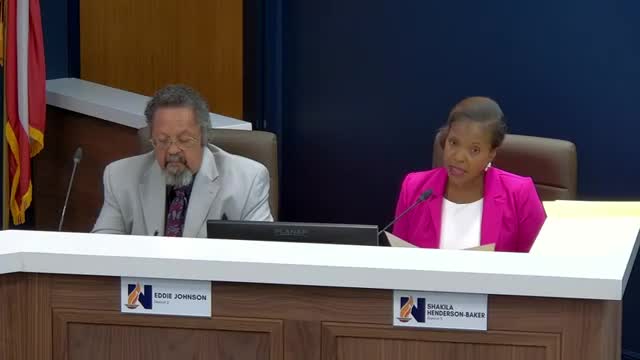
Summary
Parents of students with Type 1 diabetes told the Newton County Board of Education the district is denying medically ordered remote monitoring of continuous glucose monitors; the superintendent said the district will pursue policy development and the board approved several routine items.
Parents of students with Type 1 diabetes told the Newton County Board of Education on Tuesday that Newton County Schools is refusing to allow school staff to remotely monitor students' continuous glucose monitor (CGM) data, a practice parents and some nurses say prevents dangerous medical episodes.
At the meeting Laura Petersham, mother of a 10-year-old Mansfield Elementary School student, said she provided a medical order on March 1, 2022, stating that remote monitoring of her daughter’s CGM by the school nurse or trained staff is medically necessary. “The doctor's order reads, ‘remote monitoring of the CGM by the school nurse or trained staff is medically necessary,’” Petersham told the board during public participation. She said the district has declined to incorporate audible CGM alerts on a school device into her child's 504 plan and cited a broader legal obligation: “As a public and federally funded school system, Newton County is required to comply with the Americans with Disabilities Act,” she said.
Charlotte Petersheim, the student Petersham represents, also addressed the board. “When I'm at school, the nurse can't follow my blood sugar, so she's constantly coming to my class to check on me,” Charlotte said, adding that in-class checks interrupt her learning.
Sheena Womack, another parent, described a recent incident in which her daughter's CGM reports dropped quickly to 43 with double arrows down and the student's phone and pump did not sound. Womack said she called the school and the interim nurse responded, but that remote monitoring would have allowed earlier intervention: “If the nurse had been allowed to follow [the app on a device], she would have gotten the same notification I got, and Paisley's persistent low could have been avoided,” Womack said.
Petersham and Womack told the board they had provided medical documentation and noted that remote CGM monitoring is in use in other U.S. school systems; Petersham said she was aware of “over 183 counties across the United States” that permit the accommodation. Petersham also said she had received multiple Department of Justice letters in other counties requiring compliance in similar situations.
Board members responded during the regular meeting. School board chair Abigail Cocking and others thanked the parents for raising the issue and several members said they had not been fully aware of the district's existing practice or policy. A board member who identified herself as a parent of a child with diabetes described prior district practice of permitting monitoring and urged the board to act. Superintendent Dr. Bradley said the district lacks a written policy that governs remote CGM monitoring and that, while there has been prior practice, it has been subject to scrutiny. “My responsibility is to make sure that I am always following policy,” Dr. Bradley said. “I would urge the board, and remind the board that there are many children in our district that are suffering from the condition that was referenced earlier this evening. And I do think that it would be prudent, appropriate, and urgent to begin developing policy that would be responsive to these situations.”
Board members did not adopt a specific new CGM policy at the meeting. Several members expressed support for developing a consistent written policy and for returning with recommended language. The superintendent indicated staff will begin work on policy development and bring it back to the board for consideration; the meeting record shows no formal directive with a deadline or an adopted policy on remote CGM monitoring at this session.
Votes at a glance
• Item 12A — Adoption of revisions to Policy BCBI (standards of conduct for board meetings). Motion: moved by Miss Henderson Baker; seconded by Mister Trey Bailey. Vote: motion passed (roll-call tally not recorded in transcript). Note: item presented earlier at the August 12 work session and made available for public review; no public comments received on the policy prior to adoption.
• Items 13A–13I — Consent slate (facility requests, routine contracts and similar items). Motion: mover not specified on the record; seconded by Mister Anderson Bailey. Vote: motion passed; Mister Henderson Baker recorded an abstention on Item 13G (stated reason: membership in a specific sorority). Details for each consent item were presented at the August 12 work session; a correction to item 13G was noted in the August 19 meeting packet to align background information and specific location requested.
• Item 13J — Approval of personnel recommendations as discussed in executive session. Motion: moved by Mister Henderson Baker; seconded by Mister Anderson Bailey. Vote: motion passed (aye recorded).
Routine meeting business included approval of the meeting agenda and minutes; those motions were made and approved during the session (movers and seconders recorded in the minutes portion of the transcript). The board adjourned at the end of the regular session.
What the parents described and what the board agreed to do
Parents and the superintendent agreed on two factual points in the meeting: first, parents presented medical orders stating remote monitoring of CGMs is medically necessary for their children; second, Newton County Schools does not currently have an explicit written policy authorizing staff to receive audible CGM alerts on a district device and incorporate those alerts into a student's 504 plan in the cases presented.
Parents requested that the district permit a school device (for example, an iPad in the nurse's office) to display glucose readings and to sound audible alarms so trained staff can respond before an emergency. Parents and at least one speaker described the device practice as already widely used elsewhere and said nurse staff support the change; district staff responded that concerns have included liability and adherence to existing policy. The superintendent said he will pursue development of a clear district policy and return with proposed language for the board to consider.
Background and context
A continuous glucose monitor is typically replaced about every 10 days and samples glucose approximately every five minutes; many CGM systems can share glucose data to caregivers via an app. Parents referenced a March 1, 2022, medical order in one case and said some children have a diagnosis of hypoglycemia unawareness. Parents attributed prior district monitoring to earlier practice and described the current refusal as a change in district choice. Parents reported that other jurisdictions have been required to comply after Department of Justice correspondence in similar cases.
The meeting also included ceremonial recognitions and a public request from the Newton County Christian Learning Center to be placed on a future agenda to present a proposed off-campus release-time religious education program; the board took no action on that request at this meeting other than offering to place the group on a future agenda if requested.
What’s next
District staff will draft policy language and return to the board for consideration; the superintendent said he would follow policy requirements in that process. The transcript does not record a specific timeline or deadline for that draft to be returned to the board.