
Newton County Schools hearing considers FY26 millage options; superintendent recommends 15.75 mills
Get AI-powered insights, summaries, and transcripts
Subscribe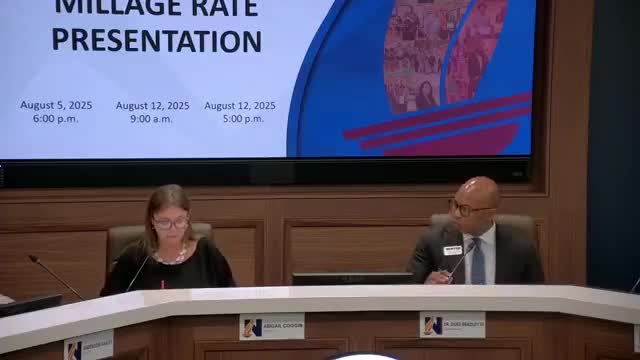
Summary
Superintendent Dr. Bradley recommended that the Newton County Board of Education set the fiscal year 2026 millage rate at 15.75 mills during the district's final public hearing on the proposal.
Superintendent Dr. Bradley recommended that the Newton County Board of Education set the fiscal year 2026 millage rate at 15.75 mills during the district's final public hearing on the proposal. The hearing, led by Board Chair Coggin, included a staff presentation on legal requirements and multiple public comments urging a deeper rollback to the statutory “rollback rate.”
Dr. Bradley opened the hearing by saying, “I am recommending that this board adopt a decrease to the district's millage at 15.75 mills.” Chief Financial Officer Erica Robinson then reviewed the legal process and numbers, telling the board that “according to the Official Code of Georgia Annotated 48-5-32” and OCGA 48-5-32.1 the district must publish the current tax digest, a five-year history and hold three public hearings if the proposed rate exceeds the rollback rate.
The nut graf: The hearing presented the choice facing the board between holding the proposed 15.75 mills — a level the superintendent described as a continued reduction from recent years — and adopting the rollback rate of 14.84 mills, which public commenters and some board members said would provide immediate taxpayer relief but reduce district revenue by several million dollars.
Robinson said the district's most recent digest is approximately $6.1 billion and that applying 15.75 mills would generate about $96.6 million in gross revenue (about $5.8 million more than FY25), with net tax revenue projections used in the FY26 budget ranging from roughly $91.5 million (baseline) to $93.3 million under updated digest assumptions. She walked the board through alternative millage scenarios presented in the slide deck: small reductions such as 15.7, 15.65 and 15.6 would still produce modest increases relative to the budget baseline; a drop to the rollback rate of 14.84 would lower revenue by roughly $3.6 million compared with the FY26 budget projection.
Board discussion focused on two tensions: immediate taxpayer relief versus maintaining reserves to cover uncertain state and federal changes and fixed obligations. One board member, who said the district has lowered the millage in five of the past six years, argued the board could adopt the rollback rate and draw on reserves to cover the shortfall this year. “We could do the 14.84, and we could do the full rollback rate,” the board member said, noting projected reserves and the district budget passed in May.
Other board members and the superintendent urged caution. Robinson and one board member highlighted that the local five-mill share and other state formulas will shift as the digest grows, reducing state funding in coming years; Robinson noted an estimated $9.2 million reduction in state funding over three years tied to local share increases. Board members also raised standard reserve-management practices, citing a commonly referenced target of three months of expenditures in reserves.
Public participation reflected the split. Resident James Peterson urged action on millage for seniors and provided county-rate comparisons for future consideration. Tess Taylor thanked staff for security and services but asked the board to balance affordability for families and seniors with school needs. Greg Pops encouraged a smaller reduction to 15.65 or 15.6 mills so seniors would “have something to say, yeah, we did something.” Larry McSwain spoke in favor of the rollback rate, calling it taxpayer protection and urging the board not to retain excess funds unnecessarily.
No final millage rate was adopted at the hearing. Chair Coggin said the board will meet in a regular work session at 7 p.m. to formally set the millage rate; the hearing closed with a motion to adjourn the millage hearing and a planned short break before an executive session.
Ending: The decision on the FY26 millage rate remains pending the board's work session later the same evening. The public hearing record and the slide deck presented by CFO Erica Robinson will be part of the materials the board uses when it formally adopts the rate.