Get Full Government Meeting Transcripts, Videos, & Alerts Forever!
Get email alerts on the Comprehensive Plan topic
No spam. Unsubscribe anytime.
Shelton council studies comprehensive plan update; adoption aimed for Dec. 2025
Summary
At an Aug. 12 study session, consultants and staff reviewed a draft comprehensive plan update for Shelton addressing growth projections, housing, land use, transportation and economic development, with a target adoption by December 2025 and a required 60-day review by the Washington State Department of Commerce.
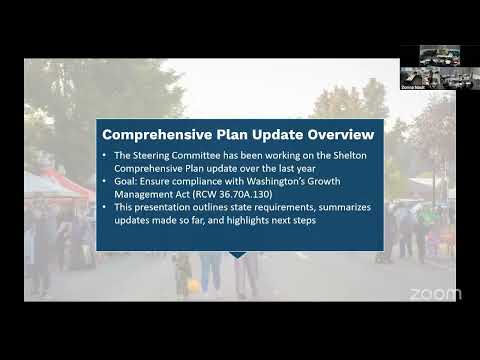
Shelton City Council held a joint study session Aug. 12 to review the city’s draft comprehensive plan update, a 20‑year framework that consultants said must address state planning mandates, projected population growth, housing and transportation needs, and be sent to the Washington State Department of Commerce for a 60‑day review before adoption.
Kirsten Peterson, a consultant with SCJ Alliance, told the council the update consolidates existing material, adds a new climate‑resilience chapter and merges the city’s urban growth area chapter into the land‑use chapter. "A comprehensive plan is really a 20 year plan for growth," Peterson said, adding the update incorporates county partner work, recent state housing legislation and locally tailored economic development analysis.
The draft includes the required elements the state expects — land use, housing, capital facilities and utilities, transportation and economic development — plus parks, shoreline and historic preservation material already on file. Peterson said population forecasts prepared with FCS Group show Shelton and its urban growth area will need to accommodate new housing; the consultant team estimated a projected population increase for the city/UGA over the next 20 years and estimated housing unit needs that staff said have been coordinated with Mason County data.
Why it matters: The comprehensive plan sets the city’s future land‑use map, guides rezoning and development code updates, and shapes capital improvement priorities that affect streets, utilities and public facilities. Officials said the plan will also be used to pursue grant funding and to ensure infrastructure capacity for projected growth.
Key details from the session
- Timeline and review: The consultant team aims to return to the council for another joint study session in September to review housing and land‑use chapters, then submit a final draft to the Washington State Department of Commerce for its 60‑day review. An environmental impact statement (EIS) will be issued for public review simultaneously once the transportation element and modeling are complete. The stated target is adoption by December 2025, though staff said a short delay into January would not create a statutory penalty.
- Transportation analysis: Peterson said the project team secured the Thurston Regional Planning Council (TRPC) to prepare a transportation‑demand model to analyze future intersection and network needs; the transportation element remains under development while the model is finalized.
- Changes and new content: The draft merges the previous separate urban growth area chapter with the land‑use chapter, and adds a state‑required climate change and resiliency chapter. The economic development chapter was expanded to include Mason County target sector data, workforce and commuter analysis, land‑readiness information, and additional goals and policies to support existing businesses, entrepreneurship and youth employment.
- Population and housing figures: The packet and presentation include population and housing projections prepared with FCS Group and Mason County coordination; the consultant summarized projected housing‑unit need and said Shelton (city + UGA) is estimated to capture roughly 41% of the county’s new growth. The consultant provided an illustrative chart of current and projected population used in the introduction chapter.
- Public engagement: Peterson summarized outreach to date — an online survey, outreach events (including the Shelton Art Walk and the local expo), a steering committee that met for more than a year and targeted engagement to underrepresented groups. A public engagement summary will be posted online and updated as the process continues. Council members were thanked for broad representation on the steering committee, which included residents, a business representative, a scientist and a student.
- Implementation and funding: Staff and the consultant noted the capital‑facilities element is intended to coordinate with department six‑year capital improvement plans (CIPs) to help pursue grants (examples cited: Transportation Improvement Board and Recreation and Conservation Office funding). The draft plan points to continued coordination with public utilities, the school district and other partners on growth‑related capital needs.
Points of concern and constraints discussed
Council members raised limits that could affect where growth happens, including large undeveloped properties held by single owners, contamination on historically polluted parcels, and gaps in utility service in parts of the city and UGA. Peterson outlined the difference between site‑specific rezones and area‑wide rezonings and said the comprehensive plan’s future land‑use map is the appropriate place to show long‑term expectations for how parcels may be used, with rezoning occurring later by ordinance.
Next steps
The consultant and staff will return with housing and land‑use proposals (including possible multifamily zoning and refined commercial corridor designations), complete the transportation model, issue the EIS and submit the draft to Commerce for review. Council meetings and public hearings will follow prior to final adoption; staff reiterated the goal of having the plan adopted by December 2025.
The session was a study session rather than a decision meeting; no formal votes were taken.