Planning commission opens public hearing, continues Springville station‑area plan after extensive public comment
Loading...
Summary
Planning staff presented a draft station‑area plan for the future FrontRunner station. Commissioners heard more than a dozen public comments raising traffic, flooding, privacy and school capacity concerns and voted to continue the item so staff can incorporate commission guidance and hold a planning‑commission work session.
Planning staff presented the Springville station‑area plan — a vision and regulatory framework for development around the planned FrontRunner commuter rail station — and the Planning Commission opened a public hearing that drew extensive public comment and commissioner questions. After public testimony and discussion, the commission voted to continue the item so staff could address concerns and return with revisions.
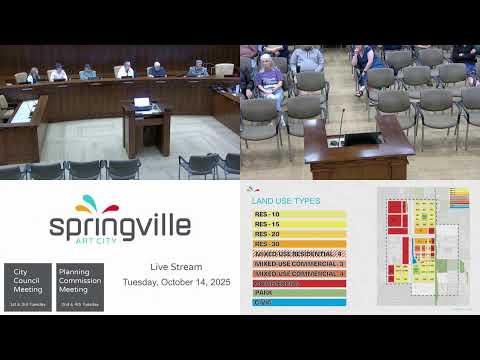
Presentation and purpose Planning staff described the station‑area plan as an update to the Westfields Community Plan (adopted in 2002) intended to guide development west of the rail and around the planned FrontRunner station. The plan’s goals include creating a walkable, mixed‑use village core, capturing transit value, providing a range of housing types, adding public spaces and connecting the street network to improve access. Staff explained the plan’s land‑use map, which assigns block‑level land‑use types (residential 10–30, mixed‑use/core up to four stories, and commercial) and included illustrative building massing and circulation concepts.
Numbers in the draft Staff said the plan’s illustrative outcomes total about 1,311 maximum dwelling units across the planning area and a residential density of about 8.3 units per acre as presented, and that utilities and major transportation infrastructure were planned when the Westfields area was annexed. The presentation emphasized that zoning and design regulations that follow the plan will define specific building heights, setbacks and parking; the station‑area plan itself is a higher‑level policy document.
Public comment: concerns raised More than a dozen residents testified during the public hearing. Main themes included: - Traffic and safety: multiple commenters said intersections along 400 South (including 1750 West and 950 West) already show high crash counts and long delays. Residents asked how the city and UTA will handle added trips, pick‑up/drop‑off (kiss‑and‑ride) activity and commuter parking, and urged traffic calming and safer crossings near schools. Josh (planning staff) and others said traffic modeling has been done regionally and that the plan anticipates connections (for example a new east–west crossing over the rail at Ninth South) and ongoing design work for 1200 West to improve circulation. - Bridge/rail crossing location: several residents who back up to 900 South asked why the east–west crossing must be a grade‑separated overpass and why it could not be located farther from existing backyards. Staff explained that Union Pacific and UTA requirements and safety constraints make a new at‑grade crossing unlikely and that an overpass at Ninth South emerged as the feasible alignment during negotiations. Staff said the bridge alignment remains an engineering and federal environmental review matter tied to the FrontRunner project and that the FrontRunner environmental process will include public hearings and studies on noise, vibration and other impacts. - Groundwater and flooding: residents near Renaissance Way and other neighborhoods described prior basement flooding and high groundwater tables and asked how the plan and future development will address stormwater, recharge and foundation impacts. - Schools and services: residents asked about school capacity and whether the district has been informed. Staff said regular coordination is ongoing with the school district and that the district holds land for potential future schools in the area. - Public safety: commissioners and residents asked for police involvement in station planning. Staff said public safety staff, including the police chief, have been engaged and that CPTED (crime‑prevention through environmental design) principles will be used in designing the station area.
Commission discussion, requested changes and formal action Commissioners discussed multiple technical and design questions, including whether the plan should read more as a policy/vision document or include more prescriptive block‑level layouts. Several commissioners asked staff to present a more diagrammatic (“bubble‑diagram”) land‑use map rather than an illustration that readers could interpret as a precise regulating plan. Commissioners requested that staff: - Provide a planning‑commission work session to review the draft in detail and incorporate the commission’s guidance before a formal recommendation; - Provide clearer documentation of transportation modeling, safety measures and coordination with UDOT, MAG and UTA; and - Engage the public‑safety director for a supplementary analysis addressing station‑area safety and patrol/operations considerations.
Formal action The commission voted to continue the station‑area plan item to a future date and asked staff to bring revisions that reflect the commission’s requested clarifications and to schedule a public planning‑commission work session. The motion to continue carried by voice vote.
Why this matters The station‑area plan sets long‑term expectations for density, building form and multimodal connections around the new FrontRunner station. It will guide subsequent zoning, design guidelines and regulating plans that determine lot standards, setbacks, parking and building form. Because the plan affects hundreds to thousands of potential future residents, transit patrons and adjacent neighborhoods, the commission’s request for more public feedback and technical detail reflects the project’s high civic significance.
Next steps Staff will: hold the requested work session with the planning commission, refine the plan to be clearer about what the policy will and will not regulate (diagrammatic land‑use vs. regulating plan), provide further traffic and public‑safety analyses, and return the item for a future recommendation and subsequent city‑council consideration. The FrontRunner project’s environmental review will evaluate bridge alignment, noise, vibration and other site‑level impacts and will include separate public comment opportunities.