Get Full Government Meeting Transcripts, Videos, & Alerts Forever!
Get email alerts on the Short Term Rental Variance topic
No spam. Unsubscribe anytime.
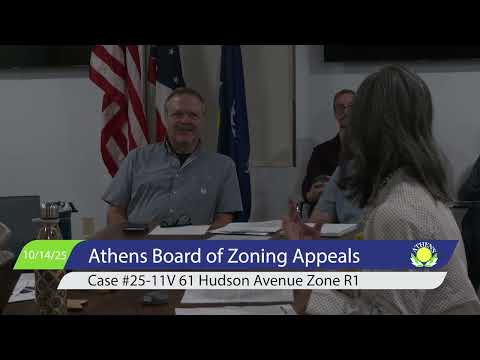
Athens zoning board denies variance to allow non‑owner short‑term rental at 61 Hudson Avenue
Summary
The Athens Board of Zoning Appeals on Oct. 14 denied a request to allow a non‑owner occupied short‑term rental at 61 Hudson Avenue in an R‑1 zone, after neighbors submitted 19 letters and raised concerns about noise, privacy and loss of long‑term housing stock.
The Athens Board of Zoning Appeals on Oct. 14 denied a variance request to allow a non‑owner occupied short‑term rental at 61 Hudson Avenue, concluding the application did not meet the city code standards for variances in an R‑1 residential zone.
The variance request sought an exception to ACC 23.04.01(b) to permit operation of a non‑owner occupied short‑term rental in an R‑1 zone. Zoning Administrator David Riggs explained to the board that non‑owner occupied short‑term rentals are allowed only in specific, location‑defined corridors and this property does not meet those locational criteria.
The applicant, homeowner Sue Brosh, told the board she purchased the small, two‑bedroom house on a large lot to support herself after the death of her husband and asked for the short‑term rental permit so she could check the property between guest stays. “I’m asking for permission … so when the customer leave, I can go in and clean up and see if anything [is] leaking or anything flooding,” Brosh said, adding she lives a block away and would post house rules including a 10 p.m. quiet policy and a four‑guest limit.
John Wharton, a realtor and property manager who spoke in support, said owner‑occupied or nearby management provides better oversight than long‑term rentals managed offsite. “I think you’ll have more oversight and control for the benefit of the neighbors, especially if they live in the neighboring properties, as an Airbnb than it will be if she turns it over … as a long‑term rental,” Wharton said.
Opponents — including neighbors who spoke at the meeting and 19 letter writers the board recorded — argued the variance would harm neighborhood character, privacy and safety and could set a precedent that encourages conversion of owner‑occupied homes to commercial short‑term rentals. Neighbor Zach Raymond, who lives across the street, said he worried the approval would “open up a door that we can't close” and increase short‑term rental pressure in the neighborhood. Immediate next‑door neighbors Zachary Martin and Ling (last name not provided) read a prepared statement that said their driveway borders the property and that a constantly changing stream of guests would create “ongoing loss of privacy, unpredictable noise and activity” and parking conflicts.
Several residents and letter writers cited ACC 23.07.10(c), which the board uses to test variance applications against six findings, including whether exceptional circumstances exist, whether literal enforcement would cause undue hardship, and whether the variance would be detrimental to adjacent property. Board members discussed those standards in turn, with members noting the code already defines specific locations where non‑owner short‑term rentals may be conditionally permitted and that the present property does not meet those location criteria. Board members also emphasized that a short‑term rental permit (a separate administrative permit) is renewed annually, whereas a variance — if granted without conditions — runs with the property unless the board places conditions on approval.
Rob Delich, chair of the Board of Zoning Appeals, called for a vote after deliberations. The board voted to deny the variance; the transcript records the board’s decision but does not include a roll‑call tally. The record shows four members were voting at the meeting (Chair Rob Delich, Ben Lachman, Paula Sherwood and alternate Shay Myers).
The denial leaves the property subject to the current R‑1 restrictions. Zoning Administrator David Riggs told the board that conditional short‑term rental approvals are available only in corridors specifically named in the code (for example, East State Street, Carpenter Street, Lancaster Street and Columbus Road) or where the primary home fronts on those corridors.
The board’s written decision and all letters submitted for case 25‑11B are part of the public record and were made available to board members before the vote. The file notes 19 written oppositions and at least five residents who spoke in person in opposition; three people spoke in favor, including the applicant and two neighbors who supported the applicant’s character and management plans.
The board moved on to its next case following the vote; any applicant wishing to pursue short‑term rental use in R‑1 locations not identified by code would either need to seek a different regulatory path or request a future code change from City Council.