Get Full Government Meeting Transcripts, Videos, & Alerts Forever!
Get email alerts on the Municipal Finance topic
No spam. Unsubscribe anytime.
Moline City staff outlines plan to use franchise fees and property-tax growth to boost CIP, presents bond options for city hall and fire station
Summary
City staff told the council the 2023 ordinance includes a 3% utility franchise-fee increase effective Jan. 1, 2026, and presented options to keep the levy rate steady to direct growth dollars into a Special CIP fund; council members pressed for alternatives and asked for more detail before formal votes.
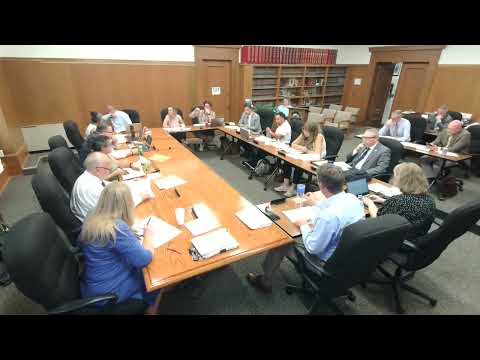
City staff told the Moline City Council at a special meeting that a previously adopted 2023 ordinance includes a 3% increase in the natural gas and electric franchise fee, effective Jan. 1, 2026, and that the fee is projected to generate about $1,846,000 for 2026. Staff said that revenue would allow the city to increase its annual capital improvement fund (CIP) transfer from $1,000,000 to $2,000,000 and move toward a strategic goal of $3,000,000 in annual CIP funding.
The explanation and revenue projections were presented as part of a broader review of revenues and expenditures for the city’s special CIP and 10-year capital plan. Carol, a city staff presenter, said the ordinance adopted in 2023 includes the 3% rate and that no immediate action by the council was required to implement the 2026 increase. Carol also noted that the city would need to notify MidAmerican to implement the fee and said the utility requires time to put the change in place.
Why it matters: staff told council members the franchise fee and property-tax growth together are the principal revenue drivers for the CIP and for a riverfront redevelopment program. Council members repeatedly pressed for variations on the revenue assumptions and asked staff to provide spreadsheets that do not rely on assumed future rate increases beyond the 3% already in the ordinance.
Property tax and levy-rate options Staff recommended the council consider maintaining the city’s levy rate at the current level to capture assessed-value growth. Under the staff scenario presented, maintaining the levy would generate about $159,000 above what is required to balance the 2026 budget; staff said that incremental revenue could be deposited to the Special CIP fund. The minimum property-tax revenue required to balance the budget as presented was listed at $837,582; including the additional captured growth would raise the total to roughly $996,009 and would trigger a truth-in-taxation public hearing if the city adopts the higher amount.
Carol summarized the assessed-value growth numbers the city received and said overall assessed value growth was approximately 5.92% (5.83% without new construction, 5.92% with new construction). Staff presented estimated household impacts: keeping the levy at staff’s recommendation would increase the typical residential property tax burden by about $44 a year (roughly $3.67 per month); combined with the proposed utility franchise-fee change, staff estimated a monthly household impact of about $9.77 (about $117.24 annually) under the central scenario.
Council reaction and requests for more analysis Several council members said they did not support capturing more than 50% of assessed-value growth for city operations and warned about the cumulative burden on taxpayers when combined with utility-fee increases. One council member said, “I won't support an increase in captured more than 50% of our growth,” and asked staff to return with alternative scenarios that keep the city’s revenue assumptions more conservative. Another council member requested historical comparisons with neighboring jurisdictions and additional context on how one-time federal ARPA dollars versus assessed-value growth contributed to the current revenue picture.
Bonding and project options for city hall and Central Fire Station Staff presented two financing options for major capital projects including City Hall and a new Central Fire Station. Option 1 spread bonds over 30 years for City Hall and the fire station, which staff said would allow roughly $10 million to remain available for riverfront improvements over a 10-year window but would increase total principal and interest costs over the life of the bonds. Staff presented a numerical example in which the City Hall principal and interest payment under a 30-year scenario was shown as about $31 million and the fire station roughly $50 million in total principal and interest over the bond period in that scenario.
Option 2 scaled back scope: renovate rather than fully rebuild in some cases, shorten some bond terms (for example, 15 or 20 years on selected elements) and reduce the immediate borrowing amount. Staff described station No. 2 needs as structural and HVAC work, ADA upgrades, and roof and ventilation work, and recommended members tour the facilities to see the issues firsthand.
Staff also told the council there is about $1.3 million in anticipated cash to apply to immediate City Hall needs and that roughly $1.4 million was listed as unallocated in the near-term budget; those amounts could reduce the principal to be bonded depending on council choices.
Other revenue notes Staff reported an anticipated $500,000 in amusement-tax receipts, potential land sales, interest income, and placeholder grant revenues assumed as carry-in matching dollars on the expenditure side. Staff emphasized that franchise fees and property-tax decisions are the determinative drivers for the proposed CIP and riverfront program.
Next steps and unanswered questions Staff emphasized no formal decisions were required at the special meeting and asked the council for guidance on revenue assumptions and whether to include the recommended levy capture in the October budget process. Council members asked for additional spreadsheets showing alternatives that do not assume future franchise-fee increases beyond the already-adopted 3%, a clearer history of levy rates compared with neighboring jurisdictions, and a line-by-line comparison of resident impacts at staff’s recommended level and at the minimum required level. Staff said it would update materials and return to the council for additional review before any formal levy or bonding decisions.
The meeting moved to an executive session for property acquisition, sale/lease, and litigation matters after the budget discussion.