
Regional Planning Commission approves three-year resiliency strategic plan
Get AI-powered insights, summaries, and transcripts
Subscribe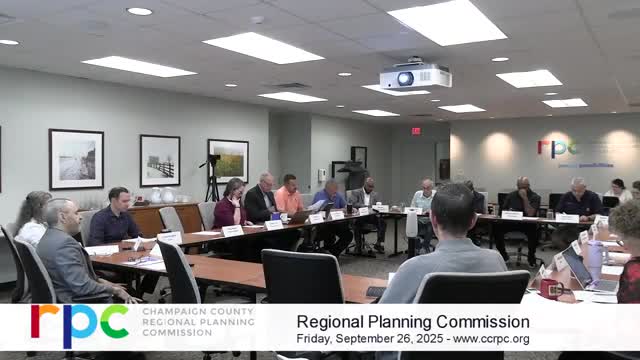
Summary
The Regional Planning Commission approved a three-year strategic (resiliency) plan presented by consultant Roger Pavey to meet Department of Commerce and Economic Opportunity requirements and guide RPC operations amid staffing, facilities and funding challenges.
The Regional Planning Commission on Sept. 15 approved a three-year strategic plan focused on organizational resilience, the commission heard.
Roger Pavey, president and CEO of the Illinois Association of Community Action Agencies, presented the abbreviated strategic plan and said the work was aimed at helping RPC adapt to rapid external changes while remaining compliant with Department of Commerce and Economic Opportunity requirements for a current strategic plan. “This plan, the theme of this is resilience,” Pavey said.
The plan prioritizes four areas adapted from a balanced scorecard approach: customer access (broadly defined to include clients and partner municipalities), internal processes (including cross-program accessibility and data performance systems), staff learning and growth (with emphasis on retention and leadership pathways), and financial sustainability. Pavey told commissioners the strategy map the leadership team produced emphasizes facility planning, mission identity, technology and new revenue streams such as fee-for-service expertise to supplement flat grant funding.
Pavey noted workforce retention as a particular challenge and cited the national nonprofit turnover benchmark; “The national nonprofit average… is 21%,” he said, adding RPC’s turnover is challenging though he believed RPC compared favorably to that national figure.
Commissioners pressed for clearer, measurable metrics. One commissioner said the draft felt “more touchy-feely” than numeric; Pavey and staff said the plan intentionally focuses on resilience and narrower three-year goals rather than longer-range numeric forecasts because of uncertainty in the coming months. Pavey said leadership pared back specific targets after considering that near-term volatility could render precise year-over-year targets unreliable.
A dashboard tied to the strategy areas will be returned to the commission to monitor progress, Pavey said. Commissioners moved to approve the strategic plan and the motion carried by voice vote.
The approval satisfies the requirement cited by staff that RPC maintain a current strategic plan under its funder rules, and commissioners asked staff to bring back the dashboard and any recommended metric refinements for future review.
Votes at the meeting were recorded by voice; an explicit roll-call tally for the strategic-plan motion was not read aloud.