Get Full Government Meeting Transcripts, Videos, & Alerts Forever!
Get email alerts on the Human Services Grants topic
No spam. Unsubscribe anytime.
Evanston panel hears nonprofit presentations as staff outlines FY26 budget process and Oct. 27 scoring deadline
Summary
At a Social Services Commission hearing, city staff briefed commissioners on the draft FY26 budget and scoring rubric for human-services grant applications; 10 nonprofit applicants presented program summaries. Staff set an Oct. 27 deadline for commissionersto return evaluation sheets and flagged several applicantsbudget adjustments.
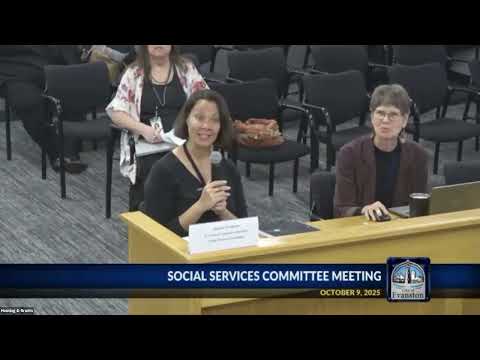
Evanston— At a hearing of the City of Evanston Social Services Commission, staff reviewed the city's process for evaluating FY26 human-services grant applications, heard presentations from a slate of nonprofit applicants and set an Oct. 27 deadline for commissioners to return completed evaluation sheets.
The session featured presentations from Turning Point, Peer Services, Lydia Home, Impact Behavioral Health Partners, Infant Welfare Society of Evanston, Family Promise Chicago North Shore, Family Focus, Child Care Network of Evanston, Books and Breakfast, and others. Jessica (city staff) told commissioners that the city had released a draft FY26 budget and that the Human Services Fund "is primarily 93% funded through a tax levy," and that the city is proposing a $2,500,000 increase to that levy in the draft budget.
The staff briefing focused on the scoring rubric commissioners will use to evaluate applications, the timetable for allocation discussions and how the commission will handle application adjustments. "When you guys submit the score rubrics to me, I tally them and come up with an average score for each application. This average score then becomes the basis of the allocation discussion we will have in November," Jessica said, urging commissioners to return completed evaluation sheets by Monday, Oct. 27.
Most presenters described ongoing program work and requested continued or adjusted city funding. Anne Rainey, chief executive officer of Turning Point, said the agency's Evanston living room and mobile response work divert people in crisis from emergency departments: "A 98 percent success rate at diverting guests who otherwise would have to go to a hospital emergency department," she said, adding Turning Point served 101 Evanston residents in the first half of FY25 at the Evanston location. Lauren Warsaw, division director of clinical services at Impact Behavioral Health Partners, said the Evanston case manager has "served 45 participants so far this year, and there are currently 15 people on the wait list."
Presenters also highlighted service specifics and program needs. Diana Newton, director of development and communications at the Infant Welfare Society of Evanston, described intensive early-head-start services and consultant supports delivered in classrooms, and reported that children diagnosed with developmental delays "have nearly doubled since the pandemic." Kyle Henowalt, executive director of Books and Breakfast, described school-based breakfast, tutoring and summer programs that rely on hundreds of volunteers and said summer tutoring produced gains of six to 10 months in pilot evaluations.
Staff called attention to several application budget adjustments that arrived after initial submissions: Child Care Network of Evanston reduced its request by about $30,000 and narrowed scope to increase the share of Evanston residents served; Family Promise trimmed its ask from roughly $92,000 to about $89,000; and Evanston Scholars revised its request from $10,000 to $30,000, identifying $20,000 for a book fund and $5,000 each for two emergency-fund lines, according to staff.
Commissioners discussed whether to form a two-member working group to review scores prior to the full November allocation discussion; no volunteer pair was recorded in the transcript, though the panel did not object to the idea. Jessica said the November meeting will cover allocation guidelines and that agencies should expect the December meeting to be the forum for the commission's initial allocation recommendation; agency representatives were told the December session is mandatory.
Procedural actions recorded in the transcript included a vote to permit virtual participation by Councilmember Harris and approval of minutes from the Sept. 11 meeting. A commissioner also recused themselves from Family Promise's presentation; the transcript records the recusal statement but does not identify the commissioner by name. There were no public comments registered during the two public-comment periods.
The commission and staff repeatedly emphasized uncertainty in final funding levels: the staff briefing noted the FY26 amounts remain subject to city council decisions and could change, and staff warned that allocations recommended by the commission will still be contingent on the council-approved city budget. "While we have the request in for our funds, nothing is guaranteed," Jessica told the panel.
Votes at a glance
- Motion to allow Councilmember Harris to participate virtually: moved and seconded; chair called for "All in favor?" and recorded "Aye." (Outcome: approved; transcript does not show a roll-call tally.)
- Motion to accept minutes from Sept. 11: moved, seconded and accepted following an "Aye" vote. (Outcome: approved; roll-call not recorded in transcript.)
What happens next
Commissioners must complete and return the evaluation spreadsheets to city staff by Oct. 27 so staff can tabulate average scores. Staff recommended commissioners consider the rubric categories and, if needed, weigh some criteria differently if many applicants score similarly. The commission will take up allocation-guideline discussions at its November meeting and present an initial allocation recommendation in December to forward to city council for final action.
Because final awards depend on the council-approved FY26 budget, staff and commissioners stressed that allocations remain subject to change pending the council's appropriation decisions.