
Howard County leaders review APFO data, updated facility plan and capital timeline amid tight budgets
Get AI-powered insights, summaries, and transcripts
Subscribe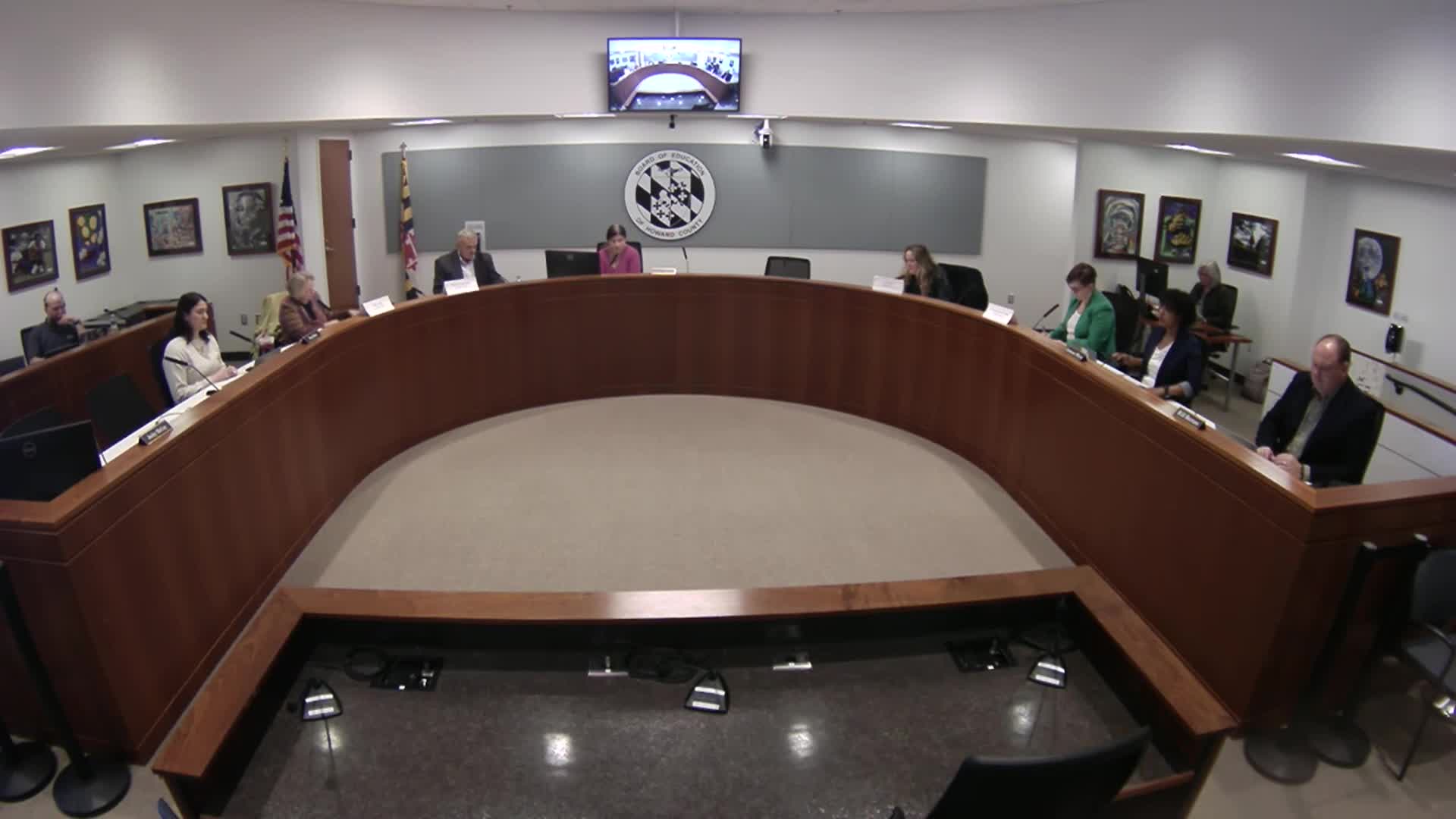
Summary
School and county officials met Oct. 14 to review updated Adequate Public Facilities Ordinance (APFO) charts from the Educational Facilities Master Plan, discuss projected school capacity pressures and construction cost estimates, and outline a revised state/local capital budget timeline. No formal votes were recorded.
Howard County school and county officials reviewed updated Adequate Public Facilities Ordinance (APFO) projections and the Educational Facilities Master Plan at a joint Board of Education and County Council meeting on Oct. 14, focusing on where enrollment growth, neighborhood turnover and constrained school facilities will create capacity pressure and what the county can afford to do about it.
The meeting was convened to address a staff chart identifying schools that were at least 95% utilized in 2024 and projected to exceed 110% utilization within five years, and to provide updated projections through 2030. “The chart shows various items such as the program capacity, the actual enrollment, the observed enrollment, the projected capacity utilization, as well as the relocatable classrooms in place,” Tim Rogers, manager of school planning for Howard County Public School System, told the joint panel.
Why it matters: Officials said the updated data will inform which renovation or replacement projects the district asks the state and county to fund. The discussion also touched on sharply higher construction cost estimates for large projects, the district’s deferred maintenance backlog and options to use state funds from programs such as Built to Learn.
Key points from the discussion
- Scope of the capacity problem: Rogers said the updated charts list five elementary schools and four middle schools that met the 95%-to-110% trigger in the earlier analysis. The presentation included both current relocatable-classroom counts and projections that extend to 2030.
- Cost estimates for major projects: Dan Lubel, executive director of capital planning and construction, said updated FY27 estimates put Oakland Mills High School (renovation and addition) at about $160 million and Centennial High School at about $156 million. Lubel said a newly built high school in today’s dollars would likely be in the $180 million–$190 million range.
- Middle school estimates: Rogers and Lubel discussed Dunlog (transcript: Dunlog/Dunlaug) Middle School, with the current FY27 estimated project cost in the materials shown as roughly $93,500,000; Lubel cautioned that market volatility and escalation could raise those totals.
- Deferred maintenance and funding constraints: The district’s current deferred-maintenance estimate, cited in the meeting, is about $198 million and officials said that figure could grow by roughly $30 million a year. For FY2026 the county provided $66,745,000 in local capital funds toward a total district capital request of $100,644,000 (state plus local participation). Rogers and Brown noted limited statewide capital resources; Lubel said Maryland’s annual state school construction pool is roughly $285 million for all districts.
- Portables and capacity management: The district reported approximately 235 relocatable units in use, of which about 220 are classroom units. Staff said some relocatables are used for nonclassroom space and that units are moved among sites; officials said many are not in a condition that would make resale practical.
- Redistricting costs and transportation impacts: The superintendent’s redistricting proposal and two consultant concepts were discussed. Rogers said the superintendent’s plan was estimated to add roughly $200,000 for two buses; consultant concept 1 carried an estimated $300,000 (three buses) and concept 2 an estimated $500,000 (five buses). Rogers said exemptions (for example, for rising fifth graders) would add to those costs and could be temporary (one year) if applied only to a single cohort.
- Neighborhood turnover vs. new development: Several board and council members emphasized that student generation comes both from new housing and from turnover in established neighborhoods. “We know developments are coming, but…we're missing almost 60% of the other challenge in terms of student and facility management, which is the neighborhood turnover piece,” said Miss Rigby (Board/Council member), summarizing concerns raised earlier in the meeting.
- Sidewalks, hazard busing and crossing guards: Members pressed for coordination with the Department of Public Works and the county’s Complete Streets policies to reduce hazard busing by delivering sidewalks and crossing guards at targeted locations. Council members asked for a prioritized list of crossing-guard needs and for joint budget advocacy.
Capital budget process and timing
Officials described a two-track approach to the capital-submission workflow: submit state-eligible projects to the state by its October deadline, then follow with a fuller local-priority package later in fall/winter. Cornell Brown, chief operating officer for the school system, said the district hopes initial consultant outputs will be available in late spring to inform the FY28 capital budget and a final report in summer or early fall for FY29 planning.
“There are state submission requirements and local processes,” Brown said. “Our intent is to submit state projects on the state timeline and then socialize local initiatives in the following months.”
What officials will do next
- The district plans to complete the educational sufficiency (educational facilities master plan / EFMP) consultant work, which will (1) update educational specifications, (2) evaluate each school’s facility condition and program space against those specifications, and (3) produce CPTED (Crime Prevention Through Environmental Design) reviews. Rogers said the consultant will provide initial information in late spring to feed FY28 capital planning and a final product thereafter.
- Staff will provide clearer public explanations of what smaller HVAC-control upgrades and component work do and do not achieve, after several board members expressed concern that listeners assume control upgrades fully modernize systems.
- Transportation and planning staff will continue working on bus-routing impacts and hazard-bus reduction with DPW and DPZ (Department of Planning and Zoning).
Quotable
“Depending on the size of the facility…we would anticipate a new facility in today’s dollars would be approximately 180 to $190,000,000 for a total project,” Dan Lubel, executive director of capital planning and construction, said when asked about the cost of a newly built high school.
“The chart shows various items such as the program capacity, the actual enrollment, the observed enrollment, the projected capacity utilization, as well as the relocatable classrooms in place,” Tim Rogers, manager of school planning, said when introducing the APFO materials.
“No one should assume that control work or small component work completely revitalizes the system,” Cornell Brown, chief operating officer for the school system, said when explaining ongoing HVAC-control projects and the need for more comprehensive studies.
Ending
No formal actions or votes were recorded during the APFO and capital-timeline discussion. Officials said they will return with consultant reports, updated cost estimates and clearer public materials as the educational sufficiency study and capital budget work proceed into the spring and next fiscal-year submission cycle.